

If you are sourcing products from China, two platforms are popular: 1688 and Alibaba. These two platforms may seem identical to beginners at first. But they are not. Although both are part of the Alibaba Group, they cater to completely different customers and employ different business models.
When you export products from China and select the wrong platform, it is a waste of time, money, and patience. Selecting the appropriate one can maximize margins and streamline operations.
Let’s explore how 1688 differs from Alibaba, and understand which platform is most suitable for your business.
What is 1688: The Domestic Wholesale Powerhouse in China?
1688.com is one of the largest B2B wholesale markets in China. It primarily satisfies Chinese customers. The factories and manufacturers use it, and the local wholesalers sell products in bulk within China.
Many Chinese vendors work with 1688 and sell their goods on platforms such as Alibaba, AliExpress, Taobao, and even Amazon.
Consider 1688 the factory back door to China. Prices are low. Margins are tight. Buyers are expected to be familiar with the seller's system.
- Built for domestic trade
- Prices close to factory cost
- Chinese language only
- Domestic shipping only
What is Alibaba: China’s Export Marketplace
Alibaba.com is targeted at global customers. It links international commerce to the Chinese manufacturers and exporters.
The Alibaba suppliers anticipate foreign customers. They often speak English. They are aware of export regulations, packaging requirements, and global shipments. Alibaba focuses on convenience, trust, and international payments.
- Built for overseas buyers
- English-language interface
- Export-ready suppliers
- Foreign logistic support.
1688 vs Alibaba: How 1688 Differs from Alibaba
Core Purpose: Domestic vs Global Buyers
This is the most significant disparity between the two platforms.
1688 is designed to cater to China's internal supply chain. Alibaba is a company that facilitates global trade.
Because of this difference:
- 1688 eliminates the cost of exportation and layers of service.
- Alibaba incorporates export services, sales force, and freight.
Most of the pricing, payment, and shipment differences can be attributed to that one design.
Pricing Inequality: 1688 is usually cheaper
1688 products often cost less. Sometimes a lot less.
Why?
- No sales personnel who speak the English language.
- No export packaging
- None of the international logistics support.
- Low-margin and high-volume business.
The prices at Alibaba are higher since suppliers:
- Factor in export handling
- Provide customer service
- Shipment and documentation management.
Critical observation: When the price is low, it is not necessarily the case that the total cost is low. Shipping, agents, and errors will soon devour your savings on 1688.
Types of Suppliers and Quality of Products
Buyers are connected to factories, trading companies, and wholesalers in both 1688 and Alibaba. The structure of suppliers appears to be the same at first glance, but the manner in which they are utilized on both platforms is quite different.
1688 Suppliers and Products
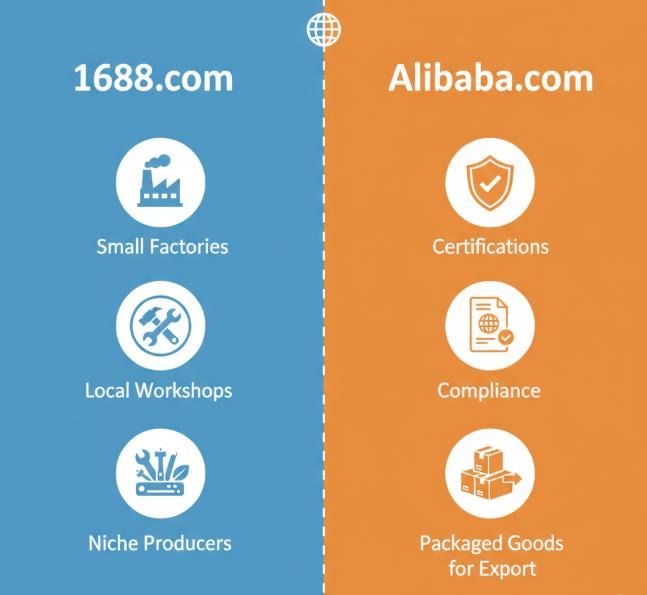
There are many small factories and local workshops in 1688, primarily targeting domestic demand. These suppliers manufacture large quantities of goods and have narrow profit margins, which helps maintain prices down. Some factories produce goods under the brand of international companies or export-oriented trading. Due to this fact, product quality at 1688 can vary and be diverse, even within the same product line.
1688 has a higher concentration of:
- Small factories
- Local workshops
- Niche producers
Alibaba Suppliers and Products
The suppliers of Alibaba tend to be more export-based. Most design products are targeted at foreign markets and comply with the quality standards. They are also aware of the labeling regulations and safety standards.
Alibaba suppliers are more export-focused. They often:
- Offer certifications
- Understand compliance standards
- Package products for overseas shipping
Minimum Order Quantities (MOQ)
Both 1688 and Alibaba have flexible MOQs; however, how MOQs are applied in practice in real transactions usually varies.
Many sellers on 1688 will accept very small MOQs, especially for domestic buyers. Mixed product orders are standard, and some suppliers also accept sample orders to attract new customers. This is flexible because the sellers are dependent on local customers purchasing repeatedly and rapidly.
Alibaba suppliers are also capable of presenting low MOQs, but smaller orders tend to have a higher price per unit. The packaging, documentation, and handling expenses must be borne by suppliers concerned about exports; thus, small orders become less profitable. The pricing usually becomes competitive and stable as the volume of orders increases. On both platforms, negotiation plays a significant role. Contacting suppliers before placing an order helps establish price, packaging, and production schedules.
Language and Communication Barriers
1688 (Mostly Mandarin)
One of the most significant differences between 1688 and Alibaba is the language. The 1688 site is primarily written in Mandarin, and most of the sellers are Chinese speakers. Although translation tools help navigate, they frequently omit technical information or industry-specific details, which can be confusing.
Customers who make international purchases through 1688 tend to rely on direct messages, images, and straightforward specifications to present their needs. In the absence of proper communication, there is a possibility of mistakes, such as the use of incorrect materials, incorrect sizing, or even production delays.
Alibaba (English Language)
Alibaba was created to suit English-speaking consumers. The majority of the suppliers available on the platform have experience in dealing with overseas customers and are familiar with typical negotiation styles. This lessens the communication barriers and accelerates the sourcing process, particularly for new buyers.
When quick and clear communication is key to your operations, you will feel more comfortable and productive overall with Alibaba. Although 1688 demands more effort, with the help of appropriate tools and encouragement, experienced customers can handle it.
Models of Domestic and International Shipping
1688 (lack of in-built International Logistics Solution)
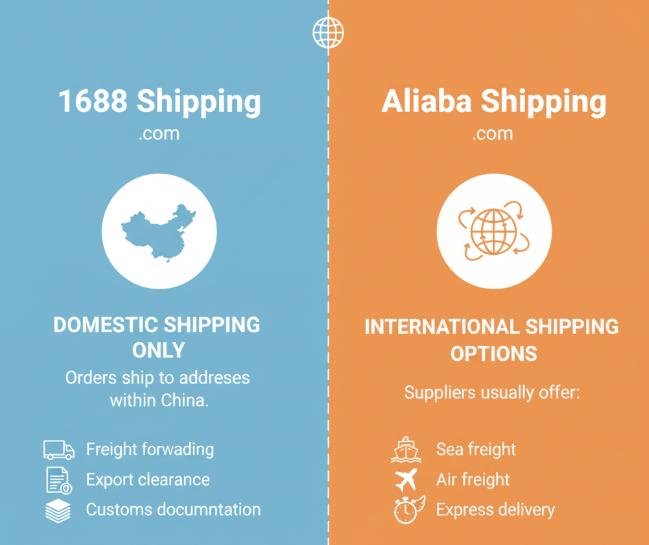
Shipping is another distinction that clearly sets 1688 apart from Alibaba. The 1688 platform is used for domestic deliveries, where orders are shipped to addresses within China. It also lacks in-built global logistics solutions for international customers.
The exportation of goods abroad between 1688 and the present requires buyers to assume the role of structuring the export process themselves.
This usually entails contracting with freight forwarders, sourcing agents, or logistics partners that handle consolidation, customs clearance, and international delivery. This solution enables the control of shipping costs and procedures, requiring planning and coordination.
Alibaba (Support international Shipping)
The suppliers of Alibaba offer international delivery services directly. A significant number of them offer clear shipping rates, process custom paperwork, and provide door-to-door delivery. This makes it less complex, allowing buyers to concentrate on sales and growth rather than logistics.
To put it simply, Alibaba is easier to deal with in terms of logistics since it packages the services together, whereas 1688 offers greater customer control but requires more personal engagement.
Payment Options: Buyer Payments in Reality
Payments highlight a clear difference in platform design.
Alibaba supports international payment methods such as:
- Credit cards
- Bank transfers
- Online payment services
This makes payments familiar and predictable.
1688 relies on Chinese payment systems. International buyers often use:
- Cross-border payment solutions
- Sourcing agents
- Trading companies
Setting up payment on 1688 requires more effort, but experienced buyers adjust quickly.
Note: Payment friction is real on 1688. Plan for it early.
Drop-shipping: What and What Doesn’t Work
As we mentioned, 1688 doesn’t support drop-shipping. The site focuses on bulk domestic orders rather than individual customer shipments. Buyers request suppliers to deliver single-order shipments or outsource agents to store and fulfill their needs.
Alibaba favors drop shipping-like delivery, such as small-order shipment to clients and third-party connections. Alibaba or AliExpress would be a better solution for dropshipping as a primary business model.
Supplier Verification, Risks, and Trust.
The two sites provide verification tools of suppliers.
Alibaba provides:
- Verified Supplier badges
- Trade Assurance
- Buyer protection
1688 offers:
- Labeling of factory verification.
- Business history indicators.
- Regardless of platform:
Note: Check business licences before placing order. Avoid rushing large orders. Risk management matters more than platform choice.
Who Should Use 1688?
1688 works best if you:
- Buy in bulk
- Have sourcing experience
- Use freight forwarders
- Want maximum price control
- Can manage language barriers
It suits:
- Private label brands
- Large resellers
- Experienced importers
Who Should Use Alibaba?
Alibaba works best if you:
- Want simplicity
- Need English communication
- Prefer supplier-managed shipping
- Run a global business
It suits:
- New importers
- Small businesses
- Dropshippers
- Brand owners scaling internationally
Final Verdict: Choosing the Right Platform
1688 and Alibaba are not competitors. They serve as platforms for various stages of sourcing. 1688 offers raw access to China’s manufacturing base. Alibaba offers structured access for global trade. If you want control and lower prices, choose 1688. For speed and ease, choose Alibaba. The best buyers often use both. They researched on 1688. They execute on Alibaba. That balance creates innovative sourcing and more substantial margins.