

The most frustrating experiences in product sourcing are the process of making a Request for Quotation (RFQ) and not getting any or few responses. Where responses are received, they are not always met to the buyer’s expectations. This is not always the case that suppliers are reluctant to do business with you. However, it is rather that the RFQ does not provide them with a sufficient degree of clarity, conviction, or incentive to respond.
A properly prepared sourcing RFQ is not merely price asking. It conveys seriousness, professionalism. It also gives the suppliers assurance that their time will be taken seriously. We have made this detail in creating a sourcing.
What is a Sourcing RFQ (Request for Quotation)?
Sourcing RFQ, also known as Request for Quote, is a formal document that is issued to potential suppliers requesting them to give a price and commercial terms of a well-defined product or service. The primary objective of the buyer is the comparison of the cost, lead time, and the simple terms of business.
An RFQ is not a casual sourcing email or price request. It informs suppliers that the buyer is on evaluation and is about to make a purchasing decision. That is why the suppliers consider RFQs quite different in comparison with exploratory messages.
Reasons Why RFQs Are Not Responded To?
RFQs are sent to the suppliers from different sources, more than they have the capacity to respond to. Therefore, they very soon sieve out RFQs that seem vague, risky, or unlikely to transform into actual business.
Lack of clarity is one of the factors that makes suppliers disregard RFQs. Suppliers have to guess when there are no specifications, quantities, or unrealistic timelines. All these assumptions make them risky.
RFQs that lack information on the buyer, the process by which they make a decision, or what they do with received responses, can be accompanied by the feeling of price fishing. Suppliers will not take the time and create a detailed quotation in case they think it will not result in a real order.
There are also complex RFQs, which discourage participation. Suppliers like RFQs that are well organized, to the point, and mindful of their time.
How to Create a Sourcing RFQ (Request for Quotations) that Suppliers Actually Respond To?
Step 1: Clearly Define Your Sourcing Objective
The buyer has to be clear about his goal before he writes an RFQ. This is one of the steps that are most frequently neglected, but which defines the success of the whole process.
The question to be considered internally is what decision the RFQ is supposed to support.
Do you choose one supplier on a long-term basis, or do you have more than one supplier on a short-term basis? Do you think it is the price or it is the quality, reliability and lead time as well?
The RFQ is more focused when the sourcing objective is in place. The suppliers get a better idea of what they value the most and can respond based on that. This also helps in internal alignment of the stakeholders, and the confusion level is minimized in the later stages of evaluation.
Example:
“We are sourcing a long-term supplier for custom aluminum housings with monthly volumes of 5,000 units, prioritizing quality consistency and lead time over lowest price.”
Step 2: Choose the Appropriate Suppliers
Don’t send the same RFQ with a common template to different suppliers. As a matter of fact, it tends to lower the quality of responses. These can easily make suppliers aware that they are among dozens of receivers.
When a specific RFQ is dispatched to the correct suppliers, this is an indication of professionalism as well as respect. It also enhances the chances of getting valuable responses that would be compared equally. Quality sourcing is not associated with size, but relevance.
Step 3: Structure Your RFQ for Maximum Clarity
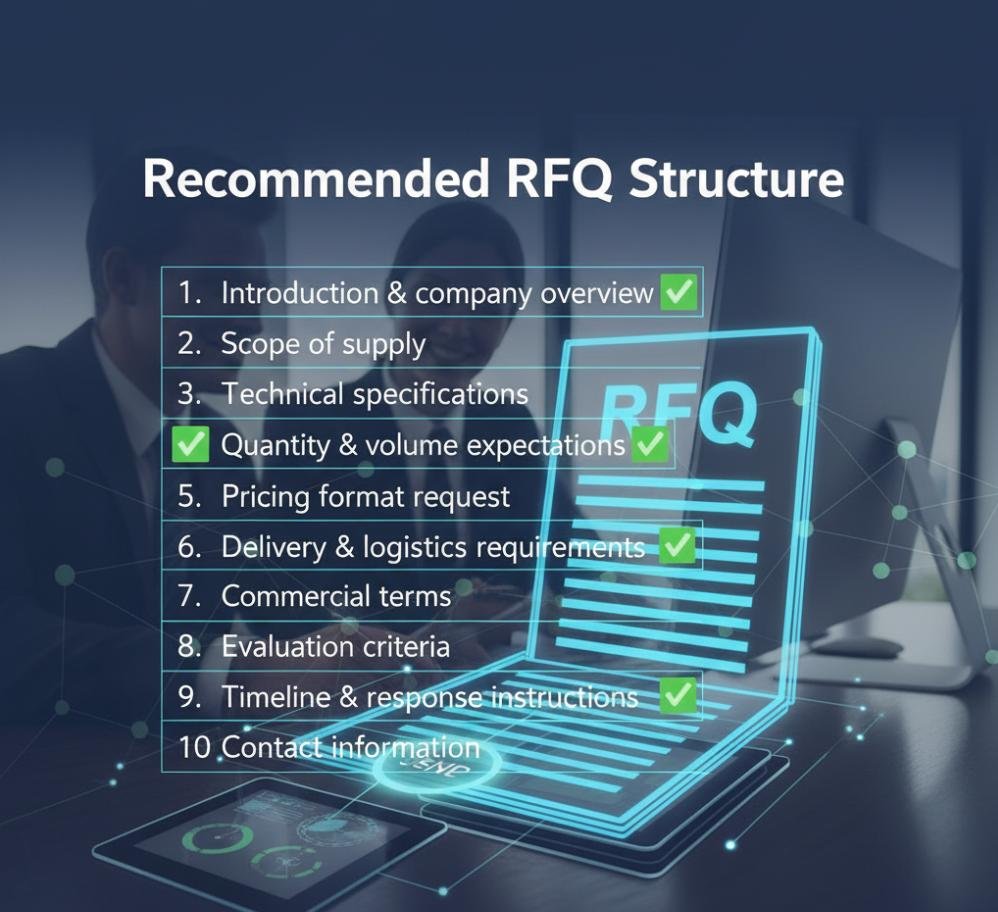
RFQs that are reader-friendly give the suppliers a pleasant experience. Having a clear structure will save time on the need to comprehend the requirements and respond. This itself can play a major role in enhancing response rates.
Recommended RFQ Structure
- Introduction & company overview
- Scope of supply
- Technical specifications
- Quantity & volume expectations
- Pricing format request
- Delivery & logistics requirements
- Commercial terms
- Evaluation criteria
- Timeline & response instructions
- Contact information
The suppliers can work with efficiency and in confidence when they know where to find the information. Order conveys professionalism and assists in establishing expectations early in the game.
Step 4: Write a Strong RFQ Introduction
The introduction is the most critical part suppliers read, and it is important to the perception of the suppliers about the opportunity. The introduction should be a good one in which the buyer, what is being sourced, and why the RFQ is being issued are briefly explained.
What to Include in the Introduction
- Who you are
- What you are sourcing
- Why are you issuing the RFQ
- What happens after submission
Example RFQ Introduction
We are [Company Name], a [industry/type of company], currently seeking qualified suppliers for [product/service]. This RFQ is part of a supplier selection process for an anticipated contract starting in [month/year]. Suppliers selected through this process may be considered for long-term collaboration.
Step 5: Define the Scope of Supply in Detail
The scope of supply describes exactly what the supplier is expected to provide. This section must be precise. It forms the basis for pricing and delivery commitments.
Example:
“Supply corrugated cardboard boxes, double-wall, printed with 2-color logo, including die-cutting and bulk palletized delivery.”
Definitive scoping eliminates confusion, unwarranted costs, and biased assessment.
Step 6: Propose Technical Detailed Specifications
Any sourcing RFQ involves technical specifications. It presents the suppliers with a clear picture of what is needed and removes speculation.
What to Include
- Dimensions, materials, grades
- Standards or certifications
- Drawings, datasheets, or images
- Tolerances or quality requirements
Best Practices
- Attach files instead of embedding everything in text
- Reference document version numbers
- Avoid assumptions—spell everything out
Step 7: Identify Quantities or Volumes
Volume data are necessary for the suppliers to compute costs, plan production, and evaluate feasibility. RFQ must specify the initial order quantity and preliminary volumes. Although quantities may be approximate, a range is much better than letting suppliers make assumptions.
Defined quantity expectations will help suppliers to provide more competitive prices and achievable lead times.
Suppliers price very differently based on volume.
Always Include
- Initial order quantity
- Expected annual or monthly volume
- Minimum order quantity (if applicable)
Example Initial order: 2,000 units Estimated annual volume: 24,000–30,000 units Order frequency: Monthly
Even estimated volumes are better than none.
Step 8: Ask for Pricing in a Clear, Comparable Format
Among the most widespread RFQ errors, one should mention the situation when suppliers are free to offer their prices in whatever manner they prefer. This usually leads to inconsistent quotations that are not easily compared.
The RFQ must state the way pricing is to be organized. This can involve the unit prices, volume breaks, tooling costs, packing costs, freight terms, and payment terms.
Regularity in the price form will quicken the assessment process, make it more justifiable, and open.
Specify the Pricing Format
Ask suppliers to break down pricing into:
- Unit price
- Tooling or setup costs
- Packaging costs
- Shipping costs
- Taxes or duties
Example Pricing Request Please provide pricing in the following format:
- Unit price (EXW and DDP options)
- Tooling/setup fees (one-time)
- Volume price breaks
- Payment terms
Step 9: Deal with Lead Time and Logistics Requirements
Delivery timelines and logistics are just as important as price. An RFQ that does not consider such factors gives a partial view of the overall cost and practicability.
The suppliers are to be requested to specify production lead times, methods of shipping, inconvenience, and places of delivery. This data enables the buyers to evaluate not only the cost but also the reliability and fit of operation.
This minimizes unexpected occurrences in the sourcing process later through clear logistics requirements.
Step 10: Add Critical Commercial Terms
Although the RFQ is not a contract, it is expected to state major commercial expectations. You can add payment terms, currency, validity of quotations, warranty expectations, as well as confidentiality requirements.
These terms should be included at the start of the process to enable suppliers to determine the risk and make realistic quotations. It also saves time in negotiations in the future.
Step 11: Clarify the Manner of Evaluation of Responses
When suppliers know how their answers will be evaluated, then chances are that they will take the time to respond to an RFQ. A fair and professional attitude is clear in defining the evaluation criteria.
The criteria of evaluation can be price, technical compliance, lead-time, quality standards, and the value in general. This pushes suppliers to concentrate on what is really important, but not speculating on the priorities of buyers.
Easy assessment criteria result in more congruent responses.
Step 12: Set a Realistic Timeline
Deadlines communicate urgency and seriousness, but unrealistic timelines discourage participation. Suppliers need adequate time to prepare accurate quotations, especially for complex or custom products.
Providing a clear submission deadline and a separate deadline for clarification questions helps keep the process organized and fair.
A realistic timeline signals respect for supplier effort.
Step 13: Simplify the Reply Process
The more convenient the response, the greater the response rate. RFQs must be submitted easily, either through email or a shared document. So they easily reply to you.
Step 14: Follow-up
Response rates can be greatly boosted by a polite follow-up reminder. A number of suppliers will respond, yet they might require prompting.
Follow-up by the professionals also involves order and adds significance to the opportunity.
Conclusion
The most effective sourcing RFQs are written with empathy. Recognize the suppliers as partners, not just price providers. When buyers invest effort into creating clear, structured, and professional RFQs, suppliers respond with better pricing, higher-quality information, and stronger long-term commitment.