

Sourcing tools and hardware from China looks straightforward, but a batch of soft wrenches or brittle hammers can wreck your brand. When a tool fails, it doesn't just disappoint; it can be dangerous.
The quality control essentials for tools and hardware are material verification (steel grade and hardness), dimensional accuracy against technical drawings, and rigorous functional and durability testing. A China sourcing agent must enforce these checks to prevent catastrophic quality failures and ensure product safety.
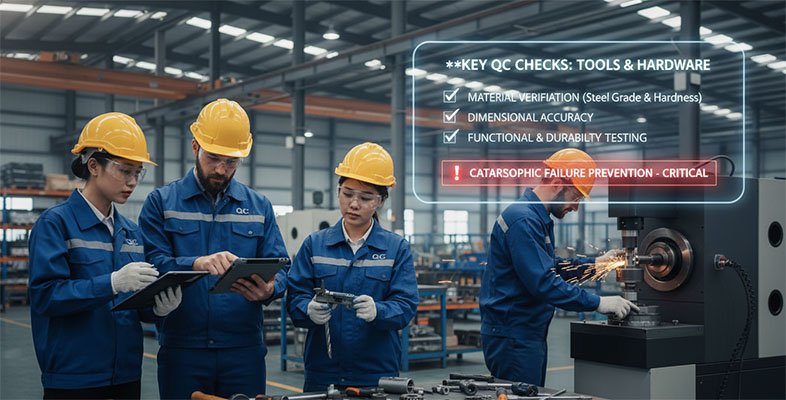
These essentials form a protective shield for your business. Ignoring any one of them is a gamble on your inventory, your customers' safety, and your brand's reputation. As a sourcing agency based in Yongkang, the heart of China's hardware industry, we have built our processes around these non-negotiable checks. We see firsthand how a robust QC plan transforms a risky purchase into a reliable product line. Let's break down exactly what you need to test and verify.
Why Is Yongkang the Epicenter for Sourcing Tools and Hardware?
Finding a specialized tool manufacturer online is like finding a needle in a haystack. You often end up with a generalist trading company that promises everything but lacks the deep manufacturing knowledge required for high-performance tools, risking quality and consistency.
Yongkang is globally recognized as China's "Hardware Capital." Its industrial ecosystem is built on forging, casting, and machining, making it the premier sourcing destination for hand tools, power tools, and general hardware. This concentration ensures access to expert factories and competitive pricing.
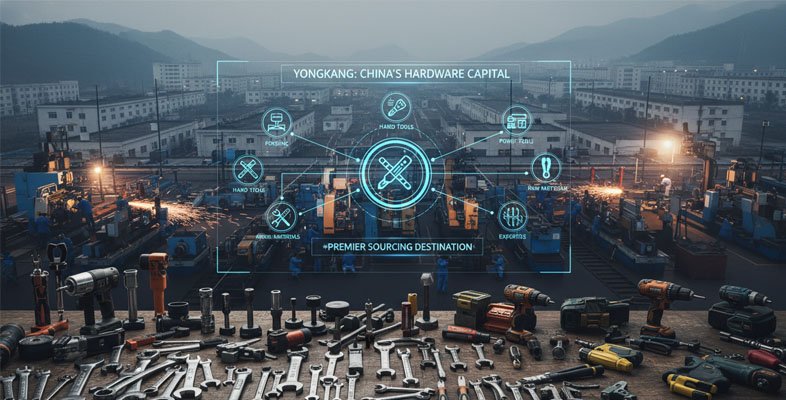
Where you source from matters immensely. Sourcing from a specialized industrial cluster gives you a decisive advantage. In Yongkang, the entire supply chain for hardware production is at our fingertips. This isn't just about finding a factory; it's about tapping into a whole ecosystem of expertise, raw material suppliers, and specialized services. Our physical location here allows us to leverage this ecosystem for our clients, ensuring we connect them with factories that are true masters of their craft.
Yongkang's Manufacturing Prowess
The city's identity is forged in metal. The local industry has deep, multi-generational expertise in the processes that are fundamental to creating quality tools:
- Forging and Casting: Creating the raw shapes for wrenches, hammers, and sockets with superior strength.
- Machining and Grinding: Achieving the precise dimensions required for tools to function correctly.
- Heat Treatment: The critical process of hardening and tempering steel to achieve the perfect balance of hardness and toughness.
- Surface Finishing: Applying durable coatings like chrome plating or powder coating for corrosion resistance and longevity.
The Complete Hardware Ecosystem
The power of Yongkang is that everything is local. A factory producing adjustable wrenches can source high-quality forged steel blanks from a supplier a few streets away, and then send them to a specialist heat treatment facility in the same industrial park.
| Tool Category | Key Yongkang Manufacturing Advantage |
|---|---|
| Hand Tools (Wrenches, Pliers) | Expertise in Cr-V steel forging, heat treatment, and chrome plating. |
| Garden Tools (Shears, Spades) | Stamping of carbon steel blades, plastic injection molding for handles. |
| Power Tool Components | Machining of gears and shafts, motor assembly supply chain. |
| General Hardware (Hinges, Locks) | High-volume stamping, die-casting, and assembly lines. |
This tight-knit network enables incredible efficiency. If we encounter a quality issue with a component during an inspection, we can often go directly to the sub-supplier on the same day to resolve it at the source, preventing delays and ensuring accountability.
How Do You Verify the Quality of Raw Materials?
A chrome-plated wrench looks great, but if it's made from cheap, soft steel, it will round off a bolt head on its first use. This instantly destroys customer trust and leads to a flood of negative reviews and returns.
To verify raw materials, you must demand Material Test Certificates (MTCs), confirm the steel grade (e.g., Chrome Vanadium vs. Carbon Steel) with an XRF analyzer, and conduct Rockwell hardness tests (HRC) on finished parts. This is the only way to guarantee the tool's core strength.
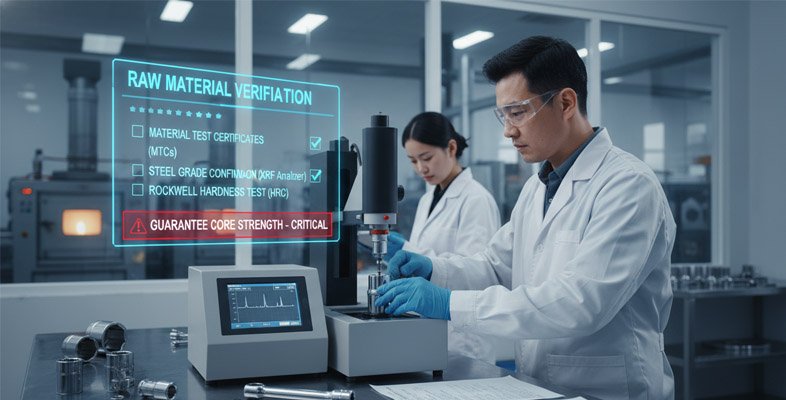
The material is the soul of the tool. It's an area where factories can easily cut costs with devastating consequences for performance. We treat material verification as the most critical QC step. We don't rely on the factory's word; we insist on objective proof. This starts with documentation and ends with physical testing, creating a chain of evidence that ensures the material is exactly what our client specified.
Steel Grade Verification
The type of steel determines a tool's performance. For example, Chrome Vanadium (Cr-V) is standard for high-quality wrenches and sockets due to its strength and toughness. A cheaper carbon steel might look the same after plating but will fail under high torque. We use a handheld X-Ray Fluorescence (XRF) analyzer during inspections. This device gives us an instant elemental breakdown of the metal, allowing us to confirm if the factory used Cr-V steel or a cheaper substitute.
Hardness Testing (HRC)
Hardness is crucial. A screwdriver tip that is too soft will deform, while a hammer face that is too hard and brittle can chip and send dangerous fragments flying. We use a Rockwell Hardness Tester to get a specific HRC value.
- Too Soft: The tool will bend, deform, or wear out quickly.
- Too Hard: The tool becomes brittle and can shatter under impact or stress.
Our QC inspectors know the target HRC ranges for different tools and will test samples from the batch to ensure they fall within the correct specification.
Auditing Heat Treatment
Proper hardness is achieved through heat treatment. A factory's ability to control this process is a key indicator of its quality. During our factory audits, we inspect their heat treatment facilities. We look for modern, temperature-controlled ovens and clear process documentation. A factory with outdated or poorly managed heat treatment is a major risk, as inconsistent heating leads to inconsistent tool quality.
What Are the Critical Checks for Dimensions and Functionality?
Imagine a socket set where the 10mm socket doesn't fit a 10mm bolt, or pliers whose jaws don't align. The tool is fundamentally useless, leading to immediate customer frustration and returns, making your entire shipment worthless.
Critical checks involve precise dimensional verification using digital calipers and go/no-go gauges against the approved CAD drawings. Functional testing includes hands-on checks for smooth movement, secure locking, proper assembly, and ergonomic feel. These are core components of our Pre-Shipment Inspections.
A tool must not only be strong but also precise. "Close enough" is not acceptable in the world of hardware. We establish a "Golden Sample" and a detailed technical drawing as the single source of truth for every project. Our inspectors then use these as the benchmark during production, checking a statistical sample of the products to ensure the entire batch meets the required tolerances.
Dimensional Accuracy
Precision is everything. A deviation of even a fraction of a millimeter can render a tool ineffective.
- Calipers and Micrometers: We use these tools to check critical dimensions like the jaw opening of a wrench, the diameter of a drill bit, or the thickness of a saw blade.
- Go/No-Go Gauges: For checking threads or specific hole diameters, these simple tools provide a quick and definitive pass/fail result, ensuring interchangeability of parts.
- CAD Drawing Comparison: Every measurement is checked against the client-approved technical drawing. Any deviation outside the specified tolerance is flagged as a defect.
Functional Testing Checklist
We test the tools the way a customer would use them. Below is a simplified checklist for an adjustable wrench:
| Check Category | Specific Inspection Points |
|---|---|
| Mechanism | Does the adjustment screw turn smoothly without binding? Is there excessive "play" or wobble in the moving jaw? |
| Alignment | Are the fixed and moving jaws perfectly parallel when closed? |
| Grip & Ergonomics | Is the handle free of sharp edges from the molding or forging process? Does it feel secure in the hand? |
| Markings | Are the size markings clear, legible, and accurate? Is the brand logo applied correctly? |
| Assembly | Is the tool assembled correctly without any loose parts? |
This hands-on approach catches problems that a simple visual check would miss.
How Can You Test the Long-Term Durability of Tools?
A new pair of pliers might work perfectly out of the box, but will they hold up after six months of use? A tool that fails prematurely gets a one-star review and tarnishes your brand with a reputation for being cheap and unreliable.
To test long-term durability, we perform torque tests to failure, automated cycle tests for moving parts, and impact/drop tests for brittleness. These destructive tests predict a tool's lifespan and resistance to real-world abuse, ensuring it meets customer expectations for longevity.
Simulating a product's entire life cycle is a core part of professional QC. While we can't use a tool for years, we can apply advanced stresses that reveal long-term weaknesses in a matter of hours. We perform these tests on a small number of samples from the batch. This destructive testing provides invaluable data on the product's true limits and build quality, offering the ultimate peace of mind before a container is shipped.
Torque and Stress Tests
This is about finding the breaking point. For tools like wrenches, sockets, and ratchets, we use a calibrated torque wrench to apply force until the tool either meets a specified standard (like ANSI or DIN) or fails. For example, we will tighten a bolt until the wrench breaks. This tells us if the material and heat treatment were correct. A good tool will withstand enormous force, while a poor one will snap or deform easily.
Cycle and Endurance Tests
For tools with moving parts, we need to simulate wear and tear.
- Ratchets: We might use a machine to cycle the ratchet mechanism 5,000 times and then re-test its function.
- Pliers: We can set up a rig to open and close a pair of pliers repeatedly to check the pivot point for wear.
- Locking Mechanisms: On tools like locking pliers or utility knives, we test the lock/unlock function hundreds of times to ensure it doesn't fail.
Impact and Environmental Tests
Tools get dropped and exposed to the elements.
- Drop Test: We drop tools like hammers or screwdrivers from a set height onto a concrete surface to test for brittleness. A poorly heat-treated tool can shatter, which is a major safety hazard.
- Salt Spray Test: For chrome-plated or coated tools, we place samples in a salt spray chamber to simulate accelerated corrosion. This tests the quality and thickness of the protective coating. A tool that rusts quickly will not last.
Conclusion
Sourcing quality tools from China hinges on rigorous QC: verifying materials, checking dimensions, and performing brutal durability tests. A sourcing partner in Yongkang is your key to enforcing these standards. Ready to source tools and hardware with confidence? Contact Auro Sourcing today.