

Sourcing personal care products feels risky. One compliance mistake can mean seized shipments, legal trouble, and a damaged brand reputation. It's a lot to manage from thousands of miles away.
A robust compliance checklist for sourcing personal care products includes verifying factory certifications (ISO 22716), confirming product registrations (FDA, CPNP), obtaining key documents like MSDS and COA, and conducting ingredient list reviews. This ensures safety, quality, and smooth customs clearance for your brand.
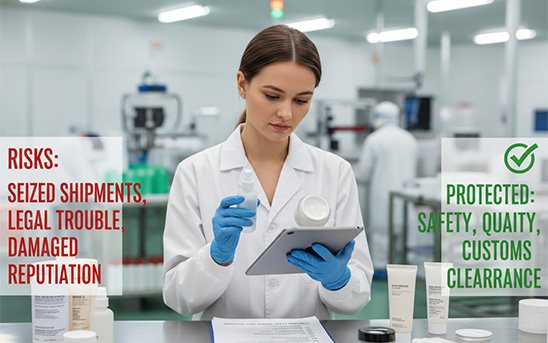
This checklist isn't just about ticking boxes; it's a critical framework for protecting your business and your customers. I’ve seen too many importers, especially those new to the category, stumble over these exact points. The good news is that with a systematic approach, you can navigate these challenges effectively. Let's break down exactly what you need to look for. This process is a core part of how we, as a China sourcing agent, de-risk the entire procurement journey for our clients, turning potential liabilities into a safe, scalable supply chain.
What are the core compliance standards for personal care products?
Regulations for cosmetics and personal care are constantly changing. Are you sure your new product line is fully compliant with EU and US standards? A single banned ingredient can get your entire inventory blocked.
Core standards include ISO 22716 (GMP for cosmetics), FDA regulations for the US market, and CPNP notification for the EU. Your factory must demonstrate adherence to the specific rules of your target market, which dictate labeling, ingredients, and required testing protocols.
When I work with clients, the first question is always: "Where are you selling?" The answer determines our entire compliance strategy. Sourcing personal care products is not a one-size-fits-all process. The requirements for an Amazon US seller are different from those for a retail chain in Germany. As your purchasing agent on the ground in China, my job is to translate these market-specific rules into actionable steps at the factory level.
Key Standards by Market
The two biggest markets, the US and the EU, have distinct regulatory frameworks. Here’s a simplified breakdown:
| Requirement | United States (FDA) | European Union (CPNP) |
|---|---|---|
| Good Manufacturing Practice | Recommended, follows ISO 22716 | Mandatory, must comply with ISO 22716 |
| Product Registration | Voluntary Cosmetic Registration Program (VCRP) | Mandatory notification on CPNP portal before sale |
| Responsible Person | No formal requirement | Mandatory appointment of a Responsible Person in the EU |
| Ingredient Regulations | Prohibited & Restricted Cosmetics Ingredients list | Extensive list of banned/restricted substances (Annexes II-VI) |
| Labeling | Requires INCI name, net quantity, warnings, etc. | Strict rules on claims, allergens, INCI, and PAO symbol |
What is ISO 22716 (GMP)?
ISO 22716 is the international standard for Good Manufacturing Practices (GMP) for the cosmetics industry. When I audit a factory, I'm not just looking for a certificate on the wall. I’m checking if they live by these principles. This means assessing their clean rooms, confirming they have documented processes for mixing and filling, and verifying their system for batch traceability. This ensures that if an issue ever arises, we can trace it back to the exact production batch. A factory that truly follows GMP is organized, clean, and transparent—key indicators of a reliable long-term partner.
How can a sourcing agent verify a factory's certifications?
You receive a polished PDF of an ISO certificate from a potential supplier. Is it authentic? Fake or expired documents are a common trap in international sourcing, and for personal care products, the consequences are severe.
A China sourcing agent verifies certificates by checking the issuing authority's public database, contacting the certifier directly, and conducting an on-site factory audit. We cross-reference the company name, address, and scope of certification to ensure the document is valid and applies to the actual facility producing your goods.
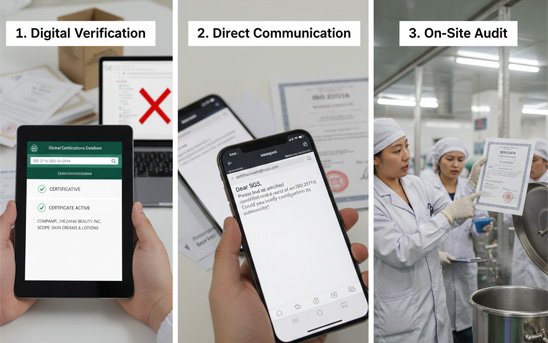
Verification is a non-negotiable step in our sourcing process. I treat every certificate with healthy skepticism until I can prove its validity. This detective work is one of the most valuable services a purchasing agent provides. It’s the difference between sourcing with confidence and gambling with your brand’s future. Here’s how I approach it.
H3: The Three-Step Verification Process
-
Digital Verification: My first step is to go directly to the source. Major certification bodies like SGS, Intertek, TÜV, and Bureau Veritas have online databases where you can input a certificate number to check its status. I look for three things: Is the certificate active? Does the company name and address match the supplier I'm talking to? And most importantly, does the "scope" cover the product category we want to source (e.g., "production of skin creams and lotions")?
-
Direct Communication: If an online database isn't available, I will contact the issuing body directly via email or phone. I send them a copy of the certificate and ask for direct confirmation of its authenticity. This simple step foils most attempts to use fraudulent documents.
-
On-Site Audit: This is the ultimate test. During a factory visit here in Zhejiang, I ask to see the original, physical copy of the certificate. I then walk the production floor to see if their operations align with the certification they claim to have. I once audited a factory that showed me a beautiful ISO 22716 certificate. But when I toured the facility, their mixing vats were open to dust, and workers were handling raw materials without gloves. It turned out the certificate belonged to a sister company in another province. We immediately disqualified them. This on-the-ground presence is irreplaceable.
What documents are essential for customs clearance?
Your shipment of 10,000 units of face serum has finally reached the port, but you get an email: "Shipment on customs hold." This is a common nightmare for importers, often caused by missing or incorrect paperwork.
Essential documents include the Commercial Invoice, Packing List, and Bill of Lading, plus product-specific files like the Material Safety Data Sheet (MSDS), Certificate of Analysis (COA), and a detailed Ingredient List (INCI). These prove the product's composition, safety, and compliance with import regulations.
Managing documentation is a critical function of a sourcing agent. We don't just find a factory; we manage the entire information flow to ensure a smooth transition from the factory floor to your warehouse. For personal care products, the paperwork is as important as the product itself. Here’s a breakdown of the key compliance documents I always secure for my clients.
H3: The Holy Trinity of Product Compliance Documents
-
Material Safety Data Sheet (MSDS/SDS): This document details the chemical properties and potential hazards of a product. It provides handling, storage, and emergency procedure information. Airlines, shipping lines, and customs officials all require it to ensure the product is transported safely. I make sure the factory provides an up-to-date, 16-section SDS that is compliant with international standards.
-
Certificate of Analysis (COA): A COA is a lab report confirming that a specific batch of product meets the agreed-upon specifications. This is not a generic marketing document. We insist on a COA for every single production run. It typically includes results for microbial testing, heavy metal analysis, and stability tests. This document is your proof that the batch you are paying for is safe and meets your quality standards.
-
Ingredient List (INCI): The International Nomenclature of Cosmetic Ingredients (INCI) is a standardized system for listing ingredients. Before we even start production, I review the client's desired formula against the INCI list and the regulations of the target market. I once helped an Amazon seller who wanted to launch a brightening serum. Their formula contained an ingredient that was perfectly fine in Asia but heavily restricted in the EU. By catching this early, we worked with the factory's lab to find a compliant alternative, saving the client from producing thousands of units they couldn't sell.
Conclusion
Compliance for personal care is not optional. It requires a systematic checklist, on-the-ground verification, and meticulous document management. A reliable China sourcing agent like Aurosourcing is your partner in this essential process.
Ready to source your personal care products with confidence? Send us your product specifications, and let's build a safe and compliant supply chain together.