

Social media has stopped being only a place of entertainment; it is now a potent B2B sourcing medium. Platforms such as TikTok, Douyin, and Xiaohongshu (RED) enable companies to find suppliers, assess product quality, and contact manufacturers directly.
TikTok connects buyers worldwide, Douyin offers direct access to Chinese factories, while Xiaohongshu is a source of growing niche or high-end items, built on trust and community validation. Let’s explore in detail how to source via TikTok/Douyin and Xiaohongshu.
Core Differences Between TikTok and Douyin
TikTok and Douyin are separate applications operated by the same parent company, ByteDance. While they look similar and have almost identical interfaces, they operate in different digital ecosystems. Have a look at the differences:
| Feature | Douyin (China) | TikTok (International) |
|---|---|---|
| Geographic Availability | Mainland China only | Over 150 countries worldwide |
| Data & Content | Separate servers; content does not cross-share | Separate servers; cannot access Douyin content |
| Functionality | Advanced “super-app”: in-video product search, hotel booking, e-commerce (Taobao) | Entertainment-focused: viral videos, memes, and trends |
| Content Philosophy | Regulated, promotes educational and positive content; Teen Mode limits minors to 40 mins/day | Entertainment-driven content: challenges, trends, memes |
| Ownership & Management | ByteDance, Beijing HQ, CEO Liang Rubo | ByteDance, global HQ in Los Angeles & Singapore, CEO Shou Zi Chew |
| User Interface | Similar to TikTok, but includes China-specific integrations | Global UI, entertainment-focused feeds |
Douyin is ideal for sourcing within China due to its advanced verification and e-commerce tools, while TikTok offers global reach and trend monitoring for international buyers.
TikTok & Douyin: The Factory-Direct Powerhouses
TikTok and Douyin are both short-video platforms. Douyin is designed for local Chinese sourcing, providing direct access to factories through live-stream tours, product demonstrations, and interactions with official stores. Buyers have the opportunity to visit production lines, evaluate quality control levels, and interact with manufacturers, in many cases without intermediaries.
TikTok serves the entire world market, enabling customers to find suppliers in other countries, engage sourcing agents, and track market trends worldwide. Collectively, these platforms offer businesses real-time information on products, factories, and market trends, which is changing the B2B sourcing process.
How TikTok and Douyin Work in B2B Sourcing?
Live Streams and Factory Tours
Live-streamed factory tours are among the most effective features of Douyin/TikTok. Manufacturers present their production lines, research and development, and quality control in real time. Buyers can view how products are manufactured, tested, and packed, which serves as a pre-vetting measure before they contact the supplier. There are also streams where product search can be done in-video, so buyers can simply click the product in the stream and immediately see its catalogue, price, and availability.
Short-Form Videos
The two sites use videos of 15-60 seconds to highlight the products and capabilities of suppliers. These brief video clips tend to emphasize product longevity, qualifications, shipping, and manufacturing, thus giving the purchaser a brief yet detailed overview of what goes on with the supplier.
Algorithmic Discovery
Douyin and TikTok have advanced algorithms that suggest suppliers based on what you search for and how you interact. Searching Chinese terms on Douyin, such as 厂家 (factory), 货源 (source of goods), or 批发 (wholesale), will regularly yield verified manufacturers and not middlemen. Using English industry-specific keywords, you can find global suppliers or sourcing agents on TikTok.
Direct Interaction
The platform offers certified accounts to connect with suppliers. Several manufacturers provide links to official stores, WeChat accounts, or phone numbers that enable buyers to send RFQs (Requests for Quotes), negotiate terms, and request samples without intermediaries. This direct interaction is beneficial, as it accelerates sourcing and ensures good communication and trust before making larger purchases.
How to Source From TikTok/Douyin?
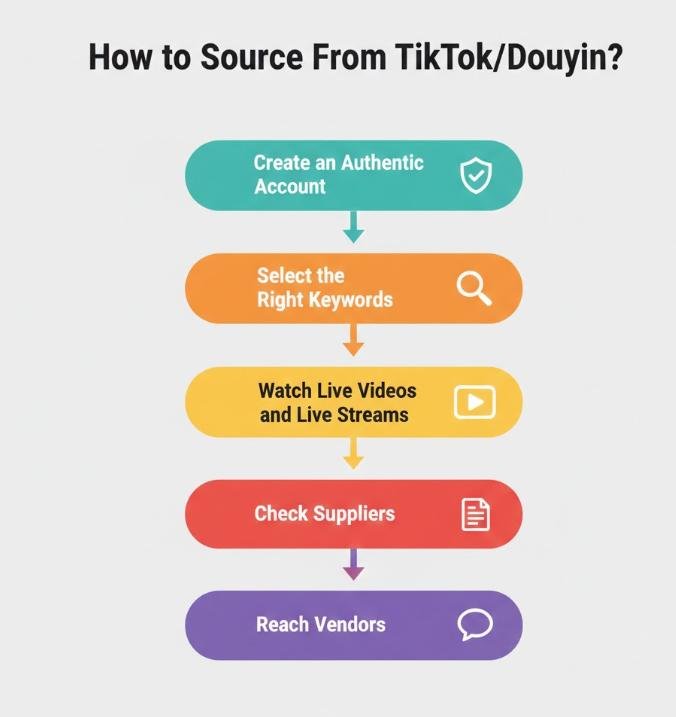
- Create an Authentic Account To access platform analytics, messaging, and official store capabilities, the account should be verified. A blue verification badge on Douyin serves as a sign of validity, and it is more likely to prompt suppliers to answer questions.
- Select the Right Keywords It is important to select the right search words. When searching in Simplified Chinese on Douyin, one should use words such as 厂家 (factory), 货源 (source of goods), and 批发 (wholesale). Use industry-specific English terms on TikTok, like "OEM cosmetic manufacturer" or "LED lights supplier".
- Watch Live Videos and Live Streams Live videos and streams enable buyers to evaluate how the factory operates, its quality control, and its packaging. Reliable suppliers often post numerous videos of various production processes, which gives one additional confidence in their consistency and quality.
- Check Suppliers Find verification badges, links to official stores, and sales history to assess legitimacy. It's also wise to cross-verify suppliers on other reputable sites.
- Reach Vendors Once potential suppliers have been identified, reach out to them using in-app messaging, WeChat, or by phone. Never place bulk orders without first requesting samples, quotes, or customization details.
Navigating the language barrier on Douyin and thoroughly vetting suppliers can be time-consuming. To have an expert on the ground manage this process for you, contact the Aurosourcing team.
Pros and Cons of TikTok/Douyin for B2B Sourcing
| Pros | Cons |
|---|---|
| Direct access to manufacturers and OEMs | Language barrier (Douyin is primarily Chinese) |
| Real-time visual proof of production | Risk of unverified or fraudulent suppliers |
| Algorithmic supplier discovery | Short-form videos may lack full specifications |
| Global (TikTok) and domestic (Douyin) reach | Cultural differences in business practices |
| Quick vetting via videos & live demos | Time-intensive to monitor multiple streams |
B2B Sourcing From Xiaohongshu (RED): The Curation & Trust Expert
Where Douyin emphasizes direct factory access, Xiaohongshu emphasizes trust, curation, and community verification. Xiaohongshu, also known as the Little Red Book, is especially useful for sourcing niche or high-quality products. Industries like fashion, beauty, home decor, and lifestyle goods can leverage community-based recommendations, with feedback used to assess product quality and supplier reliability.
What is Xiaohongshu?
Xiaohongshu is a social commerce and content-sharing site that integrates social networking with e-commerce. Compared to the fast-paced video content on Douyin, Xiaohongshu is associated with longer, more detailed content, making it an excellent option for buyers who prefer in-depth research. The platform has developed a trust-based ecosystem where content authenticity is valued, and peer ratings inform purchasing decisions.
B2B buyers, KOLs (Key Opinion Leaders), and KOCs (Key Opinion Consumers) place a lot of trust in it when judging suppliers and products. Buyers can find not only product specifications but also actual use cases, customer photographs, and reviews, which give a clear picture of a supplier's performance.
Features of Xiaohongshu
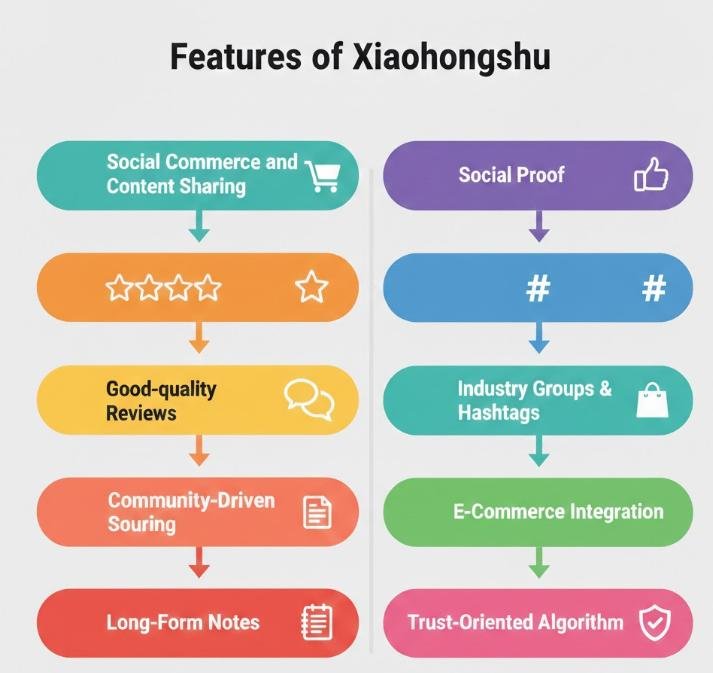
- Social Commerce and Content Sharing: Businesses and individuals can post content while integrating products directly for purchase, enabling buyers to find suppliers through real user experiences.
- High-Quality Reviews: Customers can read detailed reviews and view authentic photographs from others who have already purchased the product.
- Community-Driven Sourcing: Industry-specific groups and hashtags help buyers find trending, trusted suppliers.
- Long-Form Notes: The platform emphasizes detailed posts (called "notes") that include specifications, unboxing content, and comparison charts.
- Social Proof: Peer reviews and testimonials provide credibility and minimize the risk of scams.
- Industry Groups & Hashtags: Tags like
#SourcingInChinahelp buyers find highly recommended suppliers. - E-Commerce Integration: Customers can often buy directly on the platform, streamlining the discovery-to-procurement process.
- Trust-Oriented Algorithm: The ranking system gives higher weight to genuine, verified posts over viral content.
How to Source from Xiaohongshu?
- Verified Business Account: Enable analytics, messaging, and engagement features.
- Search by Product Categories or Supplier Names: Find posts with detailed photos and videos.
- Vet Suppliers by Reviews: Look for repeat recommendations and mentions from trustworthy KOLs.
- Join Industry Groups/Track Hashtags: Monitor suppliers and product quality trends.
- Contact Suppliers: Interact via in-app messaging or official stores. Request quotations or samples before placing a bulk order.
Pros and Cons of Xiaohongshu for B2B Sourcing
| Pros | Cons |
|---|---|
| Trust-focused, peer-reviewed sourcing | Primarily Chinese-focused; limited global reach |
| Long-form content with detailed product info | Slower pace compared to short-form video platforms |
| Ideal for niche, lifestyle-oriented products | Smaller supplier pool for industrial goods |
| Peer evaluation reduces sourcing risks | Active monitoring of groups is required |
| Social proof helps pre-vet suppliers | Some reviews may be sponsored or biased |
Best Practices for B2B Social Media Sourcing
- Verify accounts and suppliers before placing large orders.
- Use multiple platforms to cross-check supplier legitimacy.
- Engage actively via live streams, comments, and messaging.
- Monitor trending keywords and hashtags for supplier discovery.
- Always request product samples to confirm quality.
- Understand cultural and language differences for better communication.
- Use translation tools for non-native content.
- Track analytics across platforms to optimize sourcing strategies.
Implementing these best practices requires significant time and expertise. To ensure your social media sourcing strategy is effective and secure, contact the Aurosourcing team for professional support.
Conclusion
Social media platforms have revolutionized B2B sourcing. Douyin provides direct factory access and local reach, TikTok serves as a global platform for supplier discovery, and Xiaohongshu offers community-trusted, niche-focused sourcing.
Combining these platforms provides a comprehensive sourcing strategy, enabling businesses to find reliable suppliers, reduce risks, and stay competitive in both domestic and global markets.