
Choosing the right payment method is one of the most important decisions when buying products from Chinese suppliers. Using incorrect payment options may result in delays, lower-quality shipments, or even the loss of all funds. An effective payment system helps secure your funds, ensure quality management, and foster long-term relationships with suppliers.
Chinese suppliers can accept payments in various forms, although for an international customer, the three most widely employed methods are: Telegraphic Transfer (T/T), Letter of Credit (L/C), and Open Account (OA). How do you pay a Chinese supplier? Let’s discuss these payment methods, so you can select the right one.
Common Payment Methods Used in China
International trade with China relies mainly on bank-based payment systems. Although digital platforms are available, conventional methods are still prevalent. T/T is the most widespread due to its simplicity. Large or high-risk transactions are typically handled through Letters of Credit (L/C). OA is infrequent and restricted to trusted buyers who have strong financial backgrounds.
In simple terms:
- T/T offers flexibility but requires careful timing.
- L/C provides strong protection but adds cost and complexity.
- OA favors buyers, but it is difficult to obtain.
The correct decision is based on order quantity, trust in suppliers, and the risk that you are willing to take.
What is the Telegraphic Transfer (T/T) Payment Method?
Telegraphic Transfer, also known as a bank transfer, is the most widely used payment method when working with Chinese suppliers. The buyer transfers money directly from their bank account to the supplier's bank account. Almost all Chinese manufacturers and trading firms accept this method, making it the most feasible option for small and medium-scale buyers.
Even though T/T does not come with inherent protection for the buyer, it can be safe when managed correctly.
How T/T Payments Usually Work?
The majority of T/T transactions follow a common structure:
- 30% deposit before production
- 70% balance after production, before shipment
This structure is beneficial for both sides. The supplier receives funds to buy materials and commence production, while the buyer retains control and can withhold the final payment until the goods are completed and inspected.
Typical T/T Payment Flow
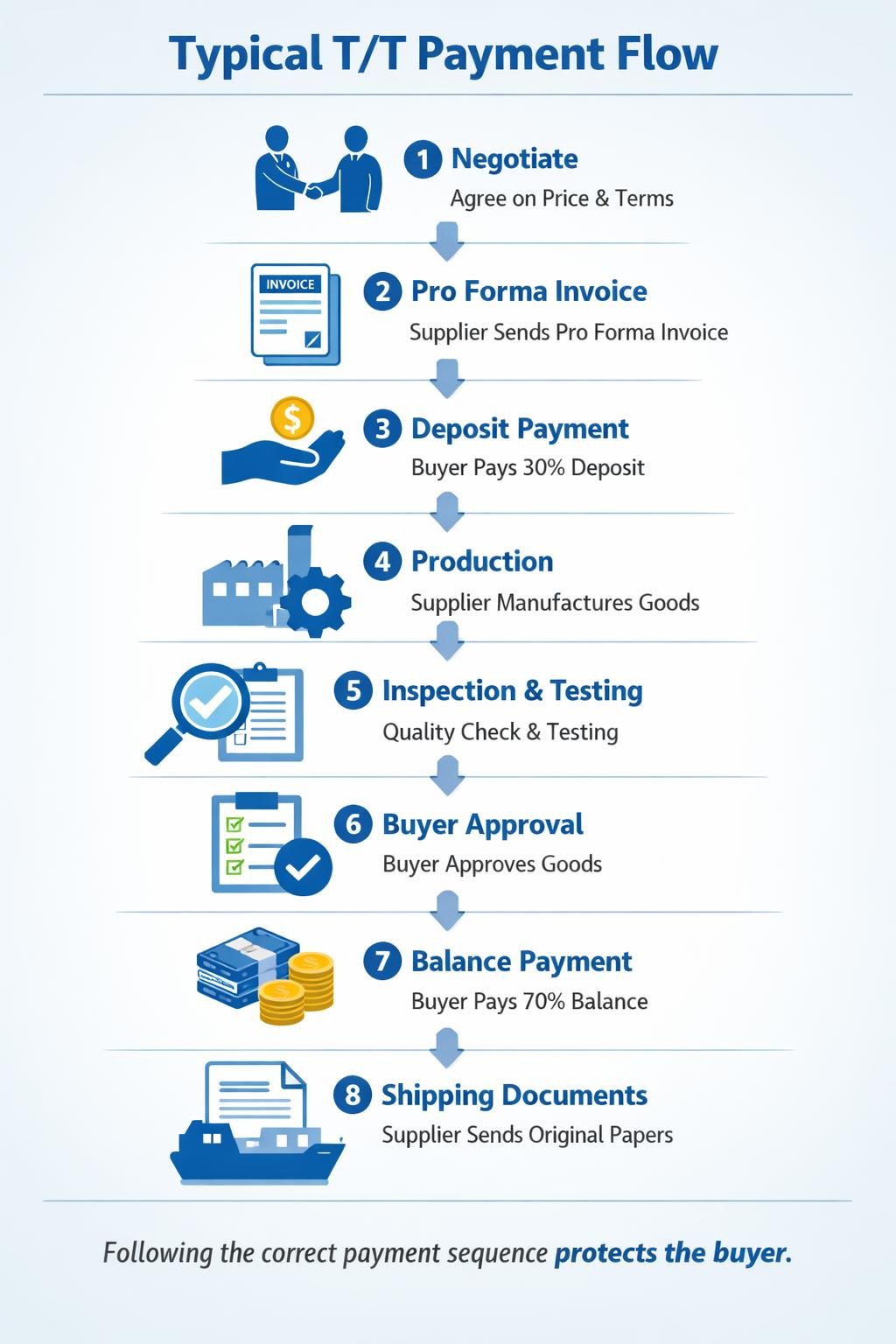
A regular T/T transaction is conducted in the following way:
- The buyer and seller negotiate the price, specifications, and delivery conditions.
- The supplier issues a Proforma Invoice (a detailed quote before the sale is final).
- The buyer pays the deposit (e.g., 30%).
- The supplier starts and finishes production.
- Quality inspection and testing occur.
- The buyer approves the goods based on the inspection report.
- The buyer pays the balance (e.g., 70%).
- The supplier releases the original shipping documents (like the Bill of Lading).
These steps secure the buyer as long as they are followed in the right sequence.
Why is T/T still Widely Used For Chinese Suppliers?
T/T is effective because many Chinese factories operate on low-profit margins. Most products are custom-made and not easily marketable in the local market. If a supplier fails to deliver satisfactory goods, they risk losing the final payment, which often represents their entire profit. This encourages suppliers to meet quality and delivery standards when buyers exercise control over the final payment.
Reducing Risk When Paying by T/T
Buyers can use the following key rules to minimize risk:
- Never pay 100% before production.
- Always sign a stamped sales contract or purchase order.
- Conduct third-party inspections before making the final payment.
- Verify bank account details carefully.
It is essential to match the company name on the supplier's invoice with the beneficiary name on the bank account.
Common T/T Payment Scams
One of the most common scams involves changed bank details. A hacker can access the supplier's email and modify the bank account information in the invoice. The customer, without knowing, sends money to a fraudulent account. It is normally impossible to recover the money once it has been transferred.
To prevent this, the buyer should always verify bank details through a secondary channel, such as a phone or video call, before remitting money. Navigating these risks can be challenging. For expert guidance on secure transactions and supplier verification, contact the Aurosourcing team.
Is T/T Safe?
T/T is safe when managed with discipline. It can be highly effective when purchasers thoroughly vet suppliers, conduct quality checks, and avoid making payments under pressure. For the majority of buyers, T/T remains the most realistic and efficient method of payment.
What is the Letter of Credit (L/C) Payment System for Chinese Suppliers?
A Letter of Credit (L/C) is a payment system controlled by banks that ensures high security for buyers. With an L/C, the buyer's bank guarantees payment to the supplier only if pre-agreed conditions are met. Often, no deposit is needed, which dramatically lowers the risk for buyers.
How L/C Protects Buyers and When to Use It
When purchasing from China, customers often worry that they will pay money and receive the wrong items. An L/C is designed to minimize this risk by shifting control of the payment from the buyer and supplier to neutral banks, making the process safer for large and sensitive transactions.
How L/C Protects Buyers
An L/C secures buyers because the payment is not released automatically. The supplier receives money only after presenting the exact documents specified in the L/C agreement.
Under an L/C, payment happens only after the supplier submits correct documents, such as:
- Bill of Lading (proof that goods were shipped)
- Quality inspection report
- Laboratory test reports (if required)
- Packing list and commercial invoice
If the documents do not comply with the L/C terms, the bank will decline to pay. This provides buyers with strong bargaining power and limits the chances of fraud or shipping failure.
Note: However, there is one limitation to understand. Banks only check documents, not the actual product quality. If poor-quality goods are shipped but the documents are correct, the bank will still process the payment. This is why independent inspections remain crucial.
Typical L/C Payment Process
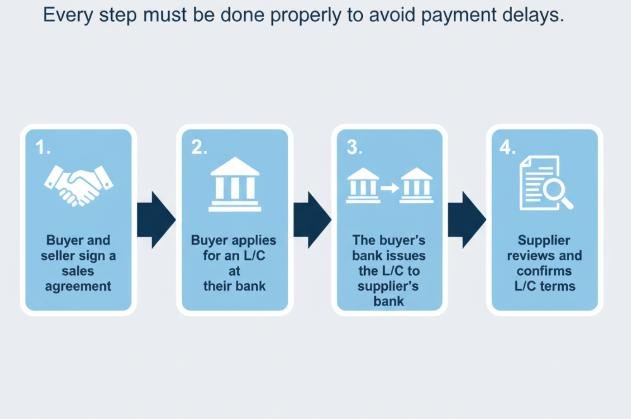
The L/C process is guided by a very strict, step-by-step procedure. Every step must be done properly; otherwise, the payment can be postponed or blocked.
The common procedure is as follows:
- The buyer and seller sign a sales agreement specifying payment by L/C.
- The buyer applies for an L/C at their bank.
- The buyer’s bank issues the L/C to the supplier’s bank.
- The supplier reviews and confirms the L/C terms.
After the L/C is accepted, production begins. Once production is completed, the following steps are taken:
- Goods are inspected and tested.
- Goods are shipped.
- The supplier submits all required documents to their bank.
- The banks verify all documents against the L/C terms.
- The bank releases payment if all documents match.
This structured flow is why Letters of Credit are trusted for high-value international trade.
Advantages of Using L/C
L/Cs provide great security, particularly when entering into a contract with a new supplier or placing a large order.
Key advantages include:
- No upfront deposit is typically required.
- Strong payment security backed by banks.
- Appropriate for large and high-risk orders.
- Minimizes the risk of supplier default.
Since suppliers must adhere to stringent conditions, buyers have greater influence over the transaction.
Disadvantages of L/C for Chinese Buyers
Despite the protection, L/Cs are not flawless. They are associated with high costs, delays, and complexity that can be challenging for smaller companies.
Common drawbacks include:
- High bank fees.
- Complex and unforgiving paperwork.
- Slow processing time.
- Many small suppliers refuse to accept L/C.
Most Chinese factories prefer T/T because L/Cs tie up their cash flow and increase banking expenses. This is why L/Cs are more popular among medium- and large-scale factories. Given the complexity and strict requirements of L/Cs, having an expert manage the process is invaluable. The Aurosourcing team can facilitate L/C transactions to ensure your high-value orders are secure.
When Should You Use L/C?
L/C is not suitable for all transactions. It is best used in circumstances where risk control is more important than speed or simplicity.
L/C is a good choice when:
- The order value is very high (e.g., over $50,000).
- The supplier is new or untested.
- There must be strict compliance with product specifications documented via reports.
- You are dealing with institutional or government contracts.
For smaller orders or with trusted, long-term suppliers, T/T is often more convenient.
Open Account (OA) Payment Method
What is an Open Account (OA)?
Open Account is the most buyer-friendly payment method. Under OA terms, the supplier ships the goods first, and the buyer pays later, usually after 30, 60, or 90 days.
Why is the Open Account Rare in China?
OA is extremely rare in China because it exposes suppliers to serious financial risk. Most Chinese suppliers lack legal authority overseas and face difficulties in collecting unpaid invoices.
The main reasons why OA is not common are:
- High risk of non-payment for the supplier.
- No robust legal enforcement in foreign countries.
- Heavy cash flow pressure on the manufacturer.
- Poor access to trade credit insurance.
Because of these risks, OA is offered only to:
- Very large, reputable buyers.
- Long-term customers with a perfect payment history.
- Well-known international brands (e.g., Walmart or IKEA).
OA is almost impossible for small or first-time buyers to obtain.
Advantages of Open Account
For eligible buyers, OA offers significant financial advantages by improving cash flow.
Main advantages include:
- Zero upfront payment required.
- Strong cash flow for the buyer.
- No need to raise financing for production.
This is why large retailers strongly prefer OA terms.
Disadvantages of Open Account
While attractive, OA has severe drawbacks. Most buyers will never be offered these terms, and suppliers who do offer them often increase product prices to compensate for the risk.
Key disadvantages include:
- Almost impossible for small or new buyers to get.
- Requires a long history of trust.
- May lead to higher product prices to offset the supplier's risk.
OA is not a starting point; it is a reward for years of established dependability.
How Can Buyers Earn OA Terms?
Buyers cannot demand OA terms. They must be earned through consistent performance and trust-building over time.
To qualify, buyers must:
- Place frequent, repeat orders.
- Demonstrate a strong financial history.
- Pay on time, every time.
- Maintain a strong, positive relationship with the supplier.
OA terms are built over years, not negotiated in the initial deal.
Payment Methods of Chinese Suppliers: T/T vs L/C vs OA
Each payment method balances risk differently between the buyer and the supplier. Understanding these differences helps buyers make informed choices that protect their investment while fostering a good relationship with their manufacturing partners.