

Struggling to decide between overseas sourcing and local production? The wrong choice can quietly drain your margins or limit your growth potential.
Sourcing kitchenware from China typically offers lower unit costs and scalability, while local manufacturing provides faster lead times and easier communication. The right choice depends on your cost structure, order volume, and long-term business strategy.
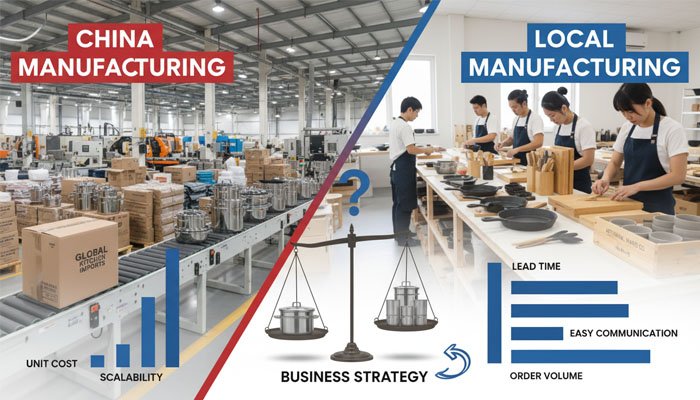
Cost is never just about the price per unit. To make the right sourcing decision, you need to break down the full cost structure and understand where each option truly performs. This guide cuts through the noise to help you make a smart, profitable choice.
What are the core cost components in kitchenware sourcing?
Many buyers only compare unit prices and overlook hidden costs that significantly impact total sourcing expenses. This is a critical mistake.
The total cost includes unit price, tooling, shipping, duties, inventory holding, and quality control. A full cost breakdown is essential for an accurate comparison and to calculate the true "landed cost" of your goods.
In my 13+ years as a sourcing agent, I've seen countless buyers fixate on a low factory price from China, only to be surprised by the final cost. To avoid this, you must account for every expense.
Main Cost Components
| Cost Element | Description | Why It Matters |
|---|---|---|
| Unit Price | The manufacturing cost per item. | This is the most obvious but often misleading number. |
| Tooling/Molds | The upfront cost for creating custom molds or tools. | Can be a significant initial investment, especially for new products. |
| Shipping & Logistics | The cost to transport goods from the factory to your warehouse. | A major variable that can erase unit cost savings on small orders. |
| Duties & Tariffs | Taxes your country charges on imported goods. | A mandatory cost that can be 5-25% or more of the product's value. |
| Quality Control (QC) | Expenses for inspections to ensure products meet standards. | Essential for managing risk, whether you pay for travel or a third-party service. |
Ignoring these factors often leads to incorrect sourcing decisions and unexpected losses. A reliable China sourcing agent will help you calculate these costs upfront.
Why is China often cheaper for kitchenware production?
Wondering what gives China its powerful cost advantage? It's a systemic efficiency that goes far beyond just labor rates.
China offers lower comparative labor costs, mature supply chains, and vast economies of scale. This integrated ecosystem dramatically reduces production costs for most kitchenware categories.
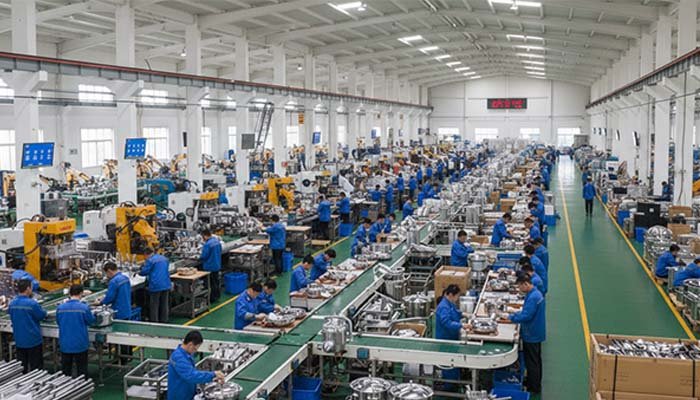
This advantage is built on a highly integrated manufacturing ecosystem. Here in Yongkang, the "Hardware Capital of China," I see it daily. A factory making vacuum flasks can source its stainless steel, plastic lids, and packaging from specialized suppliers just down the road. This density creates unmatched speed and cost efficiency.
Key Advantages of China's Ecosystem
| Factor | Impact on Kitchenware Production |
|---|---|
| Manufacturing Clusters | Regions like Yongkang (metalware) and Yangjiang (knives) have deep expertise, specialized machinery, and experienced labor. |
| Integrated Supply Chains | Factories source materials and components locally, reducing costs and lead times. This is difficult for Western manufacturers to replicate. |
| Economies of Scale | High production volumes allow factories to buy raw materials in bulk at a discount, passing savings to you. |
This system is engineered for large-scale production, making the unit prices for standard kitchenware items extremely competitive, often 50-70% lower than local alternatives.
When does local manufacturing become more cost-effective?
A lower unit cost from China doesn’t always translate to a lower total cost. For startups and brands that need to be agile, local production can be the smarter financial move.
Local manufacturing is often more cost-effective for small batch orders, projects requiring a fast turnaround, or when you need to minimize inventory risk. The savings on shipping, duties, and cash flow can outweigh a higher unit price.
I always advise clients to consider their risk. Tying up thousands of dollars to meet a Chinese factory's Minimum Order Quantity (MOQ) for an unproven product is risky. Producing a smaller batch locally to test the market first is often a more capital-efficient strategy.
Key Scenarios Where Local Sourcing Wins
| Benefit | Impact on Total Cost |
|---|---|
| Low or No MOQs | Frees up cash flow. You don't have to sink capital into excess inventory, drastically reducing your upfront investment. |
| Short Lead Times | Allows you to restock in days, not months. This prevents lost sales from stockouts and helps you react to trends. |
| No Import Costs | You save directly on international freight and import tariffs, which can make the final landed cost very competitive. |
| Easier Communication | No time zones or language barriers. Resolving issues is faster and cheaper, preventing costly production errors. |
For product testing, custom or niche items, or urgent restocking, the speed and flexibility of local manufacturing often provide a better return on investment.
How do logistics and tariffs affect total cost?
Shipping and import duties are the two biggest variables that can quickly diminish the cost savings of sourcing from China if not planned for properly.
International freight costs, tariffs based on your product's HS code, and customs clearance fees significantly increase the total landed cost. You must calculate these before placing an order to understand your true profitability.
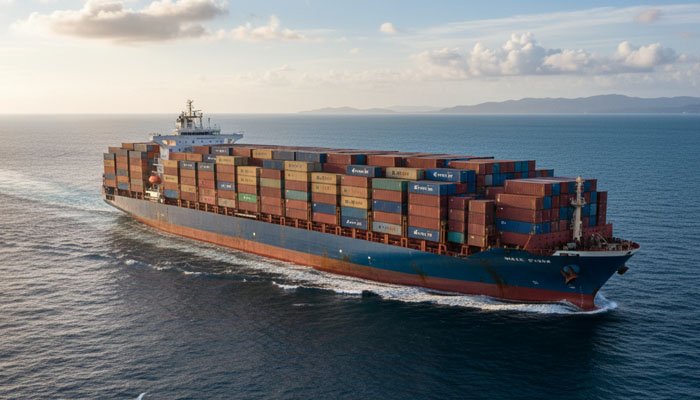
Calculating your true "landed cost"—the final price per unit once it arrives at your door—is non-negotiable. It's the only way to make an accurate comparison.
Key Factors in Landed Cost
| Factor | Description & Impact |
|---|---|
| Freight Method | Sea freight is cost-effective for bulk orders but slow (30-45 days). Air freight is fast (5-10 days) but can be 5-10x more expensive, erasing margins on most goods. |
| Duties & Tariffs | This tax is a percentage of your goods' value, determined by its HS code. A China purchasing agent can help you classify your product correctly to estimate duties. |
| Volume | Logistics favor volume. The shipping cost per unit for a full container (FCL) is significantly lower than for a few pallets (LCL). Small orders lose their cost advantage quickly. |
A good sourcing partner provides a detailed landed cost estimate from the start, so there are no surprises when the final invoices arrive.
What are the risks that influence real sourcing costs?
The most expensive problems aren't on the quotation; they come from unmanaged risks that create hidden costs.
Quality issues, production delays, and supplier reliability are not just inconveniences—they directly impact your total sourcing cost through returns, lost sales, and expensive rework. Proactive risk management is essential cost control.
A cheap supplier who delivers defective goods is far more expensive than a reliable partner. At Auro Sourcing, our primary job is to mitigate these risks for our clients.
Common Risks & Their Financial Impact
| Risk | Cost Impact | How to Mitigate It |
|---|---|---|
| Quality Defects | Cost of unsellable inventory, returns, rework, and brand damage. | On-site factory audits and professional third-party QC inspections before shipment. |
| Production Delays | Lost sales from stockouts, penalties from retailers, and paying for expensive air freight. | A local team on the ground for proactive production follow-up. |
| Miscommunication | Receiving goods that don't match your specs, leading to a total loss or steep discounts. | Bilingual project management and detailed, confirmed specification sheets. |
Investing in a reliable sourcing agent on the ground in China is the most effective way to turn these unpredictable risks into manageable, predictable costs. If you're ready to secure your supply chain, contact the Aurosourcing team to discuss your project.
How should you decide between China and local sourcing?
There is no one-size-fits-all answer. The right choice must align with your business model, volume, and growth stage.
Choose China for large-scale, cost-sensitive production where maximizing your margin is the goal. Choose local manufacturing for flexibility, speed, and lower operational complexity, especially for new or low-volume products.
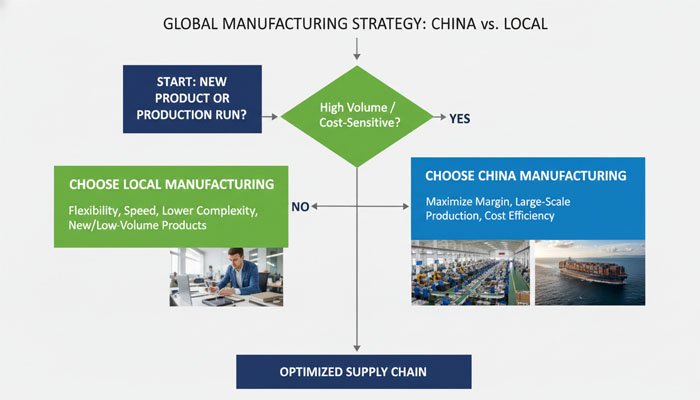
Many successful brands use a hybrid strategy to get the best of both worlds. This approach de-risks your supply chain while maximizing profitability as you grow.
A Practical Decision Framework
| Scenario | Best Option | Why? |
|---|---|---|
| High Volume, Standard Product | China | Unbeatable cost-efficiency and scalability. |
| Low Volume, New Product Launch | Local | Minimizes risk and upfront capital; allows market testing. |
| Need for Speed/Fast Restock | Local | Lead times are days, not months. |
| Highly Custom/Complex Product | Local | Easier collaboration and fewer communication errors. |
| Primary Goal: Maximize Margins | China | Lower unit costs directly translate to higher profit at scale. |
You can start locally to validate an idea and then move production to China with a trusted sourcing partner once you're ready to scale. This strategic approach is a proven path to success. Ready to make the move? Send your product requirements to the Aurosourcing team for a free sourcing consultation.
Conclusion
Choosing between China and local manufacturing depends on total cost, not just unit price. The best strategy aligns sourcing decisions with your volume, speed, and growth goals.