

Frustrated with inconsistent quality and endless production delays? Each new order from China feels like a gamble, costing you money, customers, and sleep, leaving your business vulnerable and hard to scale.
Standard Operating Procedures (SOPs) are detailed, step-by-step instructions that standardize your sourcing and quality control processes. They create a clear rulebook for your suppliers and your team, ensuring consistency in quality, communication, and execution, which dramatically reduces errors, delays, and costly surprises.

I’ve seen countless importers struggle with the same cycle of problems: a perfect sample followed by a disastrous bulk order, or a great supplier suddenly dropping in quality. The root cause is almost always a lack of clear, documented standards. You might think creating SOPs is a complex, corporate task, but it’s actually the most practical tool you can have as an importer. It’s about writing down the rules of the game so everyone knows how to win.
In my years as a sourcing agent here in Yongkang, I've learned that the most successful businesses are the ones that run on systems, not luck. This article will guide you, step-by-step, through creating powerful SOPs for both sourcing and quality control. I’ll show you how to turn your expectations into enforceable instructions that protect your investment and help you build a truly reliable supply chain.
What Should Your Sourcing SOP Actually Include?
Feeling like you're just guessing when choosing a supplier? This random approach leads to partnering with unqualified factories, getting misleading quotes, and wasting weeks on suppliers who can't deliver.
A comprehensive Sourcing SOP structures your entire supplier discovery and vetting process. It should define procedures for finding potential suppliers, creating a detailed RFQ, conducting audits, and evaluating samples. This transforms sourcing from guesswork into a repeatable, data-driven system for finding reliable partners.

Your Sourcing SOP is your playbook for finding the right factory. It ensures you and your team follow the same rigorous process every time, so you're not just finding a supplier, but the right supplier. Overlooking this step is like building a house without checking the foundation first. A well-defined SOP for sourcing is what separates amateur importers from professional buyers. It forces you to be systematic and is the first line of defense against future production headaches. Here at Auro Sourcing, this systematic approach is at the core of how we operate. We don't just search on Alibaba; we leverage our local network and a multi-step vetting process.
Let’s break down what a professional Sourcing SOP looks like.
Step 1: Supplier Discovery & Initial Screening
This is the top of your funnel. Your SOP should define where you look for suppliers and what initial criteria they must meet. Don't just rely on one platform.
- Sources: Your SOP can list primary sources like Alibaba, Made-in-China, and Global Sources, but also secondary ones like industry trade shows (e.g., Canton Fair) and referrals. For us, our most valuable source is our local database of factories here in Yongkang, the "Hardware Capital of China."
- Screening Checklist: Create a simple checklist for the first pass. This should include:
- Business License & Certifications (e.g., ISO 9001).
- Years in Business (we prefer 3+ years).
- Main Products & Factory Location (Are they in the right industrial cluster?).
- Verified status on B2B platforms.
- Response Time & Professionalism.
This initial screen weeds out 80% of unsuitable suppliers quickly, saving you immense time.
Step 2: The Request for Quotation (RFQ) Process
A vague RFQ gets you a vague, useless quote. Your SOP must include a standardized RFQ template. This ensures every supplier is quoting on the exact same specifications, making comparisons fair and accurate. Our RFQ template at Auro Sourcing includes:
- Product Specifications: Detailed drawings, materials, dimensions, weight, color codes (Pantone).
- Packaging Requirements: Box type, dimensions, printing, master carton specs, shipping marks.
- Order Details: Target price, desired MOQ, estimated annual quantity.
- Logistics: Incoterms (e.g., FOB, EXW), port of loading.
- Compliance: Required certifications (e.g., CE, FCC, FDA).
A detailed RFQ signals to the supplier that you are a serious, professional buyer.
Step 3: Supplier Vetting & Factory Audits
A good quote doesn't mean a good factory. Your SOP must have a vetting stage. For small orders, this could be a video call and a deep-dive questionnaire. For larger or more critical orders, an on-site factory audit is non-negotiable. As a local China sourcing agent, this is one of the most critical services we provide. Our audit SOP checks for:
- Reality vs. Claims: Is it a real factory or a trading company in a fancy office?
- Production Capacity: Can they handle your volume?
- Quality Management System: Do they have internal QC processes?
- Equipment & Maintenance: Are their machines in good working order?
- Social Compliance (BSCI): Are working conditions acceptable?
An audit we did for a client making stainless steel drinkware in Yongkang revealed the "factory" was just a small assembly workshop outsourcing all key processes. This saved the client from a potential quality disaster. Your SOP ensures this check always happens.
How Do You Build a Bulletproof Quality Control (QC) SOP?
You approved a golden sample, but the mass production units that arrive are full of defects. This nightmare scenario leaves you with unsellable inventory, angry customers, and a huge financial loss.
A Quality Control SOP (often called a QC Checklist) is a technical document that defines every quality standard for your product. It details specifications, on-site tests, and defect classifications, serving as a contractual agreement with the factory and an instruction manual for the inspector.
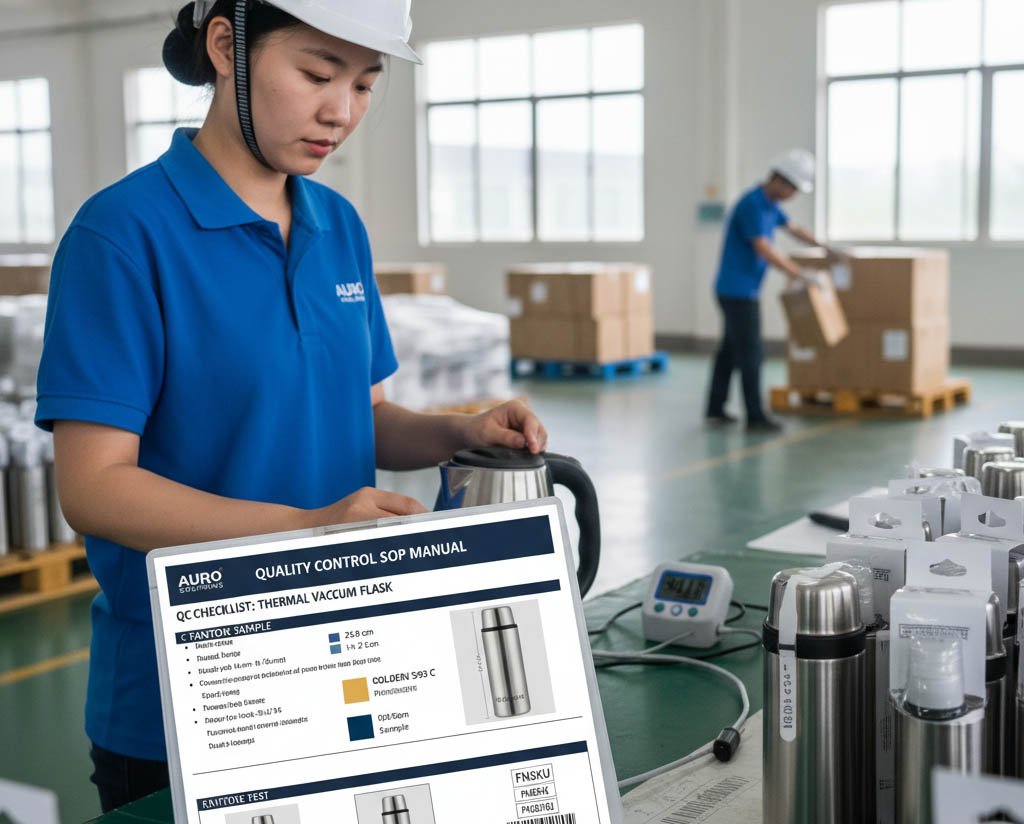
Your QC SOP is your single most important document for ensuring product quality. It removes subjectivity and ambiguity. It’s not enough to tell a factory you want "good quality." You must define what "good quality" means in measurable, objective terms. This document becomes the law. When our inspectors go to a factory for a pre-shipment inspection, they follow this SOP line by line. If a product fails a test defined in the SOP, it is marked as a defect—no arguments, no negotiations. It protects you from the common excuse, "We thought this was acceptable."
Here’s how to structure a QC SOP that leaves no room for error.
The Core Components of a QC Checklist
Your QC SOP should be a highly visual and specific document. We always tell our clients: the more detail, the better.
- Product Requirements:
- Materials & Construction: Specify the exact material grade (e.g., "304 Stainless Steel, not 201").
- Dimensions & Weight: Include all critical measurements with acceptable tolerances (e.g., "25.0 cm +/- 0.2 cm").
- Colors & Finish: Use Pantone color codes. Specify the finish (e.g., "matte powder coating, no scratches or bubbles").
- Packaging & Labeling:
- Retail Box: Specify card thickness, printing type, and include artwork files.
- Shipping Marks: Provide a clear diagram of all required marks on the master carton.
- Barcodes & Labels: For Amazon FBA sellers, this is critical. Specify the exact placement of the FNSKU label.
- On-Site Functional & Safety Tests:
- This section details the tests the inspector must perform at the factory. For a vacuum flask from Yongkang, our SOP would include: "Fill with 95°C water, seal for 12 hours. Water temperature must be ≥ 60°C." Other examples include drop tests for durability, function tests for electronics, or assembly tests for furniture.
Classifying Defects: Critical, Major, and Minor
Not all defects are equal. Your QC SOP must define how to classify them, which is essential for applying the AQL (Acceptable Quality Limit) standard.
- Critical Defects (0 Tolerance): Defects that make the product unsafe, illegal, or could cause serious injury. Example: A sharp metal edge on a children's toy. A single critical defect means the entire shipment fails inspection.
- Major Defects: Defects that affect the product's function, performance, or salability. Example: A coffee grinder that doesn't turn on, or a deep, obvious scratch on the front of the product.
- Minor Defects: Small cosmetic issues that don't affect function and most customers wouldn't notice. Example: A tiny paint speck on the bottom of a device.
We use a table in our SOPs to make this crystal clear for the factory and our inspectors.
| Defect Type | Definition | Example for a Stainless Steel Tumbler | AQL Tolerance |
|---|---|---|---|
| Critical | Unsafe, non-compliant, or harmful. | Sharp metal burr on the drinking lip. | 0 |
| Major | Affects function, usability, or appearance. | Lid does not seal properly (leaks), visible deep scratch. | Usually 2.5 |
| Minor | Small cosmetic flaw, unlikely to cause a return. | A tiny imperfection in the powder coating on the base. | Usually 4.0 |
Inspection Stages: IQC, IPQC, and FQC
Finally, your SOP should specify when inspections happen.
- IQC (Incoming Quality Control): Checking raw materials before production starts. This prevents a whole batch from being made with the wrong steel or plastic.
- IPQC (In-Process Quality Control): Checking during production. This is crucial for catching problems early before thousands of units are made incorrectly. We often do this for complex products.
- FQC (Final Quality Control): The most common type, also known as a Pre-Shipment Inspection (PSI). This is a final check on a random sample of finished goods before you pay the final balance. This is the service most of our clients rely on us for. Our purchasing agent will go to the factory and perform this check based on the AQL standard and your QC SOP.
How Can a Sourcing Agent Help Implement and Enforce These SOPs?
You've spent hours creating the perfect SOPs, but you're thousands of miles away. How do you ensure the factory in China actually follows them instead of taking shortcuts?
A China sourcing agent acts as your on-the-ground team to implement and enforce your SOPs. We bridge the language barrier, conduct on-site audits and inspections, and manage daily communications to ensure your standards are met, turning your documents into reality.
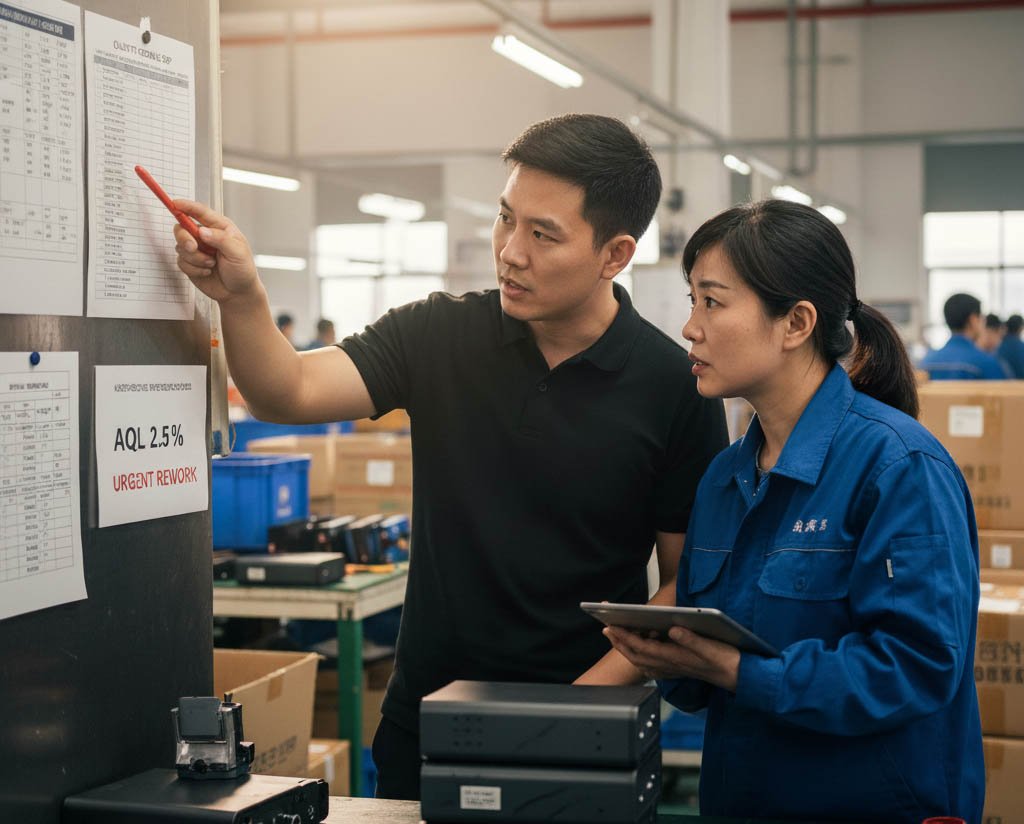
Having a great SOP is only half the battle; enforcement is the other half. This is where the value of a reliable purchasing agent becomes incredibly clear. A document sent over email can be easily ignored or misinterpreted. But when a member of my team from our Yongkang office is physically present at the factory, discussing your QC checklist with the production manager in Mandarin, your SOPs suddenly have authority. We are not just a third-party inspector; we are your local project manager, your advocate, and your problem-solver, integrated into your supply chain.
Let's look at the practical ways a sourcing agent like Auro Sourcing makes your SOPs effective.
Bridging the Communication and Cultural Gap
A major reason SOPs fail is misinterpretation. What seems obvious to you in English might not be clear after being translated or read by a factory manager with a different cultural and technical background. Our job begins by ensuring total alignment.
- SOP Kick-off Meeting: Before production starts, we hold a meeting with the factory's key personnel. We don't just email the SOP; we walk them through it, page by page. We explain the why behind each requirement. For example, we explain that a specific carton thickness is required to survive the rough handling in Amazon's fulfillment centers, not just because you prefer it.
- Clarifying Ambiguity: We use our experience to anticipate potential misunderstandings. A term like "smooth finish" is subjective. We translate that into an objective standard, like "no visible scratches from 30cm away under normal lighting," and get the factory to sign off on a master sample that represents this standard. This proactive communication prevents disputes later.
On-the-Ground Enforcement and Proactive Problem-Solving
This is where having a local team is a game-changer. Your SOPs guide our actions on-site.
- Constant Follow-up: We don't wait for the final inspection. Our team follows up on the production schedule, checks on the raw materials (IQC), and sometimes even visits during production (IPQC). This regular presence reminds the factory that the standards in the SOP are being monitored continuously.
- Real-time Inspection & Correction: Imagine our inspector is at a factory in Zhejiang for a pre-shipment inspection and finds a 15% major defect rate, well above the 2.5% AQL limit. An overseas buyer would just get a "FAIL" report and face a major delay. Our process is different. Our inspector immediately calls the factory manager to the inspection table, shows them the defects against the SOP, and starts negotiating a solution on the spot. We push for a 100% rework of the defective goods and get a firm commitment on a new inspection date, all before we even send you the report. This proactive, on-site problem-solving can save you weeks of back-and-forth emails and delays.
A Single Point of Contact for All Operations
As your business grows, you might be sourcing from multiple factories. Your SOPs for each product might be different. Managing this becomes a full-time job.
- Centralized Management: By working with Auro Sourcing, you have one point of contact. You send us your SOPs, and we handle the complex task of managing each supplier. We track different production timelines, consolidate goods from various factories in our 10,000㎡ warehouse, and arrange for a single, cost-effective shipment.
- Integrated Service: Our service isn't just about finding a supplier or doing one inspection. We manage the entire process based on your SOPs, from initial sourcing and sampling to production follow-up, quality control, warehousing, and final shipment coordination. This one-stop solution ensures the standards you set in your SOPs are maintained across the entire supply chain, giving you predictable cost, quality, and lead times.
Conclusion
SOPs are not just paperwork; they are the blueprint for a scalable, predictable, and profitable sourcing operation. They turn your expectations into clear rules that protect your business and your brand.
Ready to stop gambling on quality and start building a reliable supply chain? Send us your product specifications, and let our team at Auro Sourcing help you create and enforce the SOPs that will drive your success.