

Ocean freight is crucial for the efficient transportation of goods between continents. However, as air freight is fast and trucking is more flexible within a region, ocean freight is the most affordable option for large-scale international trade. In the domain of ocean freight, a key strategic choice a shipper is required to make is whether to ship Full Container Load (FCL) or Less than Container Load (LCL).
This decision not only has a significant impact on the shipping cost. It affects factors such as the reliability of transit time, safety of cargo, handling risk, and complexity of documentation, among others. Most people in business will first choose LCL due to the simplicity of the shipment they have, or FCL due to the perception that it is more professional, without necessarily understanding the operational implications of the two. We have made this detailed guide on FCL vs LCL to help you so that you can make the right decision according to your needs.
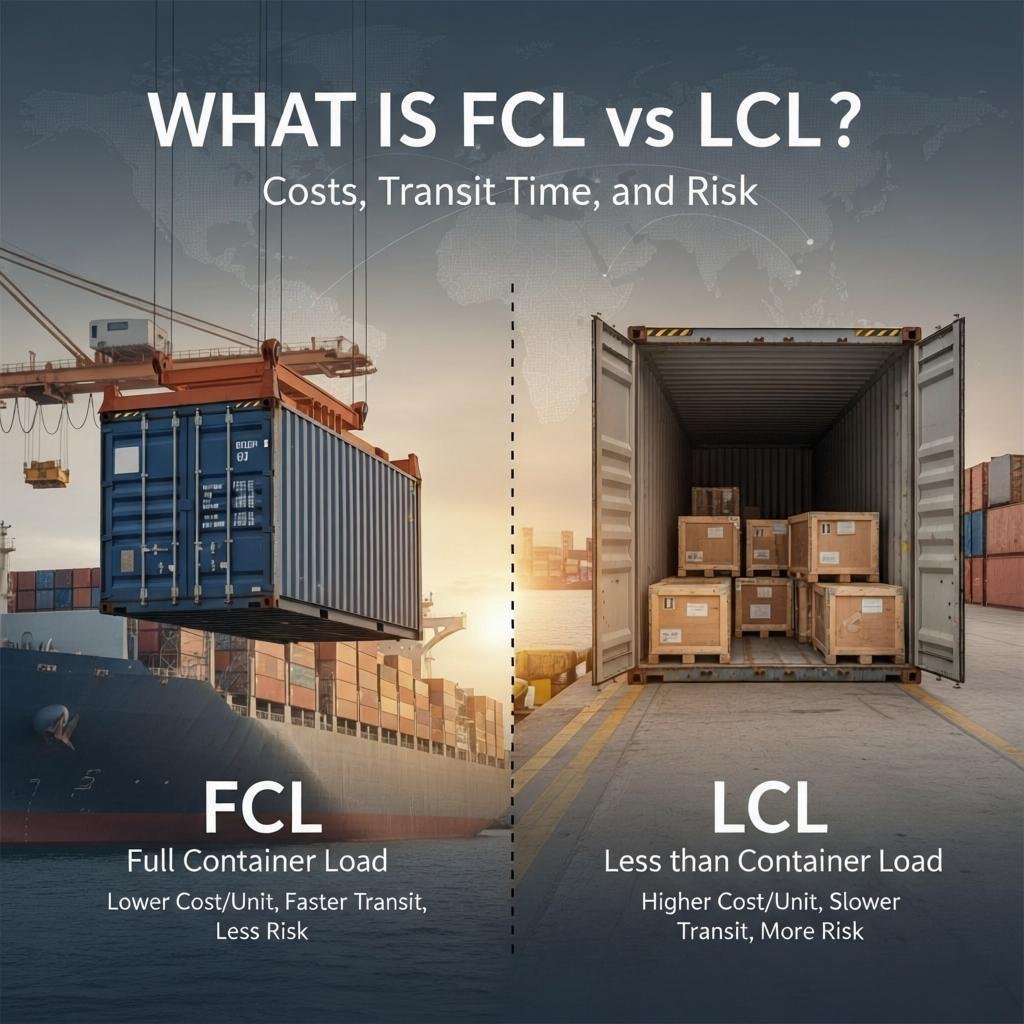
What Is Full Container Load (FCL)?
Full Container Load (FCL) is a shipping process. The shipper has exclusive use of the container, meaning only their designated personnel are authorized to handle loading and unloading. The container is assigned to one shipper, regardless of whether it has been filled or partially filled. After loading the cargo, the container is pressurized, and it is usually not opened again until it reaches the destination.
Operationally, FCL presents a direct flow of goods. The container is typically transported from the shipper's facility or a container yard at the origin to the destination. This minimizes the interference of third parties and reduces unnecessary cargo handling.
Best for: FCL is best suited for manufacturers, wholesalers, and distributors that transport regular, high-value, or time-sensitive goods regularly.
What Is Less Than Container Load (LCL)?
Less than Container Load (LCL) is a shipping service for cargo that is too small to fill an entire container, allowing multiple shippers’ goods to share the same container. A freight forwarder consigns cargo from several shippers into a single container. It is done at a Container Freight Station (CFS), where individual shipments are combined and then loaded into a container.
The basis of LCL is the standard shipping solution. The shippers only pay a fee based on the volume of their cargo in a ship (measured in cubic meters or weight). Although this reduces the barrier to small shipments, it creates additional steps in the logistics chain, such as consolidation, deconsolidation, and coordination among various parties.
Best for: Small businesses, startups, and importers that ship samples or small quantities often use LCL.
When to Use FCL vs LCL: Strategic Shipping Scenarios
Situations Where FCL Is the Best Choice
FCL is especially beneficial when the volume of shipments reaches a certain threshold or you need a full container for the shipment. FCL is usually the economically and operationally wise choice when a shipper is shipping a large amount of cargo that can fill the container to a considerable extent.
FCL is generally preferable when:
- Cargo volume is high
- The shipment value is expensive
- Goods are fragile or sensitive
- Delivery timelines are strict
- Cargo requires special equipment (reefer, flat rack, open-top)
- You want minimal handling and lower risk
- You want faster customs clearance
Situations Where LCL Makes More Sense
LCL works best when the volume of shipment is low and irregular shipping is done. A full container can not be an economical decision when a business is trying new markets or when it is shipping trial orders. LCL enables such shippers to transport goods across national boundaries without incurring high costs.
LCL is suitable when:
- Shipment volume is small
- Budget constraints outweigh transit speed
- You are shipping samples or trial orders
- Cargo does not require special equipment
- You do not ship frequently enough to justify full containers
Volume Thresholds: When FCL Becomes More Cost-Effective Than LCL
Understanding the Cost Crossover Point
The most widespread myth about ocean freight is that LCL shipments are necessarily cheaper for smaller shipments, and FCL shipments are necessarily more expensive. In fact, there is an evident crossover where FCL is more cost-effective, even when the container is not fully loaded.
Although the precise tipping point varies by trade route and prevailing market rates, the industry outlook indicates the following cubic meter (CBM) values.
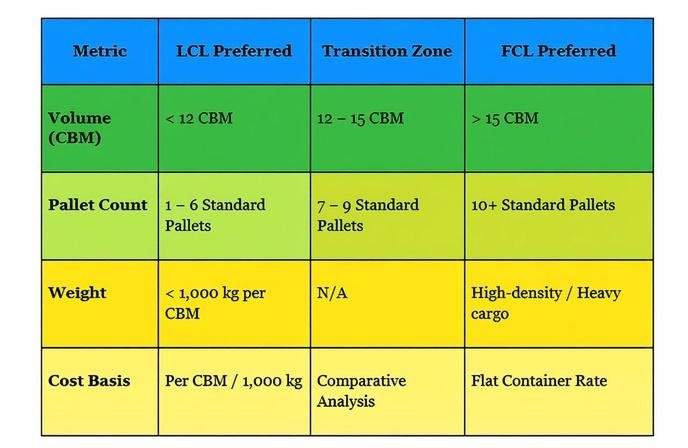
| Metric | LCL Preferred | Transition Zone | FCL Preferred |
|---|---|---|---|
| Volume (CBM) | < 12 CBM | 12 – 15 CBM | > 15 CBM |
| Pallet Count | 1 – 6 Standard Pallets | 7 – 9 Standard Pallets | 10+ Standard Pallets |
| Weight | < 1,000 kg per CBM | N/A | High-density / Heavy cargo |
| Cost Basis | Per CBM / 1,000 kg | Comparative Analysis | Flat Container Rate |
LCL prices are directly proportional to volume since the fee is based on cubic meters or metric tons. Moreover, every shipment will incur costs for handling at both the source and destination. These expenses are rapidly summed up as the shipment size increases.
Industry expert suggests that after a shipment reaches approximately 10 to 15 cubic meters, the combined cost of an LCL can be the same as, or even greater than, that of a 40-foot container. After this, FCL is nearly always a better value.
Why Volume Is Not the Only Factor when Choosing FCL Vs LCL
Although the volume is imperative, it is not the only one. The decision can be influenced by the nature of the cargo, the trade route, port congestion, and seasonal fluctuations in rates. LCL surcharges can also skyrocket in specific congested routes, further pushing the crossover point down.
Competent shippers are not considering the quoted freight rate alone, but rather the total landed cost, encompassing handling, delays, and risk exposure.
Cost Structure of FCL and LCL
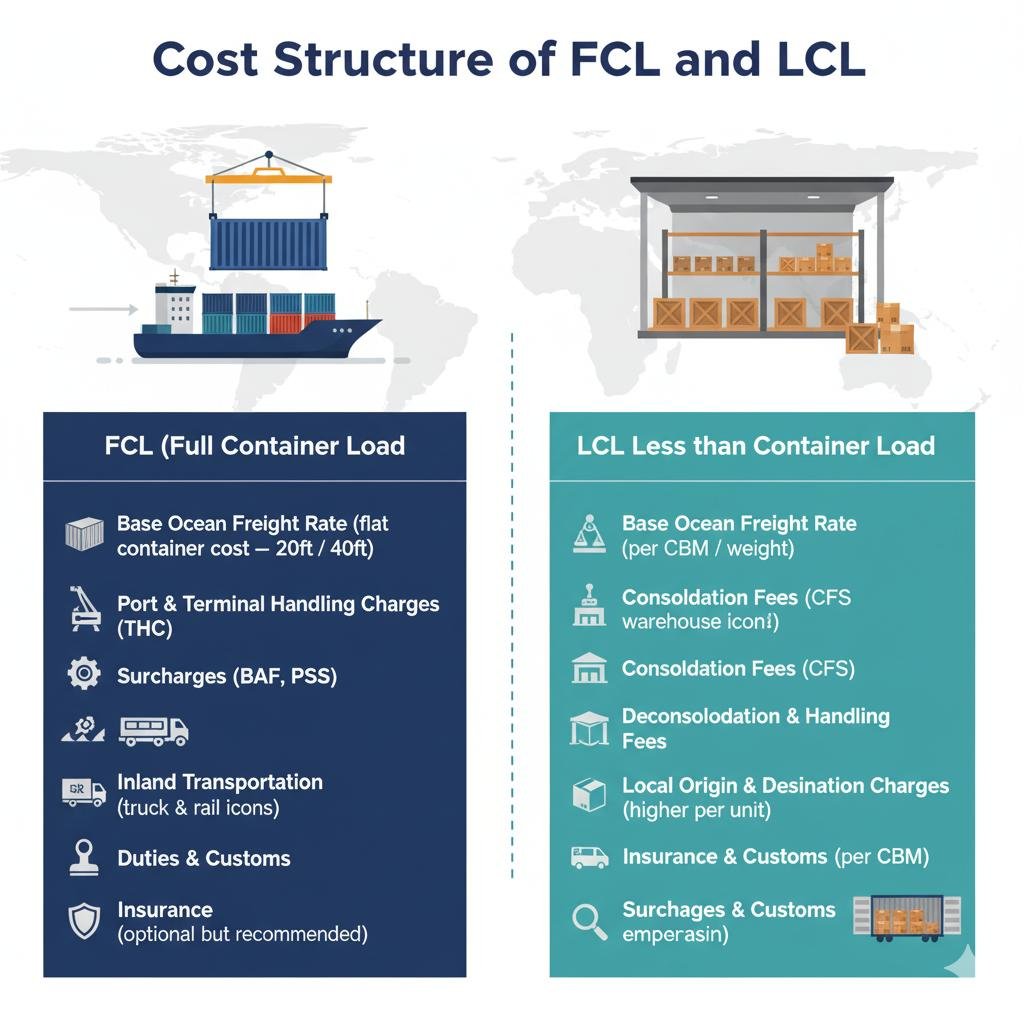
FCL Cost Structure Explained in Detail
The FCL pricing is based on the concept of booking a whole container, whether it is fully loaded or not. The primary cost elements tend to be more predictable and cheaper per unit of cargo when compared to larger shipments under LCL.
- Base Ocean Freight Rate: The flat charge for a container (e.g., 20ft or 40ft) over a specific route. This is the core cost.
- Port and Terminal Handling Charges (THC): Handling charges that are charged at the origin and destination ports.
- Surcharges: For fuel price increases, the Bunker Adjustment Factor (BAF) or Peak Season Surcharges (PSS).
- Inland Transportation: This refers to the expenses incurred in moving the container, either by truck or rail, between the seller's premises and the port of origin, as well as between the port of destination and the buyer's location.
- Duties and Customs: Duty and customs clearance expenses.
- Insurance: Cargo insurance is optional but very strongly recommended as a percentage of the cargo value.
LCL Cost Structure Explained in Detail
LCL prices are calculated using either the space your cargo occupies (in CBM) or its weight. LCL has more handling:
- Base Ocean Freight rate: This is charged on a per CBM (or weight) basis.
- Consolidation Fees: Fees at the origin Container Freight Station (CFS) to combine your cargo with other shipments in one container.
- Deconsolidation and Handling Fees: Fees at the destination CFS to separate your cargo from other containers and to reassemble it for final delivery.
- Local Charges: LCL destination and origin handling charges are typically charged per unit more than for bulk shipments (due to the multiple handling operations).
- Surcharges & Customs: Surcharges and customs are also imposed, with significant charges typically applied per CBM.
Transit Time Differences: Speed, Reliability, and Predictability
Why FCL Is Faster?
The FCL shipments have a direct logistic flow. Upon loading and sealing the container, it is transported through the port and onto the vessel. No other cargo is waiting to be loaded. Upon arrival, it can be discharged and released without delay in deconsolidation.
This automated procedure leads to a reduction in door-to-door transit time and a decrease in disruptions. FCL is a definite plus to any type of supply chain that relies on precise delivery schedules.
Why is the LCL Transit Time Longer?
Shipments of LCLs must wait until there is sufficient freight to fill a container, which also creates delays at the point of origin. The container has to be unloaded, sorted, and deconsolidated before the individual shipment's release at the destination.
Any delay in the delivery of a single shipment, like the lack of documents or customs inspections, may result in the delay of all shipments in the container. This renders LCL less predictable.
Handling and Touchpoints: Operational Differences That Matter
Handling in FCL Shipments
The number of times that FCL cargo undergoes in the shipping process is fewer. The shipper or their agent does the loading, securing, and sealing of the container. As soon as it is closed, the container remains closed until it reaches its destination.
This minimizes physical handling, thereby reducing the likelihood of physical damage, misplacement, or contamination. It also eases the monitoring and responsibility.
Handling in LCL Shipments
LCL cargo is moved through the process of consoling and deconsoling several times. Both movements present a risk of forklift damage, incorrect stacking, or administrative mistakes.
Since shipments of various goods are stored in the same space, there is a risk of exposure to incompatible goods, which can lead to damage or contamination.
Risk of Damage or Loss
Risk Profile of FCL
FCL presents a significantly better risk profile due to its dedicated container handling and limited handling. The most suitable goods that can be safeguarded under this model are those of high value, delicate, or sensitive nature.
Risk Profile of LCL
The use of shared space, handling, and reliance on the compliance of other shippers increase the risk of damage and loss to LCL shipments. These risks are highly encouraged to be reduced with insurance.
What Are The Documents Required for FCL and LCL?
Both FCL and LCL deliveries require typical business paperwork, including a commercial invoice, packing list, and bill of lading. These papers form the basis for the clearance and release of the cargo.
The complexity of documentation in LCL and FCL
The documentation for FCL is usually straightforward, as there is only one shipper and consignee.
LCL documentation is more complicated, and several house bills of lading are associated with a single master container, thereby increasing the likelihood of errors and delays.
Check out the differences in documents required (international shipment) for FCL vs LCL:
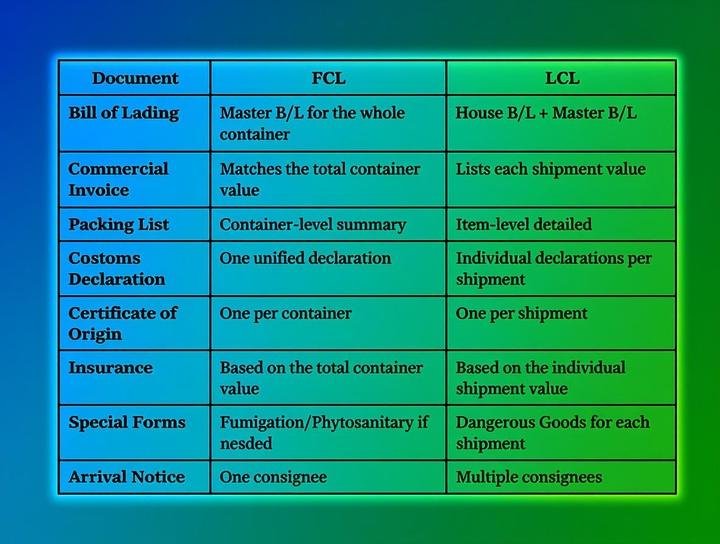
| Document | FCL | LCL |
|---|---|---|
| Bill of Lading | Master B/L for the whole container | House B/L + Master B/L |
| Commercial Invoice | Matches the total container value | Lists each shipment value |
| Packing List | Container-level summary | Item-level detailed |
| Customs Declaration | One unified declaration | Individual declarations per shipment |
| Certificate of Origin | One per container | One per shipment |
| Insurance | Based on the total container value | Based on the individual shipment value |
| Special Forms | Fumigation/Phytosanitary if needed | Dangerous Goods for each shipment |
| Arrival Notice | One consignee | Multiple consignees |
Container Types and Sizes
FCL Container Options
FCL shipments may be made with a variety of container types, including general 20- and 40-foot containers, high-cube containers, and other specialized equipment, such as reefers and flat racks.
Weaknesses of LCL Containers
LCL deliveries are limited to usual dry containers. There is no special equipment, as many shippers use containers.
Loading Methods: Stuffing and Unstuffing Processes
The shipper controls the loading process for FCL shipments and must meet specific weight distribution and cargo tightening requirements. This level of control enhances safety and compliance.
The consolidator loads cargo in LCL, and the shipper has limited control over how their shipment is packed into the container.
Origin and Destination Processes
FCL Flow: CY to CY (Container Yard (CY) at origin to Container Yard (CY))
FCL shipments pass through container yards without a specific cut-off time and quicker release processes.
LCL Flow: CFS to CFS (Container Freight Station (CFS) at origin to CFS at destination.)
The process of LCL shipments requires additional procedures at container freight stations, such as consolidation and deconsolidation, which prolong the timeline and complicate the process.
Incoterms Impact on FCL vs LCL
How Incoterms Shape Responsibility
Some of the Incoterms will be more compatible with FCL because of the more defined responsibility boundaries. LCL may make it hard to distribute responsibilities, especially when using EXW and DDP conditions.
Customs Clearance Differences
FCL Customs Clearance
FCL orders are cleared through customs more quickly since they have a single consignee and a single declaration.
LCL Customs Clearance
Containers are allowed to be detained in case some consignments in the container have issues, and not all consignees can be cleared.
Scheduling and Reliability: How FCL and LCL Differ in Real-World Ocean Freight Operations
The reliability of scheduling is one of the least considered aspects in the selection of FCL and LCL shipping. Although it is dependent on the same ocean carriers and ships, the manner in which cargo is booked, consolidated, and released produces significant differences in predictability and consistency.
FCL Scheduling: Direct Bookings and Greater Control
FCL shipments are reserved with shipping lines for a specific container on a particular vessel. After a reservation is made, the shipping is allocated space on that voyage, with equipment availability and ship acceptance rules. This is a direct relationship, which places FCL shipment in precedence over consolidated cargo.
Since the container has one shipper, the cargo does not need to wait for the other cargo to be available. The shipper is cleared through the gate and loaded onto the planned vessel as long as he/she clear the port cut-off time. The effect of this is greater compliance with schedules and fewer unforeseen delays.
The other benefit of FCL is that there is less exposure to rollovers, whereby cargo is rolled over to a later ship due to overbooking. Although rollovers may still be possible in tight markets, the carriers tend to give preference to FCL containers, particularly those of contractors or high-volume shippers.
LCL Scheduling: Groupage Dependencies and Less Predictability
The LCL deliveries are based on a groupage model. The shipment of various consignments will not start with the shipper alone. The shipment may take days to arrive, even if the rest of the cargo is ready.
The LCL cut-off times tend to be earlier than FCL because freight forwarders require time to collect the cargo, verify the documentation, load the shipments onto the container, and consolidate them. Missing the cut-off can cause the shipment to be rolled over to the next sailing, potentially delaying it by a week or more.
Reliability can also be compromised further at the destination. If any shipment within the container encounters issues related to customs, missing documentation, or inspection holds, the entire container will be subject to delay, affecting all consignees.
This common dependency is one of the most significant drawbacks of LCL in terms of scheduling reliability.
Space Availability and Peak Season: Market Conditions and Their Impact on FCL And LCL
FCL Space Availability at the High Season
Ocean freight is highly congested during peak shipping seasons, including pre-holiday rushes, back-to-school periods, and the pre-Chinese New Year rush. During these periods, carriers tend to prefer FCL bookings, particularly for shippers with long-term contracts or high volumes.
The reason carriers like FCL is that it makes operations easier and remains profitable in terms of per-container revenue. Consequently, FCL shippers have a higher chance of securing bookings than LCL shippers, provided they make their bookings in advance and deal with business partners they trust.
The congestion during peak season, however, still may affect FCL through:
- Shortages in equipment (empty containers)
- Port congestion
- Prolonged gate-in delays.
Nevertheless, FCL shipments tend to move more quickly once space has been secured.
LCL Space Constraints in Peak Season
The shipment of LCL is more difficult during the high season. Consolidators may not have sufficient space to carry groupage cargo, particularly when carriers focus on FCL bookings. This can result in:
- Decreased LCL sailing frequency.
- Growing consolidation slows down.
- Higher LCL surcharges
At the worst, LCL cargo can take weeks to find space, especially in high-demand trade lanes. This renders LCL an unsuitable choice for time-sensitive deliveries during peak times.
Insurance Issues: Cargo Protection in FCL and LCL
Insurance for FCL Shipments
The inherent risk in FCL shipments is typically lower, as there are fewer handling points and containers are used exclusively for the shipment. But it does not mean that the cargo insurance is not needed. There will always be risks, such as vessel accidents, weather damage, port incidents, or theft.
Since the shipper has control over loading and sealing, insurers consider FCL shipments less risky, which may lead to improved insurance provisions. The coverage is typically provided on a warehouse-to-warehouse basis, which includes delivery to the destination.
Insurance Nuances for LCL Shipments
LCL shipments are associated with a greater risk profile due to the use of interchangeable containers, recurring or frequent handling, and potential contact with other cargo. More common are damages due to changes in loads, leakages in adjacent consignments, or misplacement in deconsolidation.
LCL shipments insurance should include:
- Higher probability of partial damage
- Potential delays affecting delivery deadlines
- Shared liability complications
It is highly recommended that shippers obtain a detailed cargo cover for LCL shipments, as the carrier's liability is typically insufficient to reflect the actual value of the cargo.
Packaging Requirements: Meeting Standards for FCL and LCL
Packaging Standards for FCL Cargo
Shipments in FCL benefit from controlled loading conditions, enabling customized packaging options. Shippers can plan the pallet, the size of crates, and the stacking method to maximize the use of containers.
Although packaging must still withstand ocean conditions such as humidity, vibration, and stacking pressure, FCL cargo does not experience the external forces that other shipments do. This enables the more flexible packaging designs, particularly of uniform or palletized goods.
Packaging Standards for LCL Cargo
The packaging of LCL shipments needs to be more robust and resilient in terms of mixed cargo conditions. Products can be placed on top of other, heavier, or oddly shaped products, which can result in compression or impact damage.
The essential LCL packaging requirements comprise:
- Robust outer cartons or crates
- Secure palletization
- Clear and durable labeling
- Compliance with ISPM 15 (global regulation for treating wood packaging materials)
- Barcodes and shipment markings for identification
Damage in LCL shipments is primarily caused by poor packaging, making it essential to prepare them accordingly.
Cost Optimization Tips: Reducing Spend While Improving Efficiency
Optimizing FCL Costs Through Load Planning
Load planning is one of the most effective methods for cost optimization in FCL. Shippers can also utilize containers to their full capacity and minimize unused space by ensuring the cargo size and weight are set in a way that maximizes their use.
This may include:
- Adjusting carton sizes
- Using stackable pallets
- Weight distribution.
- Selecting the correct type of containers.
FCL loads that are planned help to minimize the number of extra containers used and decrease the unit shipping price.
Comparing LCL vs FCL at the Tipping Point
For shipments of less than 1015 CBM, shippers must always consider the total landed cost, not just the ocean freight cost. The CFS fees, handling charges, and delay risks usually make it clear that FCL is the more advantageous choice- even though some space in the containers will remain unused.
Strategic shippers periodically review shipments and shipment data from past periods to identify trends that benefit from switching between FCL and LCL, resulting in long-term savings and improved reliability.
Common Pitfalls: Mistakes That Increase Costs and Delays
LCL Pitfalls
- Hidden fees, such as CFS, THC, and deconsolidation charges increase costs
- Misdeclared dimensions or weight can lead to re-rated freight
- Missed cut-off times cause shipment delays
- Documentation errors in invoices, packing lists, or HS codes create customs issues
- Inadequate packaging increases the risk of cargo damage
FCL Pitfalls
- Underutilized containers raise the cost per unit shipped.
- Improper loading or weight distribution can cause safety issues and cargo damage.
- Documentation errors result in customs delays.
- Equipment shortages or peak-season congestion lead to shipping delays.
- Neglecting insurance exposes high-value cargo to financial risk.
Missed Cut-Offs and Documentation Errors
The aforementioned issues, including missed cut-off times and incomplete documentation, may result in delays in shipping to subsequent sailings. In LCL, this may result in waiting for the next consolidation cycle, significantly increasing transit time. For FCL, errors can delay the shipment to the next available sailing, potentially impacting delivery schedules. Misplaced HS codes may also lead to customs inspections or penalties, which can delay both FCL and LCL deliveries.
Real-World Examples: Cost and Time Comparisons
Example 1: 1215 CBM Shipment Comparison
A shipper exporting consumer goods weighing 14 CBM has two options: LCL or a 20-foot FCL container.
At LCL, the freight import and delivery fee is charged per CBM, including origination and destination CFS, and a long transit time due to consolidation.
The overall prices are close to or more than the prices of a 20’ FCL, and the transit time is 7- 10 days longer. By selecting FCL, the shipper can obtain a quicker transit, lower risk, and easier customs clearance - at a similar or lower total expense.
Case 2: A Time-Sensitive Electronics Shipment.
The shipment of electronics with a high unit price and 8 CBM is appropriate in LCL. Nevertheless, the shipper chooses FCL due to the deadlines for deliveries and its sensitivity to risks.
The predictability of delivery, minimized damage risk, and ease of managing the customs process are also beneficial to the shipper because the container is not fully utilized, thereby avoiding disruptions to complex downstream operations, which are expensive to handle.
Conclusion
It can be challenging for beginners to decide between FCL and LCL. With proper knowledge of all aspects related to this shipping process, it becomes easier to choose the right method.
Assessing the entire operational impact of FCL versus LCL, businesses will have an advantage in reducing risk, enhancing delivery performance, and gaining a competitive edge in global commerce.