

Struggling to tell if a Chinese supplier is legitimate? A business license holds the key, but it's a puzzle if you can't read Chinese. Mistakes here can be costly.
A Chinese business license verifies a company's legal status. Key fields to check are the Unified Social Credit Code for online database lookups, the company name to see if they are a trader or factory, the legal representative, and the business scope to confirm their approved activities.
This initial check is your first line of defense against scams and is a critical step in your due diligence process. But verifying a supplier goes much deeper than just one document. I've spent over a decade in Yongkang helping clients vet suppliers, and I can tell you that what the license doesn't say is just as important as what it does. Let's break down how you can use this document to protect your business and make smarter sourcing decisions.
What Are the Key Fields on a Chinese Business License?
You received a supplier's business license, but it's an intimidating document filled with Chinese characters. Ignoring it is like signing a contract blindfolded, risking your deposit on a company that might not even be a manufacturer.
Focus on four critical fields: the Unified Social Credit Code (统一社会信用代码), Company Name (名称), Legal Representative (法定代表人), and Business Scope (经营范围). These sections provide the most vital data for your initial verification of any potential Chinese partner.
Let's dive deeper into what these fields mean. When a potential supplier in Yongkang or elsewhere sends me their license, these are the exact things I look for. Understanding this structure is fundamental. I've created a simple table to help you map the Chinese terms to their English meaning and significance.
| Chinese Term (Pinyin) | English Translation | Why It's Important |
|---|---|---|
| 统一社会信用代码 (tǒng yī shè huì xìn yòng dài mǎ) | Unified Social Credit Code | This 18-digit code is the single most important piece of information. It's a unique ID for the company, used for online verification in the official government database. |
| 名称 (míng chēng) | Company Name | The name reveals location, trade name, industry, and type. For example, "永康市XX贸易有限公司" tells you it's in Yongkang City (永康市) and is a Trading Co., Ltd. (贸易有限公司). Look for "生产" (shēng chǎn - production) for factories. |
| 法定代表人 (fǎ dìng dài biǎo rén) | Legal Representative | This is the individual legally empowered to sign contracts on behalf of the company. The name here should match the person signing your POs and agreements. |
| 经营范围 (jīng yíng fàn wéi) | Business Scope | This is a crucial section. It lists all government-approved activities. You must check for words like "生产" (production), "制造" (manufacturing) versus just "销售" (sales), "批发" (wholesale), or "进出口" (import/export). A company without "production" in its scope is almost certainly a trading company, not a factory. |
| 注册资本 (zhù cè zī běn) | Registered Capital | This indicates the capital amount the shareholders have committed. While a higher number can suggest a larger scale, it's not a guarantee of financial health, as it's often "subscribed" rather than fully "paid-in." |
When I analyze a license for a client, the Business Scope is where I spend the most time. A supplier might claim to be a "leading manufacturer," but if their license only lists "sales of hardware products," I immediately know they are a middleman. This doesn't mean they are a bad partner, but it changes the entire negotiation and verification process. Transparency starts here.
How Do You Use the Business License for Online Verification?
You have the supplier's business license, but how can you be sure it hasn't been altered or faked? A well-made Photoshop file can look convincing, and trusting it without verification is a massive risk.
Use the 18-digit Unified Social Credit Code to check the company's status on China's official National Enterprise Credit Information Publicity System (NECIPS). The website (www.gsxt.gov.cn) provides real-time, official data that you can cross-reference with the license provided.
This process might seem technical, but it's a straightforward check that I perform for every new potential supplier. It's your direct window into the government's official records. Here’s a simple, step-by-step guide to doing it yourself.
Step 1: Locate the Unified Social Credit Code
First, find the 18-digit alphanumeric code on the business license. It is always labeled "统一社会信用代码". Copy this code accurately. It's the key that unlocks the official database entry for your supplier.
Step 2: Go to the Official NECIPS Website
Open your web browser and navigate to www.gsxt.gov.cn. This is the official government portal. The site is in Chinese, so I recommend using Google Chrome and its built-in translation feature. While the translation isn't perfect, it's good enough to navigate the site and understand the key information.
Step 3: Enter the Code and Complete the Verification
On the homepage, you'll see a prominent search bar. Paste the 18-digit code into this bar. After hitting enter, you'll likely face a simple CAPTCHA puzzle, such as a slider or clicking on characters in a specific order. This is to prevent automated bots from scraping the site. Once you solve it, you'll be taken to the company's detailed information page.
Step 4: Cross-Check the Information
Now, compare the information on the webpage with the business license you were given. You must confirm that the Company Name, Legal Representative, and Business Scope are identical. Also, check the company's status. If you see red characters or a warning mentioning "经营异常名录" (List of Abnormal Operations), it's a major red flag, indicating the company has unresolved legal or administrative issues. I once helped a client who was about to place a large order. A quick check revealed their potential supplier was on this "abnormal" list for failing to submit annual reports. We immediately disqualified them and found a more reliable partner in Yongkang, saving the client from a potential disaster.
Are There Limitations to Relying Solely on a Business License?
You've successfully verified the business license online. Does this mean you've found a great supplier? Not necessarily. This verification confirms they are a legal entity, but it doesn't guarantee they are a competent or reliable partner.
Yes, there are significant limitations. A business license does not verify a company's actual production capacity, quality management systems, financial stability, or export experience. It is a starting point for due diligence, not the final conclusion.
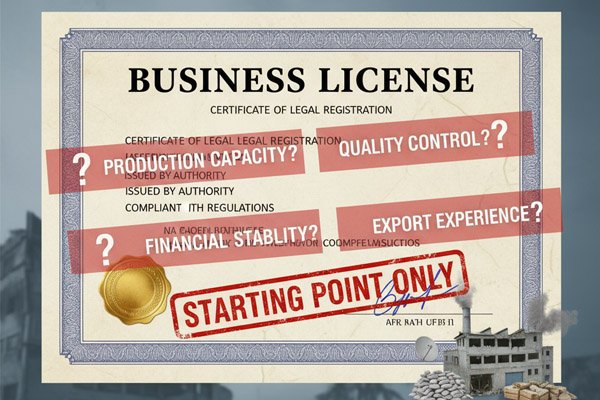
A legally registered company can still be on the brink of bankruptcy, produce low-quality goods, or have terrible communication. I've seen it happen many times. The business license tells you they exist legally, but it doesn't tell you if they can actually deliver on your requirements. This is where deeper, on-the-ground verification becomes non-negotiable for serious importers.
It Doesn't Confirm They Are the Manufacturer
The most common trap is believing a company with "production" (生产) in its business scope is the actual factory making your product. Many trading companies are legally registered with this scope but outsource 100% of their production to smaller, often unvetted workshops. The license doesn't show their production line, machinery, or number of workers. Only an on-site audit can confirm if they have the manufacturing infrastructure they claim.
It Doesn't Reveal Their True Reputation
A business license is a legal document, not a report card. It won't tell you if the supplier has a history of shipping delays, quality fade on repeat orders, or poor after-sales service. This information comes from checking references, industry reputation, and having a local presence like we do at Auro Sourcing, where we hear about which factories are reliable and which are problematic.
It Doesn't Guarantee Quality Systems
The license says nothing about whether the supplier is ISO 9001 certified, if they have an incoming raw material inspection process (IQC), or how they conduct final product inspections (FQC). A reliable partner will have a documented quality management system. A piece of paper from the government doesn't prove that. You have to see it for yourself or have a trusted agent do it for you.
How Can a Sourcing Agent Help with Deeper Supplier Verification?
You are thousands of miles away, and conducting these deep-level checks on your own is impractical, if not impossible. Trying to save money by skipping this step is a gamble that could cost you your entire investment when a production run goes wrong.
A China sourcing agent like Auro Sourcing acts as your team on the ground. We go beyond paperwork to conduct physical on-site audits, assess real production capabilities, verify certifications at the source, and interview key factory personnel to provide a complete risk profile.
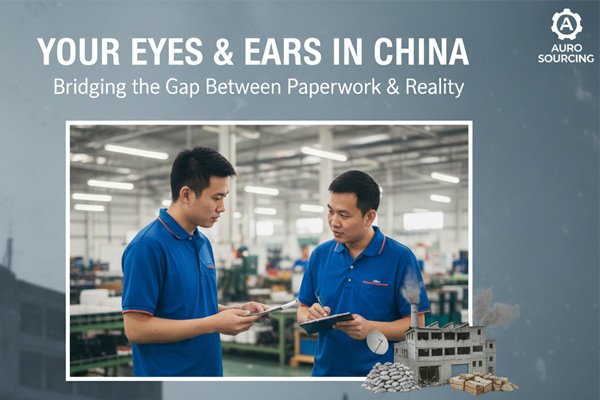
Verifying a business license is step one. What we do at Auro Sourcing is cover steps two through ten. We bridge the gap between what a supplier claims on paper and what their reality is on the factory floor. For our clients, this provides peace of mind and ensures they partner with suppliers who are not just legally registered, but truly capable.
On-Site Factory Audits
This is the most critical service we provide. When we audit a factory in or around Yongkang, we don't just take a tour. We follow a comprehensive checklist. We verify the number and condition of the machines they claim to own. We observe the number of workers on the assembly lines. We assess the cleanliness and organization of the warehouse. We take detailed photos and videos, giving our clients a virtual tour so they can see exactly what we see. This process quickly separates the real manufacturers from the trading companies and unqualified workshops.
Quality System and Certification Assessment
Many suppliers will send you a PDF of an ISO 9001 certificate. We don't just accept it. We check the certificate's validity with the issuing body. More importantly, we audit their quality system in practice. We ask to see their QC records for incoming raw materials (IQC), their in-process checks (IPQC), and their final inspection reports (FQC). A factory with a robust system will have this documentation readily available. A weak factory will make excuses.
Verifying Social Compliance and Export History
For clients selling to large retailers, social compliance audits (like BSCI) are crucial. We can conduct preliminary checks to see if a factory meets basic standards for worker safety and welfare. Furthermore, we verify their export experience. We ask for redacted copies of Bills of Lading (B/L) to prove they have experience shipping to our client's target market, be it North America, Europe, or Australia. This confirms they understand the specific compliance and documentation requirements for that region.
Conclusion
Verifying a Chinese business license is a crucial first step, but it only confirms legal existence. True supplier security comes from comprehensive, on-the-ground due diligence that paperwork alone cannot provide.
Ready to move beyond basic checks? Send us your potential supplier's information, and let our team at Auro Sourcing conduct a professional verification or a full factory audit for you.