

Hidden fees from sourcing agents can destroy your project budget. This lack of transparency often leads to bad partnerships, putting your entire investment at risk. I'll demystify the pricing models for you.
A China sourcing agent typically charges using one of three main models: a percentage-based commission (3-10% of order value), a flat fixed fee for specific services, or a hybrid model. The right choice depends entirely on your order size, complexity, and required level of involvement.

Navigating these pricing structures is one of the first and most critical steps in finding a reliable purchasing agent. A mismatch between your project needs and your agent's fee model can create friction, misaligned incentives, and ultimately, financial loss. In my 13+ years of experience here in Yongkang, I've seen it all. The goal isn't just to find the cheapest agent; it's to find a partner whose pricing aligns with your success. Let's break down each model so you can confidently choose the right one for your business.
What is the Commission-Based Model and When Should You Use It?
You need ongoing support, but percentage fees feel unpredictable. Paying a commission can align your agent's interests with yours, but only if the structure is transparent and fair for both sides.
A commission is a percentage of your total product order value (usually the FOB price). It’s ideal for larger, recurring orders where your sourcing agent manages the entire process—from supplier negotiation and production follow-up to quality control and shipment. Common rates range from 3% to 10%.

Diving Deeper into Commission Fees
The commission-based model is the most traditional structure for a full-service purchasing agent. The logic is simple: the agent’s earnings are tied directly to the size of your order. This can be a powerful motivator for them to secure you the best possible outcome. I've found this model works best for established importers and e-commerce sellers who place consistent, high-volume orders. For example, a client ordering $200,000 worth of vacuum flasks from our network in Yongkang would find a 4% commission ($8,000) a very reasonable cost for end-to-end management.
However, the model isn't without its potential pitfalls. The key is transparency. You must ensure the agent isn't inflating the factory's price just to increase their commission. A trustworthy agent will always share the actual factory proforma invoice (PI) with you. At Auro Sourcing, we make this a standard practice. We show you the real factory cost and then add our commission on a separate line item. This builds trust and ensures you know exactly what you're paying for.
Pros and Cons of the Commission Model
| Pros | Cons |
|---|---|
| Aligned Interests: The agent is motivated to manage a successful order from start to finish. | Potential for Inflated Prices: Unscrupulous agents might hide the real factory price to increase their cut. |
| Scalable: The fee naturally scales with your business growth. No need to renegotiate for every order. | Not for Small Orders: A 5% fee on a $2,000 order is only $100, which is not enough to motivate an agent. |
| Comprehensive Service: It usually covers all services, including sourcing, negotiation, follow-up, QC, and logistics. | Minimum Commission: Most agents have a minimum commission amount, which can be high for small businesses. |
I always advise clients with small or highly complex, low-volume orders to consider other models. But for businesses ready to scale with a reliable China sourcing partner, a transparent commission structure is often the most efficient and effective path forward.
Is a Fixed-Fee Sourcing Agent Right for Your Project?
Afraid of commissions that grow with your order size? A fixed fee offers predictability but might not cover all the unexpected issues that can arise during production in China.
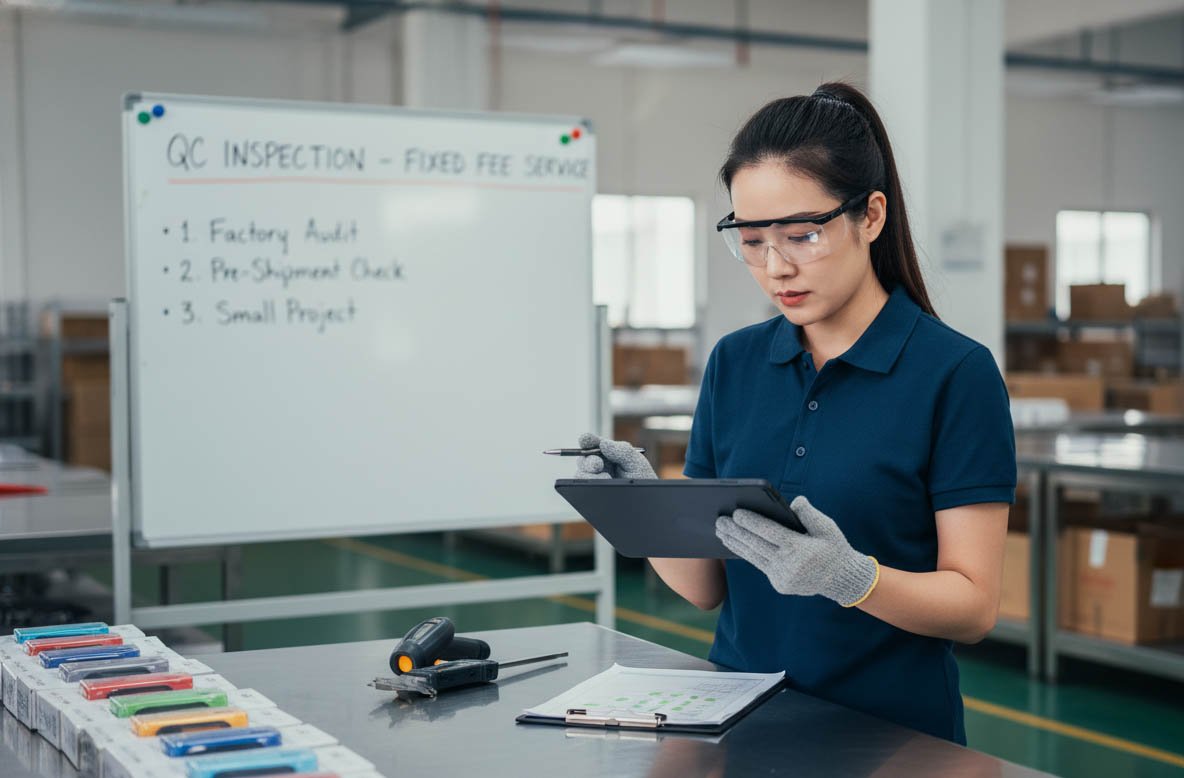
A fixed-fee model involves paying a flat rate for a clearly defined scope of work. It’s best for one-off tasks like a single factory audit, a pre-shipment inspection, or managing a small, simple project from start to finish. It provides excellent cost control for specific needs.
Diving Deeper into Fixed Fees
The fixed-fee model is all about paying for a specific, measurable result. This is perfect for experienced buyers who can manage most of their supply chain but need on-the-ground support for critical tasks. It's also a great entry point for startups or first-time importers who want to test an agent's capabilities without a long-term commitment. I've helped many new Amazon sellers by providing a simple, fixed-fee service. For instance, a client might have found a potential supplier on Alibaba but needs professional verification. For a flat fee of, say, $300, my team and I can conduct an on-site factory audit here in Zhejiang and provide a detailed report with photos and videos. This small investment saves them from potentially losing thousands on a fraudulent or incapable supplier.
Common Fixed-Fee Services
Here are some typical services offered for a flat rate:
- Supplier Sourcing & Verification: We charge a fee to research, contact, and vet a shortlist of 3-5 qualified factories based on your product specs.
- Quality Control Inspections: A per-person, per-day rate (e.g., $250/day) for conducting Initial Production Checks (IPC), During Production Inspections (DPI), or Pre-Shipment Inspections (PSI).
- Sample Consolidation & Forwarding: If you're sampling from multiple suppliers, we can collect them at our 10,000㎡ warehouse, inspect them, and ship them to you in one package for a service fee.
- Project Management: For a small, well-defined project, we might quote a single project fee that covers all our involvement from start to finish.
The major benefit is cost certainty. You know the exact cost before work begins. The main drawback is a lack of flexibility. If a simple QC inspection reveals major problems that require multiple re-inspections or lengthy negotiations with the factory, those extra hours may fall outside the original scope, requiring additional fees. It's crucial to have a clear agreement on what the fixed fee covers and what constitutes "extra work."
How Can a Hybrid Pricing Model Offer the Best of Both Worlds?
Commission feels risky and fixed fees too rigid. You need a flexible solution that adapts to your project's unique needs, especially for new product development, without surprise costs.
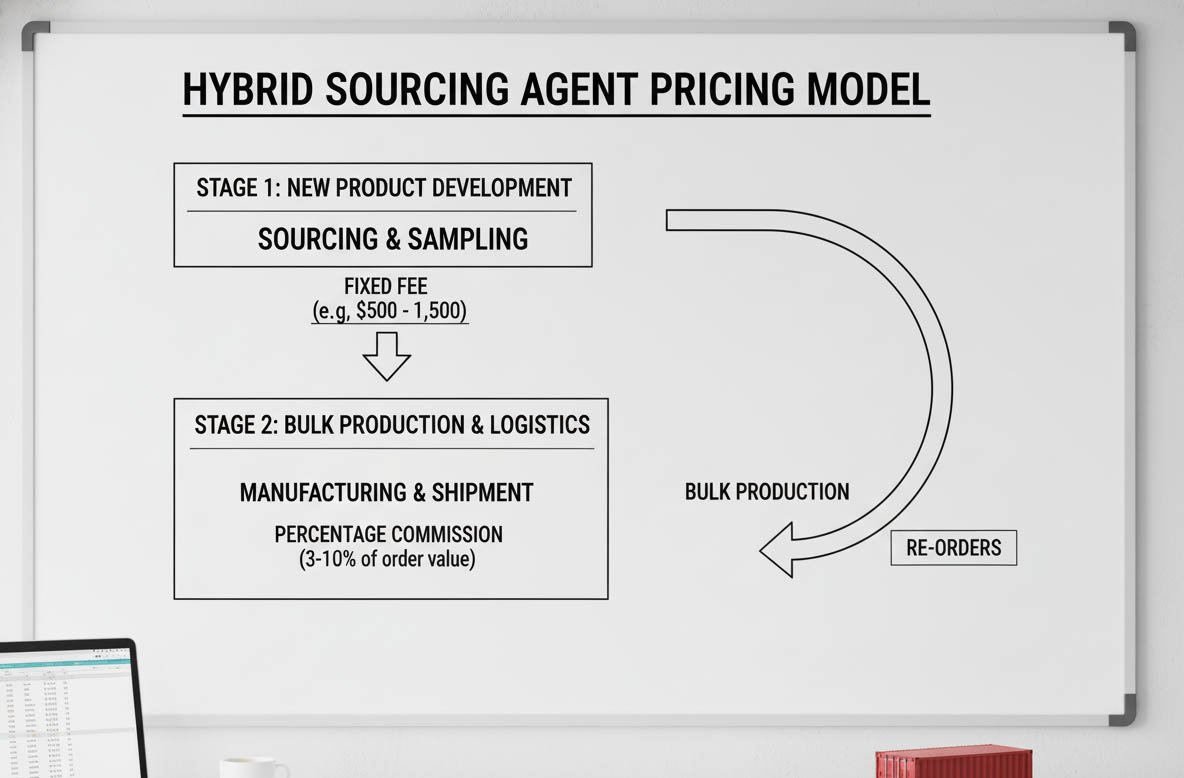
The hybrid model combines a fixed fee for initial, high-effort tasks (like sourcing and sampling) with a percentage-based commission for managing the bulk order. This provides cost clarity upfront while still aligning incentives for mass production and shipment.
Diving Deeper into the Hybrid Model
I find the hybrid model is often the best solution for startups, crowdfunding creators, and businesses launching a custom product. These projects involve significant upfront work—research, DFM (Design for Manufacturing) analysis, supplier vetting, and multiple rounds of prototyping. This work carries a risk for the sourcing agent; if the client decides not to proceed to mass production, a commission-only agent would have worked for free. A hybrid model solves this perfectly. We charge an initial fixed fee (e.g., $500 - $2,000, depending on complexity) to cover this intensive development phase. This fee compensates us for our time and expertise in getting your product "production-ready."
Once you approve the golden sample and are ready to place your mass production order, the model switches. We then charge a pre-agreed, often lower, commission percentage (e.g., 3-6%) on the purchase order value. This ensures we are fully motivated to oversee production quality, manage timelines, and coordinate logistics smoothly.
A Typical Hybrid Project Flow:
- Phase 1 (Fixed Fee):
- Scope: Product specification review, factory sourcing & auditing, sample development, and negotiation.
- Payment: Upfront fixed fee. This secures our dedicated effort for the crucial pre-production stage.
- Phase 2 (Commission):
- Trigger: Client approves the final sample and places the bulk Purchase Order (PO).
- Scope: Production management, quality control inspections (AQL-based), payment handling, warehousing/consolidation, and freight coordination.
- Payment: A percentage of the total FOB order value, paid upon order completion.
I recently used this model for a crowdfunding creator who needed to produce 10,000 units of an innovative travel gadget. The initial fixed fee allowed us to dedicate engineering resources to refine their design with a top factory in Yongkang. When their campaign succeeded and the PO was placed, the commission model ensured we were their dedicated partner through the stressful mass production phase, delivering all units on time for their backers.
Why Should You Be Cautious of "Free" China Sourcing Agents?
A "free" sourcing agent sounds too good to be true. You are right to be skeptical, as this model often hides costs that end up being far more expensive than a transparent fee.
So-called "free" sourcing agents don't charge you a direct fee because they receive a hidden commission or kickback from the factory. This creates a massive conflict of interest, as their loyalty is to the factory that pays them, not to you, the client.
Diving Deeper into the "Free" Agent Trap
In my years in the sourcing industry, the most painful client recovery stories always start with a "free" agent. Here’s how it really works: the agent asks a factory for a price. Let's say the factory quotes $8 per unit. The agent then tells you the price is $10 per unit. When you place the order, the agent pays the factory $8 and pockets the $2 difference. This margin can be anywhere from 10% to 50% or even more. You are effectively paying a commission, but it's hidden, uncontrolled, and almost certainly higher than what a transparent agent would charge.
The financial cost is only part of the problem. The real damage is the complete erosion of trust and quality control. Think about it: when a quality issue arises, who will this agent side with? You, the client who isn't paying them directly? Or the factory, their actual source of income? They will almost always protect their relationship with the factory. I've seen them approve defective goods, ignore quality standards, and refuse to help clients in disputes, all because their financial incentive is tied to the factory, not the buyer.
Red Flags of a "Free" Agent:
- They refuse to share the factory's name or contact information.
- They are unable or unwilling to provide you with the factory's original Proforma Invoice (PI).
- They heavily push you toward one specific factory without a clear justification.
- Their primary business seems to be a trading company that "sells" you products rather than an agent that "serves" you.
A professional China sourcing agent is a service provider. Their fee is an investment in transparency, quality assurance, and having an expert on your side. Any agent who claims to work for free is not working for you.
Conclusion
Choosing the right sourcing agent pricing model is vital. Match the fee structure to your project's scale and complexity, and always demand 100% transparency. A trustworthy partner is worth their fee.
Ready to source from China with a transparent partner? Send us your RFQ today. We'll provide a clear, customized sourcing proposal that aligns with your business goals, with no hidden costs.