

Struggling with stainless steel specs? Choosing the wrong type leads to rusty products, customer complaints, and costly failures. This damages your brand and wastes your investment.
To choose the right stainless steel, match the grade to the application: use 304 for general purposes like kitchenware, 316 for harsh marine or medical environments, and 201 for cost-effective indoor items. The finish—like brushed or mirror—determines the final look, feel, and durability of your product.
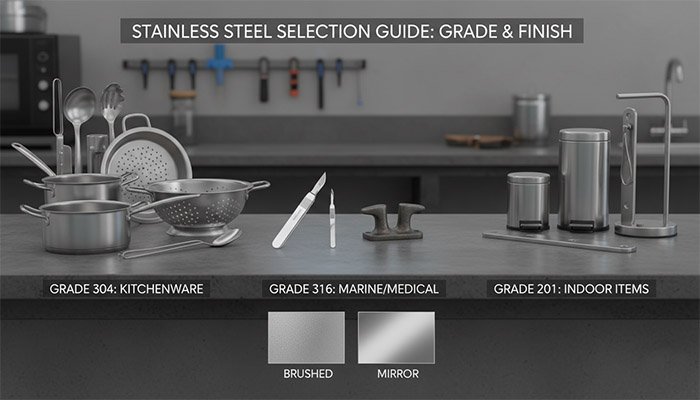
Picking the right stainless steel is one of the most important decisions you'll make. It’s not just about a shiny look; it's about making a product that lasts and keeps customers happy. Get it right, you have a winner. Get it wrong, and you're looking at rust, returns, and a warehouse full of dead stock. As a sourcing agent in Yongkang, China's hardware capital, I see this daily. A small change in material specs can make or break a product launch. Let's get straight to what you need to know to make the right call.
What Are the Most Common Stainless Steel Grades I Should Know?
Confused by numbers like 304, 316, and 201? Using the wrong grade means your product could rust or fail quickly, destroying your reputation and your money.
Focus on these four: 304 is the all-around workhorse for kitchenware. 316 is the tough "marine grade" for harsh environments. 201 is the cheap option for dry, indoor items. 430 is a magnetic grade for decorative trim and budget cutlery.
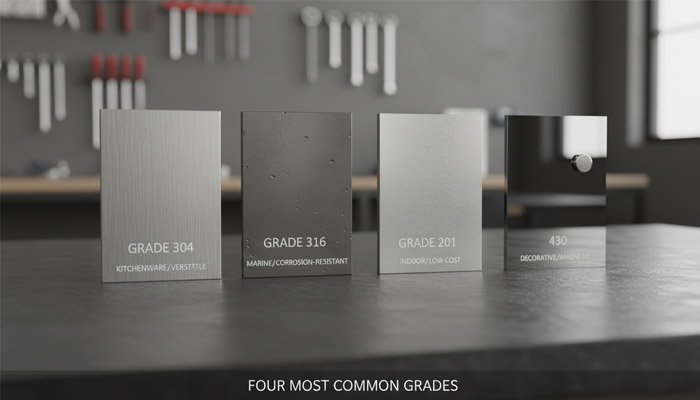
When a client's RFQ just says "stainless steel," my first question is always, "Which grade?" This detail determines your product's cost and survival in the real world. I once had a client developing a premium coffee mug who wanted to use Grade 201 to save a few cents. I told them it was a bad idea. Coffee is acidic and would cause pitting and rust, leading to terrible reviews. We went with 304, and the product sold well. Understanding these grades is your first line of defense against quality problems.
Grade 304 (18/8)
This is the industry standard. It's called "18/8" because it's roughly 18% chromium and 8% nickel, giving it great rust resistance. It's perfect for kitchenware, vacuum flasks, and sinks. Here in Yongkang, it's the default for most quality metal products. It’s the safe, reliable choice that balances performance and cost.
Grade 316 (Marine Grade)
If your product will be near saltwater, harsh chemicals, or de-icing salts, you need Grade 316. The key is the addition of molybdenum, which massively boosts its corrosion resistance. It’s used for boat parts, coastal hardware, and medical tools. It costs more than 304, but if your application is demanding, it's not optional. Don't let a factory tell you 304 is "good enough" for a marine product.
Grade 201
This is the budget grade. It replaces expensive nickel with cheaper manganese. The trade-off is much lower corrosion resistance. It will rust if it stays wet or is exposed to acidic foods. I only recommend 201 for completely dry, indoor uses like decorative frames. Be careful—unethical factories love to secretly substitute 201 to cut costs.
Grade 430
This grade is magnetic because it contains chromium but almost no nickel. This makes it cheaper but also less rust-resistant than 304. It's used for appliance panels, decorative automotive trim, and low-cost cutlery. It’s a good choice if your product needs to be magnetic (like for an induction stove), but for all-around durability, 304 is better.
| Grade | Key Feature | Common Use | Cost | Magnetism |
|---|---|---|---|---|
| 304 | Balanced & Versatile | Kitchenware, General Use | $$ | No |
| 316 | Maximum Corrosion Resistance | Marine, Medical, Outdoor | $$$ | No |
| 201 | Low Cost | Dry, Indoor, Decorative | $ | Slight |
| 430 | Magnetic & Decorative | Appliances, Budget Cutlery | $ | Yes |
How Does Surface Finish Affect My Product’s Look and Performance?
Think the finish is just for looks? A cheap-looking finish can make your product feel rough, show every fingerprint, and even corrode faster, wasting the money you spent on a good steel grade.
The finish is crucial for both appearance and function. No. 4 (brushed) is great for appliances because it hides fingerprints. No. 8 (mirror) offers a premium, reflective look. A basic No. 2B (mill) finish is for parts that will be hidden or processed further.
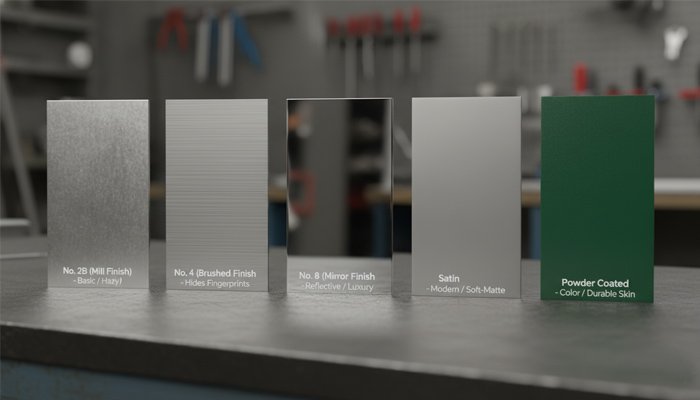
After you pick a grade, you need to specify the finish. This is just as important. The finish affects how your product looks, feels, and holds up to daily use. For a client launching premium barware, we tested several options. They first wanted a shiny mirror finish, but we found a satin finish looked more modern and didn't show fingerprints as easily. That small change elevated the product's user experience and perceived value. Here are the common options you'll see.
No. 2B (Mill Finish)
This is the basic, default finish right from the steel mill. It’s smooth and somewhat reflective but not perfectly uniform. Think of it as a blank canvas. It’s fine for internal parts or items that will be painted or covered, but it's not attractive enough for most finished consumer products.
No. 4 (Brushed Finish)
This is the most popular finish for a reason. It has fine, parallel lines that give it a sophisticated, low-gloss look. More importantly, it’s great at hiding fingerprints and small scratches. This makes it the standard for kitchen appliances, faucets, and other high-touch surfaces. It’s a practical, attractive, and cost-effective choice.
No. 8 (Mirror Finish)
This is the top-of-the-line finish. It's polished until it's perfectly smooth and reflective like a glass mirror. It creates a high-impact, luxury look for decorative items or premium goods. The downsides? It’s expensive to produce and is a magnet for fingerprints and scratches.
Powder Coating
This is a finish applied on top of the steel. A dry powder is sprayed onto the part and baked, creating a tough, colored layer. It's an excellent way to add color and an extra layer of durability. We use this method all the time for the colored vacuum flasks and outdoor products we source for clients in Yongkang.
How Can I Verify My Supplier Is Using the Correct Stainless Steel?
You ordered Grade 304, but how do you know the factory didn't use cheaper 201 to boost their profit? This is a common and costly scam that can ruin your product line.
Verification is not optional. Always request the Mill Test Certificate (MTC). On-site, my team uses a handheld XRF analyzer for instant chemical analysis. A simple magnet test can also expose fakes, as 304 and 316 are not magnetic.
"Trust, but verify" is the first rule of sourcing in China. A supplier's promise means nothing without proof, especially when cheaper materials look identical. This is where having an agent on the ground is critical. We don't just take the factory's word; we check. A few years ago, we caught a factory trying to ship 201-grade tumblers as 304. Our XRF gun spotted it instantly. We rejected the whole order, saving our client a massive headache and thousands of dollars. Verification is your insurance policy.
Mill Test Certificates (MTC)
This is your first checkpoint. An MTC is the material's "birth certificate" from the steel mill, detailing its exact chemical composition. Ask your supplier for the MTC for the specific batch of steel used for your production. While it can be faked, requesting it shows you're serious about quality.
On-Site Verification
Paperwork isn't enough. The best way to be sure is with a handheld X-Ray Fluorescence (XRF) analyzer. This is a tool my team uses during inspections. We point it at the product, and it gives us an instant chemical breakdown. There’s no cheating this test. For a quick field check, use a strong magnet. Grades 304 and 316 are non-magnetic. If the magnet sticks, you have a problem.
Performance Testing (Salt Spray)
For products that need to resist corrosion, like marine or outdoor gear, you have to test their performance. A salt spray test puts the product in a chamber with dense, salty fog to simulate years of harsh exposure in just a few days. If it comes out with rust, it fails. It's the ultimate proof of quality for durable goods.
Conclusion
Choosing the right stainless steel grade and finish is a key decision. Verifying that material is not just a detail—it's essential to protecting your business, your investment, and your brand.
Ready to source your stainless steel product with confidence? Send me your project details. As your partner in Yongkang, my team will ensure you get exactly what you paid for, every time.