

Worried about customs delays and surprise fees on your China imports? These unexpected costs can erase your profits overnight. Understanding HS codes is your key to predictable, smooth importing.
HS codes are global product identifiers used by customs to determine import duties, taxes, and regulations. Getting the classification right ensures accurate cost calculation, legal compliance, and helps you avoid costly shipping delays for your business when importing from China.
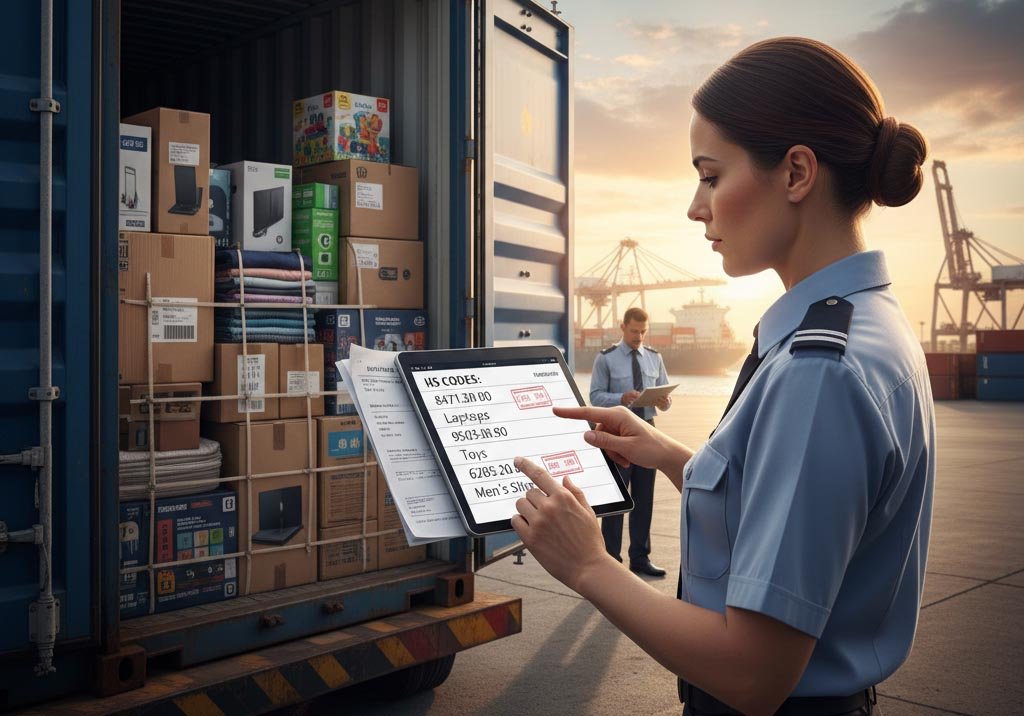
Navigating international trade regulations can feel overwhelming, especially for e-commerce sellers and importers focused on growing their business. I've seen countless clients come to us after being burned by a customs issue that could have been easily avoided. A simple mistake in a product code can spiral into thousands of dollars in fines and weeks of delays. But the good news is that you don't need to be a customs lawyer to protect your business. Understanding the basics of the Harmonized System (HS) is the first and most critical step. This guide will break down what you need to know and how a reliable partner can make the process seamless.
What Exactly Is an HS Code?
The term "HS Code" seems complex and intimidating. But ignoring it can lead to customs seizing your goods. Let's break down this system into simple, understandable parts.
An HS (Harmonized System) code is a 6-to-10-digit number that classifies a traded product. The first six digits are universal across 200+ countries, while individual countries add more digits for specific tax rates and statistical purposes. It tells customs officials exactly what you're importing.
Think of the HS code as a universal language for international trade. It's managed by the World Customs Organization (WCO) and ensures that a stainless steel water bottle is classified in a similar way whether it's entering the USA, Germany, or Australia. This standardization is what makes global trade possible.
Let's break down its structure with a real example of a product we frequently source from factories here in Yongkang: a stainless steel vacuum flask.
The Structure of an HS Code
An HS code is hierarchical. Each set of digits drills down to a more specific product description.
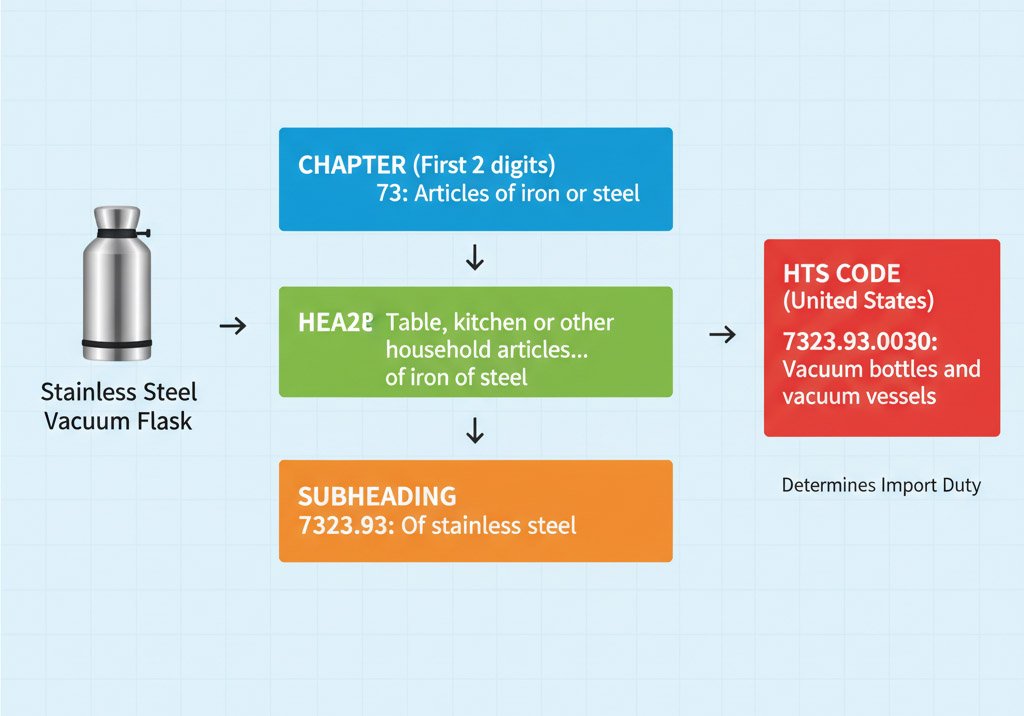
- Chapters (First 2 digits): Broad categories of goods. For our flask, it falls under Chapter 73 - "Articles of iron or steel."
- Headings (First 4 digits): More specific groupings within a chapter. Our flask fits into Heading 7323 - "Table, kitchen or other household articles and parts thereof, of iron or steel."
- Subheadings (First 6 digits): This is the internationally standardized level. Our flask is classified under Subheading 7323.93 - "Of stainless steel."
This 6-digit code, 7323.93, is the common foundation. An importing country like the United States will then add more digits to create a Harmonized Tariff Schedule (HTS) code. For example, 7323.93.0030 specifies "Vacuum bottles and other vacuum vessels." This final code determines the exact import duty.
Why Is Getting the Right HS Code So Critical?
You found a code that looks close enough and using it seems easier than digging deeper. But a small mistake here can trigger audits, fines, and destroy your shipment's profitability.
The correct HS code is critical because it directly determines your product's import duty rate. A wrong code can lead to overpaying taxes, facing penalties for underpayment, customs holds, or even seizure of your goods, causing massive financial and operational disruptions.
As a sourcing agent in Zhejiang, I've seen firsthand how a seemingly minor classification error becomes a major business crisis. The consequences are not just financial; they can damage your brand's reputation and halt your supply chain. An Amazon seller who misses a launch date because their inventory is stuck in customs loses more than just storage fees—they lose sales velocity and ranking. An importer who gets hit with an anti-dumping duty they didn't plan for might see their entire business model become unprofitable overnight.
Let's look at the specific risks in more detail.
Key Risks of Incorrect Classification
| Consequence of Error | How It Hurts Your Business |
|---|---|
| Incorrect Duty Payment | If you use a code with a higher duty, you're giving away profit. If the duty is lower, you face back-payments, interest, and fines for underpayment. |
| Customs Delays | A suspicious or incorrect code is a red flag for customs. Your shipment will be pulled for physical inspection, leading to weeks of delays and high demurrage fees. |
| Fines and Penalties | Customs authorities can issue significant monetary penalties for what they deem to be negligence or fraud, even if the mistake was unintentional. |
| Seizure of Goods | In the worst-case scenario, particularly for prohibited or restricted items misclassified, your entire shipment can be confiscated. It's a total loss. |
| Increased Scrutiny | Once you're flagged for a compliance error, your future shipments are far more likely to be inspected, creating a pattern of delays. |
These risks are why "good enough" is never good enough in tariff classification. You need to be certain.
How Can a Sourcing Agent Help with HS Code Classification?
Finding the right HS code is a research-intensive, high-stakes task. As a business owner, your time is better spent on sales and marketing, not buried in customs tariff schedules.
A reliable China sourcing agent, like Aurosourcing, helps by working with your supplier and experienced freight forwarders to verify the correct HS code. We leverage our 13+ years of experience with thousands of products to ensure your documentation is accurate from the start, preventing costly errors.
One of the biggest mistakes I see importers make is blindly trusting the HS code provided by the factory. A Chinese supplier's goal is to export goods with minimal friction on their end. They might use a code that gives them a better export tax rebate, but that code could be incorrect for your country's import regulations. As your purchasing agent on the ground in China, our loyalty is to you, the importer. Our job is to protect your interests.
Pre-Shipment Verification and Due Diligence
Before your container ever leaves the port, we have a clear process. First, we get the product specifications and the supplier's suggested HS code. We don't stop there. We use official tariff databases for your destination country and cross-reference the product's materials, function, and composition. If a product is complex, like a piece of fitness equipment with electronic components, it could potentially fall under multiple classifications. We analyze the "essential character" of the product to determine the most accurate code.
Leveraging Our Expert Network
We are sourcing experts, not customs brokers. That's why we've built a robust network of trusted freight forwarders and customs specialists over the last decade. When a new or ambiguous product comes along, we consult these partners. For example, a client was developing a new "smart" coffee mug with heating elements and Bluetooth. The factory in Yongkang called it a mug (duty-free in the US), but the electronics pushed it into a different category with a 2.7% tariff. By clarifying this before production, we built the correct duty into the client's landed cost model, ensuring their pricing and profit margins were accurate from day one. This proactive approach is a core part of our one-stop service.
Conclusion
Mastering HS codes is vital for successful importing. A trusted China sourcing agent ensures accuracy, saving you time, money, and preventing catastrophic delays. Let Aurosourcing handle the details.
Ready to import from China with confidence? Send us your product inquiry today, and let our team at Aurosourcing ensure your supply chain is built on a foundation of accuracy and reliability.