

Struggling to choose the right aluminum process? Making the wrong choice can inflate costs and delay your entire project. Understanding the core difference is your first step to success.
The best aluminum manufacturing process depends on your part's geometry, production volume, and budget. Choose die casting for complex, high-volume 3D parts where precision is key. Opt for extrusion for simpler, uniform profiles, especially when you need lower volumes or a faster turnaround.
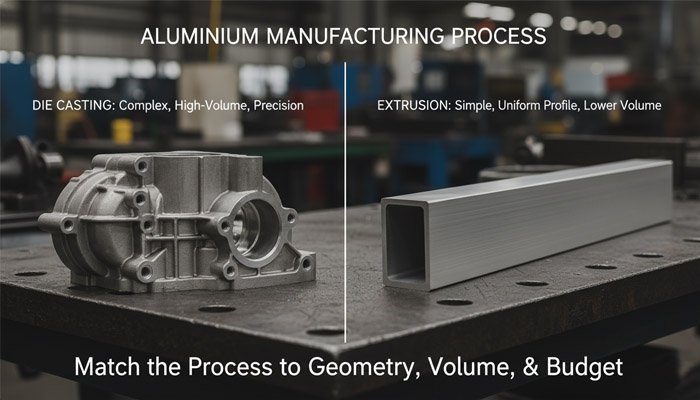
When I receive a request for a new aluminum part, the first question I ask isn't about price—it's about the manufacturing process. The choice between die casting and extrusion is one of the most fundamental decisions you'll make. It affects everything from your initial investment and lead time to the final part's performance and appearance. Making the wrong call can lead to costly tooling changes or a product that simply doesn't work as intended. Let's break down each method so you can approach your next project with the confidence that you're making the most cost-effective and practical decision for your business.
What Is Aluminum Die Casting and When Should I Use It?
Need intricate metal parts but worried about the high tooling costs? Die casting is perfect for high-volume, complex designs, but you need to understand the trade-offs before committing.
Use die casting for complex, high-precision 3D shapes in large quantities (thousands of units). It's ideal for parts like electronics housings or engine components where a smooth surface finish and tight tolerances are critical, justifying the higher initial mold cost.
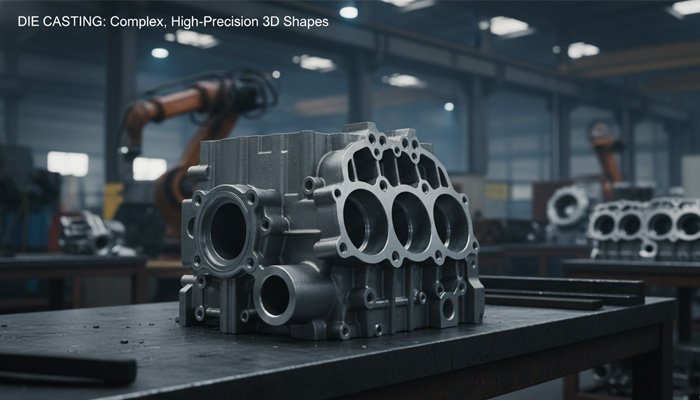
Die casting is a manufacturing workhorse, especially here in Yongkang's hardware and automotive sectors. The process is straightforward but powerful: we inject molten aluminum into a hardened steel mold (a "die") under extremely high pressure. The metal cools and solidifies almost instantly, and the finished part is ejected. This cycle repeats very quickly, making it incredibly efficient for mass production. I've worked with clients who needed to produce thousands of identical power tool housings or intricate drone frames. For them, die casting was the only logical choice.
Key Advantages of Die Casting
The main benefit is the ability to create complex 3D shapes with net-shape or near-net-shape features. This means the part comes out of the mold very close to its final form, reducing the need for expensive secondary machining. Die casting also delivers excellent dimensional accuracy and tight tolerances, which is critical for parts that need to fit together perfectly. Furthermore, the resulting parts have a very smooth surface finish, which can save you money on post-processing like polishing or painting.
Important Considerations
The biggest hurdle is the high initial tooling cost. A high-pressure die casting mold is a complex piece of engineering and can cost thousands, even tens of thousands, of dollars. The lead time to create this mold is also significant, typically ranging from 6 to 12 weeks. This is why die casting only makes financial sense for high-volume production runs where the cost of the mold can be amortized over many thousands of parts. There are also design limitations, such as a minimum wall thickness (usually around 1.5mm) to ensure the molten metal flows correctly.
What Is Aluminum Extrusion and When Is It the Better Choice?
Is your design a simple, long profile? Paying for a complex die-cast mold for a simple shape would be a huge waste of money. Extrusion offers a much more cost-effective and faster alternative.
Choose aluminum extrusion for parts with a consistent, 2D cross-section, like tubes, frames, or heat sinks. It's best for lower volumes or when speed is essential due to its significantly lower tooling costs and faster lead times compared to die casting.
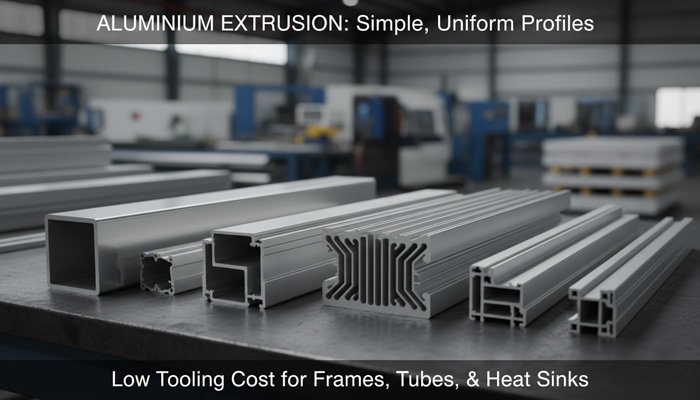
I often describe extrusion using a simple analogy: it's like squeezing toothpaste out of a tube. In this process, a heated billet of aluminum is pushed through a shaped die with a hydraulic press. The result is a long piece of aluminum with a fixed cross-sectional profile. We can then cut this long piece to any length required. This method is perfect for products that are fundamentally two-dimensional in their complexity, such as window frames, door tracks, LED light housings, and especially heat sinks with their intricate fins.
Why Choose Extrusion?
The number one advantage of extrusion is the low tooling cost. The die for an extrusion is much simpler and cheaper to produce than a die-casting mold, often costing only a few hundred to a couple of thousand dollars. This makes it a fantastic option for startups, small-batch productions, or for prototyping a new profile design. The lead times are also much faster, typically around 3 to 6 weeks to get your first parts. The process is also very efficient in terms of material usage, creating minimal waste, which contributes to its cost-effectiveness.
What Are the Limitations?
The biggest limitation of extrusion is its design flexibility. The process can only create linear, 2D profiles. If your part has complex 3D features, closed ends, or varying wall thicknesses along its length, extrusion alone won't work. Extruded parts almost always require secondary operations. After the profile is extruded and cut to length, it often needs to be machined—drilling holes, tapping threads, or milling features. At Auro Sourcing, we manage this by coordinating with different workshops; the extrusion factory creates the profile, and then we move it to a machining partner for the finishing touches before inspection and shipment.
How Do I Decide Between Die Casting and Extrusion?
You understand both processes but are still on the fence. Making the wrong choice could lead to costly redesigns or production delays, so a clear decision framework is essential.
Your decision hinges on three factors: part complexity, production volume, and budget/timeline. For complex 3D shapes in high volumes, choose die casting. For simple 2D profiles, lower volumes, or fast turnarounds, choose extrusion.
When a new client sends me a 3D model or drawing, my evaluation process is almost automatic. I look at the part and ask a few key questions that guide us to the right manufacturing method. To help you do the same, I've found a side-by-side comparison is the most effective tool. Here’s a table that summarizes the key differences to guide your decision-making process.
| Feature | Aluminum Die Casting | Aluminum Extrusion |
|---|---|---|
| Part Complexity | Excellent for complex, 3D geometries | Limited to linear, 2D cross-sections |
| Production Volume | Ideal for high volumes (5,000+ units) | Cost-effective for low to medium volumes |
| Tooling Cost | High ($5,000 - $50,000+) | Low ($500 - $5,000) |
| Tooling Lead Time | Long (6-12 weeks) | Fast (3-6 weeks) |
| Piece Price | Very low at high volumes | Low, but can increase with secondary machining |
| Surface Finish | Excellent, smooth surface | Good, but shows die lines; often needs finishing |
| Waste | Minimal, as runners are recycled in-house | Very low, highly efficient use of material |
| Typical Products | Engine blocks, gearboxes, electronics enclosures | Window frames, heat sinks, structural rails, tubing |
From a sourcing agent's perspective, the process is simple. First, I check the geometry. Is it a self-contained, complex shape? It's a candidate for die casting. Is it a long part with a uniform profile? That's an extrusion. The next conversation is about volume. If a client needs 500 units of a complex part, I will warn them that the die casting mold cost will make the per-piece price extremely high. We might then explore if the part could be redesigned as an extrusion with secondary CNC machining to achieve a similar result at a lower total cost. This practical, cost-driven analysis is at the heart of what we do at Auro Sourcing—we don't just find a factory; we help you find the right manufacturing strategy.
Conclusion
The right choice between die casting and extrusion depends on your part's complexity, volume, and budget. Understanding these trade-offs ensures a cost-effective and successful manufacturing process for your aluminum products.