

Sourcing fitness equipment is a high-stakes game. A single faulty weld or unstable design can lead to serious injury, brand-destroying recalls, and legal liabilities. Protecting your customers and your business is paramount.
Crucial standards include ASTM for the US and EN ISO 20957 for Europe, which dictate safety requirements. Essential tests involve static and dynamic load testing for structural integrity, stability checks, and material verification. A China sourcing agent must manage this compliance process from the start.
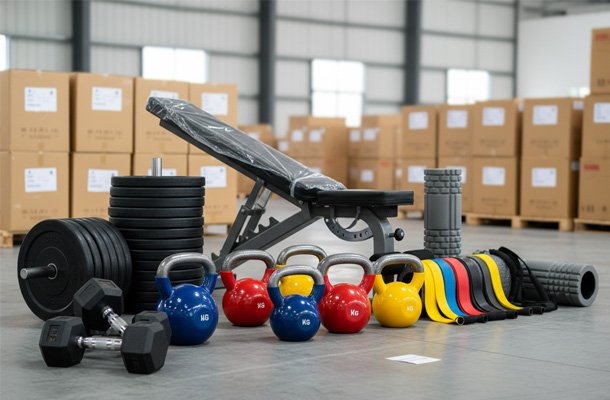
Navigating the web of international safety standards and implementing a rigorous testing plan can seem daunting. However, a structured approach makes it manageable and is the only way to ensure you're importing safe, reliable, and compliant products. At Auro Sourcing, we integrate these standards and tests into every stage of the sourcing process, turning potential risks into a reliable competitive advantage for our clients. Based in the heart of China's hardware production, we see every day how critical this foundation is.
Why Is Yongkang the Right Place for Sourcing Fitness Equipment?
Searching online for "fitness equipment supplier" yields endless, confusing results. You risk partnering with a generalist trading company that lacks the specific engineering knowledge for fitness products, leading to quality and safety compromises.
Yongkang, known as China's "Hardware Capital," is a premier hub for sourcing metal-based fitness equipment. Its deep expertise in steel fabrication, welding, and tube processing makes it the ideal location for manufacturing items like dumbbells, squat racks, and weight benches with high quality and cost-efficiency.
Choosing the right manufacturing region is as important as choosing the right supplier. Industrial clusters offer a concentration of talent, raw materials, and specialized machinery that you simply won't find elsewhere. For anything made of steel or aluminum, Yongkang, Zhejiang is a world-class choice. Our location here provides our clients with direct access to this powerful ecosystem, ensuring we partner with true specialists.
Yongkang's Metal Fabrication Legacy
The city's reputation is built on decades of metalworking expertise. This isn't a new trend; it's a deep-seated industrial capability. Factories here are masters of processes essential for durable fitness equipment:
- Tube Bending and Cutting: Precisely shaping the steel tubes that form the frames of benches and racks.
- Welding: Employing skilled welders who understand the structural importance of strong, clean welds.
- Stamping and Forging: Creating the components that require immense strength and durability.
- Surface Finishing: High-quality powder coating and electroplating for rust prevention and a professional finish.
The Fitness Equipment Ecosystem
Beyond individual factories, Yongkang offers a complete supply chain. A squat rack manufacturer doesn't have to source its J-hooks or safety pins from another province; there are specialized suppliers right down the road. This integrated network includes providers of grips, foam padding, upholstery, plastic end caps, and heavy-duty bolts. This proximity shortens lead times, reduces costs, and allows our QC team to inspect not just the final product, but also the critical components before assembly.
| Common Fitness Product | Key Yongkang Manufacturing Process |
|---|---|
| Adjustable Dumbbells | Stamping, casting, precision machining of locking mechanisms. |
| Squat Racks & Power Cages | Heavy-gauge tube cutting, robotic welding, powder coating. |
| Weight Benches | Tube bending, welding, upholstery component sourcing. |
| Kettlebells & Dumbbells | Iron casting, vinyl dipping, or rubber coating. |
What Are the Essential Safety Standards to Know?
Ignoring international safety standards is not an option. It's a direct path to getting your shipment rejected by customs, facing product liability lawsuits, and being banned from major marketplaces like Amazon.
For fitness equipment, the most important standards are ASTM in the United States and EN ISO 20957 in the European Union. These legally-binding standards define the mechanical safety requirements, testing methods, and mandatory labeling for stationary training equipment.
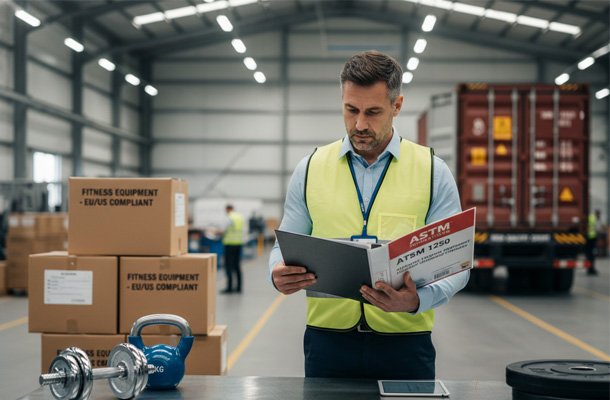
Compliance isn't just a box to tick; it's the foundation of a safe product. As a professional China sourcing agent, our first step in any fitness project is to identify the client's target market and the corresponding mandatory standards. We then build the entire product specification and quality control plan around these requirements. A factory that is unfamiliar with ASTM or EN standards is an immediate red flag for us, as they are unlikely to have the processes in place to build a compliant product.
Understanding ASTM Standards for the US Market
The American Society for Testing and Materials (ASTM) sets the standards for many consumer products in the US. For fitness gear, a key standard is ASTM F1250, which covers the safety specifications for home-use exercise equipment. It details requirements for structural integrity, stability, and entrapment hazards to ensure the product is safe for an end-user in a non-supervised environment.
Decoding EN ISO 20957 for the EU Market
This is the primary standard for stationary training equipment sold in the EU and is often considered one of the most comprehensive globally. It's broken into several parts:
- EN ISO 20957-1: This covers general safety requirements and testing methods applicable to all equipment. It also defines usage classes (H for Home, S for Studio/Commercial) which have different durability requirements.
- EN ISO 20957-2, -4, etc.: These subsequent parts provide specific requirements for different types of equipment, such as strength-training benches (Part 4) or treadmills (Part 6).
| Standard Feature | ASTM (e.g., F1250) | EN ISO 20957 |
|---|---|---|
| Primary Focus | Safety for home use, preventing injury from mechanical hazards. | Detailed requirements for Home (H), Studio (S), and Commercial (I) use classes. |
| Key Requirements | Structural integrity, stability, instructions, and warning labels. | Defines specific load tests, endurance tests, and user weight classes. |
| Market | United States | European Union (CE Marking requirement) |
Which Specific Tests Should Your Fitness Equipment Undergo?
A product sample might look perfect, but how do you know if it can withstand years of use? A weight bench collapsing or a resistance band snapping can cause severe injury and destroy your brand's credibility overnight.
Your fitness equipment must undergo load testing (static and dynamic) to verify its weight capacity, stability testing to prevent tipping, and weld/component inspections to ensure structural integrity. These tests are typically part of a formal Pre-Shipment Inspection (PSI).
"Trust, but verify" is our mantra for quality control. We never take a factory's claims about strength or durability at face value. We design and execute a specific testing protocol for every product, based on its intended use and the applicable safety standards. These are not simple visual checks; they are functional tests designed to push the product to its limits and expose any potential weaknesses before it ever leaves the factory. This rigorous, evidence-based approach is how we protect our clients' investments.
Structural Integrity and Load Testing
This is the most critical set of tests. We verify that the product can handle not just its stated weight capacity, but a significant safety margin beyond it.
- Static Load Test: We apply a stationary weight that is several times the maximum user weight rating to the equipment for a specified period. For example, a bench rated for a 250kg user might be tested with a 600kg static load. We then inspect for any bending, cracking, or deformation.
- Dynamic Load Test: We simulate real-world use by repeatedly applying and releasing loads. This tests for fatigue and ensures the product can withstand the stresses of repeated workouts over time.
Component and Material Verification
A product is only as strong as its weakest link. We scrutinize the individual components:
- Weld Inspection: A visual check by a trained inspector for cracks, porosity, or incomplete welds. For high-end commercial equipment, we may arrange for non-destructive testing (NDT).
- Material Thickness: We use digital calipers to verify that the steel tubing thickness matches the approved specification. Factories may cut costs by using thinner steel, compromising strength.
- Bolt & Fastener Check: We ensure the correct grade and size of bolts are used and that they function correctly.
Functional and Stability Testing
These tests simulate how a customer will actually use the product.
| Test Type | Purpose | Example on a Squat Rack |
|---|---|---|
| Stability Test | To ensure the equipment does not tip over during normal use. | Applying specific horizontal and vertical forces to the frame to try and tip it forward, backward, and sideways. |
| Adjustment Mechanism Test | To verify that all moving parts work smoothly and lock securely. | Repeatedly adjusting the J-hooks and safety spotter arms through their full range, ensuring they lock into place without slipping. |
| Assembly Check | To ensure all parts are present and fit together as per the manual. | Taking a unit from the production line and assembling it from scratch to identify any misaligned holes or missing hardware. |
Conclusion
Sourcing compliant fitness equipment requires sourcing from a specialized hub like Yongkang, adhering strictly to ASTM/EN standards, and executing a rigorous testing plan. A dedicated sourcing partner on the ground makes this complex process seamless. Ready to source safe, reliable fitness equipment? Contact Auro Sourcing today.