

Glassware and ceramics can look like simple products to source. They are widely available, visually attractive, and often sell well across homeware, gift, kitchenware, hospitality, and lifestyle categories. That is exactly why many importers, wholesalers, and online sellers are interested in them.
But from a sourcing point of view, these categories are rarely simple.
At AuroSourcing, we have seen many buyers focus first on style, price, and MOQ, only to run into bigger problems later: hidden defects, inconsistent finishing, poor packaging, and breakage during shipping. In fragile product categories, the real risk is usually not the quotation itself. It is what happens after production starts, and what arrives after the container is opened.
For smaller importers and growing e-commerce sellers, one bad shipment can quickly turn into a margin problem, a customer service problem, and a reputation problem. That is why sourcing glassware and ceramics needs a more controlled process from the beginning.
Why Sourcing Glassware and Ceramics Is More Difficult Than It Looks
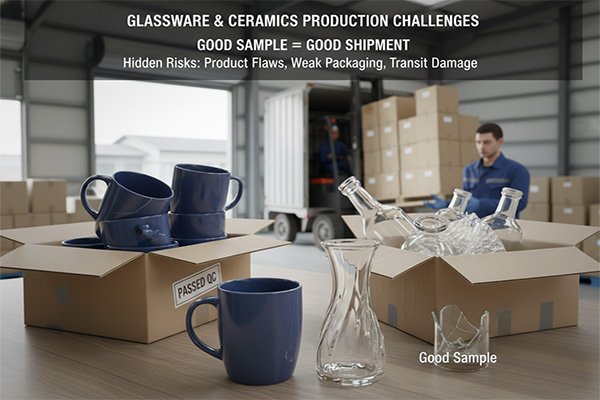
Many buyers assume that if a factory can produce a nice sample, the order is basically safe. In reality, fragile categories do not work that way.
A good sample only shows that the factory can make one version correctly. It does not prove that the full production run will be consistent. It also does not prove that the packaging is strong enough for export handling, warehouse stacking, parcel delivery, or cross-border shipping.
Glassware and ceramics have a layered risk structure. First, the product itself may have quality issues. Second, the packaging may not provide enough protection. Third, the loading and transport conditions may expose weaknesses that were not obvious at the factory.
This is why many shipments technically "pass production" but still create problems after arrival.
For example, a ceramic mug may look acceptable during a basic visual inspection, but if the glaze is inconsistent, the handle attachment is weak, or the divider structure inside the carton is not strong enough, damage can still happen later. The same applies to glass bottles, drinkware, vases, candle holders, or storage jars. They may leave the factory in decent condition, but arrive with chips, cracks, scratches, or breakage because the packaging design was not truly export-ready.
This is especially risky for overseas buyers without a local team in China. When you are not on the ground, it is harder to verify whether the supplier is controlling the details properly or simply preparing goods fast enough to meet shipment timing.
That is where a sourcing partner becomes valuable. The goal is not just to find a supplier. The goal is to control the process before defects and breakage turn into a landed cost issue.
What QC Problems and Breakage Risks Buyers Should Focus On

In fragile product sourcing, quality control should never be limited to "does it look good?" The right question is broader: "Will this product remain acceptable after production, packing, loading, and shipping?"
From our experience, the most common quality problems in glassware include bubbles, scratches, chips, rim defects, uneven thickness, unstable bottoms, poor clarity, and dimensional inconsistency. In ceramics, common issues often include glaze pinholes, black spots, warping, cracks, edge chipping, color variation, poor finishing, and handle weakness.
Some defects are obvious. Others are easy to miss during rushed inspections.
For instance, a lid may appear to fit, but the tolerance may be too loose or too tight across batches. A ceramic bowl may appear round, but stacking performance may be poor. A glass container may have no visible cracks, but weak stress points may increase breakage risk during transit. These are not just product quality issues. They directly affect customer satisfaction and return rates.
Then there is packaging risk, which is often underestimated.
A supplier may use standard inner boxes, light dividers, or cartons that are acceptable for domestic transport, but not strong enough for export conditions. If there is too much empty space inside the box, products can move and collide. If outer cartons are weak, compression damage can happen during stacking. If cartons are not designed around the actual product shape and fragility level, even a well-made product can still arrive damaged.
This is one of the biggest sourcing mistakes we see. Buyers compare only unit price, without checking whether the quoted packaging standard is actually suitable for international shipping. Later, when breakage appears, the root cause is often not just "fragile product," but "insufficient packaging control."
In glassware and ceramics, supplier capability is not only about production. It is also about process discipline. Many factories can produce attractive designs. Fewer can maintain stable quality, consistent finishing, and packaging standards that protect the goods through the full logistics chain.
What Should Be Controlled Before Shipment
When we manage fragile product sourcing, we do not treat inspection as one final step at the end. By then, many problems are already expensive to fix. The better approach is to control the critical points earlier.
First, both the product sample and the packaging sample should be approved before mass production. This is very important. Some buyers approve only the product appearance and ignore the packing method until late in the order. That creates unnecessary risk. A beautiful sample does not mean the packing design is ready for shipment.
Second, the quality standard should be defined in writing. That includes appearance requirements, dimensions, weight tolerance, finishing expectations, logo or decoration details, carton structure, labeling, and packing method. In fragile categories, vague approval standards create disputes later. If the supplier and buyer are not aligned early, the inspection stage becomes reactive instead of preventive.
Third, production consistency should be checked before the entire order is completed. For fragile goods, defects can repeat in patterns. A problem with glaze, molding, rim trimming, or divider packing may continue across the batch if nobody stops it early. In-production checking helps identify these issues before the order is fully packed.
Fourth, pre-shipment inspection should focus not only on appearance and quantity, but also on packaging reliability. For glassware and ceramics, we usually pay close attention to carton condition, drop resistance, internal protection, packing consistency, and master carton strength. Products may look acceptable in the warehouse, but if the packaging structure is weak, the shipment is still high-risk.
We also look at practical details that suppliers sometimes ignore when no one follows closely. Are the dividers properly sized? Are the products packed tightly enough without being over-pressured? Are cartons overloaded? Is there enough buffer material? Is palletization suitable if pallets are used? Is container loading planned with fragile handling in mind?
These details are not glamorous, but they are exactly what protect margins.
At AuroSourcing, this is one of the main ways we support clients. We coordinate with the supplier, review packaging logic, arrange inspections, push corrections when needed, and help prevent the common gap between "factory-ready" and "shipment-ready." For buyers without a China office, that local follow-up makes a real difference.
How Small Importers and Online Sellers Can Lower Risk on the First Order
For first-time sourcing, the safest strategy is not to move fast. It is to move in a controlled way.
One practical step is to start with a manageable order instead of too many SKUs at once. Fragile categories already carry product and logistics risk. Adding too many designs in the first order makes inspection, packaging consistency, and defect control harder. A smaller, better-controlled trial order often gives much better data for the next buying decision.
Supplier selection also matters more than many buyers expect. The lowest quotation may not reflect the true cost if the factory has weak QC discipline or poor export packaging experience. In fragile categories, the better supplier is often the one with more stable process control, clearer communication, and stronger packaging understanding, even if the price is not the lowest on paper.
Another important point is to confirm breakage policy in advance. Buyers should not wait until after arrival to discuss responsibility. Before production starts, it is much better to clarify acceptable breakage standards, spare quantity arrangements, compensation terms, and how disputes will be handled if issues exceed the agreed level. This does not solve every problem, but it creates a more professional basis for the order.
Independent inspection before balance payment is also highly recommended. Once final payment is released and the goods are shipped, your leverage becomes much weaker. A third-party inspection or local sourcing team can help verify whether the goods, packaging, and shipment readiness actually match what was agreed.
For e-commerce sellers, this matters even more. Online reviews, replacement costs, reverse logistics, and platform performance all depend on product condition at arrival. A breakage issue is not just a warehouse issue. It becomes a brand issue.
That is why many growing buyers choose to work with a sourcing partner in China. Not because they cannot find suppliers online, but because fragile product categories require more process control than most remote buying models can handle well. When problems appear, speed matters. Someone on the ground can communicate with the factory, check the real situation, and push solutions before the shipment leaves.
A Better Sourcing Process Protects More Than the Product
In glassware and ceramics sourcing, buyers often think they are purchasing products. In reality, they are purchasing a process.
The supplier matters, but so do the inspection standards, the packaging structure, the factory follow-up, and the shipment control. If these parts are weak, even a promising product can become an expensive lesson. If they are well managed, fragile categories can become stable and profitable product lines.
At AuroSourcing, we help overseas buyers source from China with more control and less guesswork. That includes supplier verification, quotation comparison, packaging review, production follow-up, quality inspection, and export coordination. For glassware and ceramics especially, our role is to reduce the hidden risks that usually do not appear in the first quotation sheet.
If you are planning to source glassware or ceramics from China, the right time to control breakage risk is before the order is placed, not after the damage report arrives.
That is usually the difference between a stressful shipment and a scalable product category.