

Finding reliable kitchenware suppliers in China is challenging. Poor quality or shipping delays can ruin your brand's reputation and bottom line. Understanding the key considerations from the start is crucial for success.
The key considerations for sourcing kitchenware from China involve verifying supplier capabilities, setting strict quality control standards for materials and safety, and managing international compliance and logistics. A local sourcing agent in a production hub like Yongkang can streamline this entire process, mitigating risks from the start.
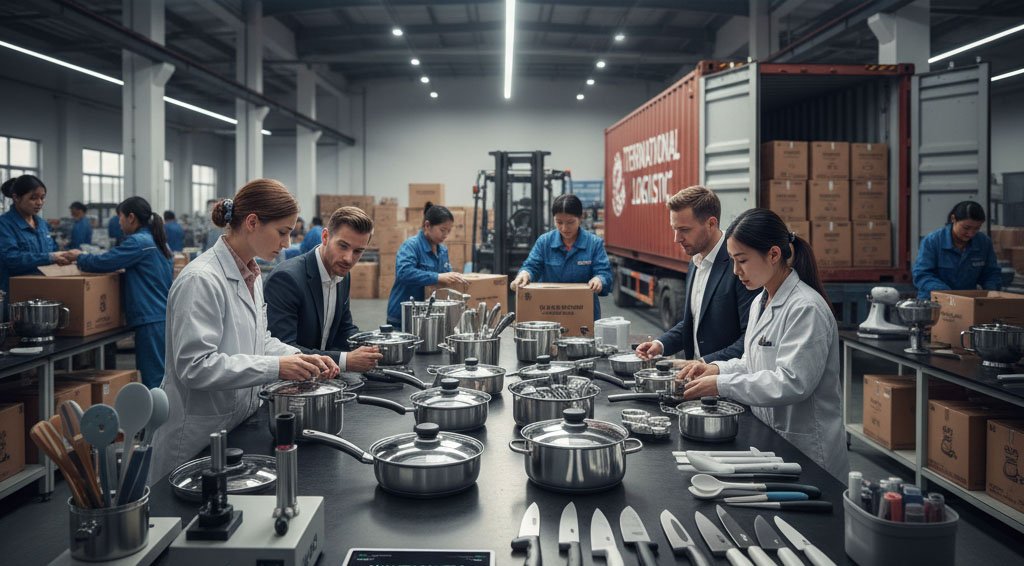
These factors might seem overwhelming, but they become manageable when you break them down. In our years as a sourcing agency here in Yongkang, Zhejiang, we've seen firsthand how a systematic approach turns sourcing challenges into competitive advantages for our clients. It's not about finding the cheapest price; it's about building a resilient and predictable supply chain. Let’s dive into the specifics of what you need to know to source kitchenware effectively and protect your business.
How Do You Find the Right Kitchenware Supplier in China?
Overwhelmed by thousands of kitchenware suppliers online? Choosing the wrong partner, like a trading company disguised as a factory, leads to higher costs, communication gaps, and less control over production.
Finding the right supplier involves looking beyond online listings. You need to verify their business license, audit their factory capabilities, and check their experience with your specific product type and export market. A local China sourcing agent can perform these essential on-site verifications for you.
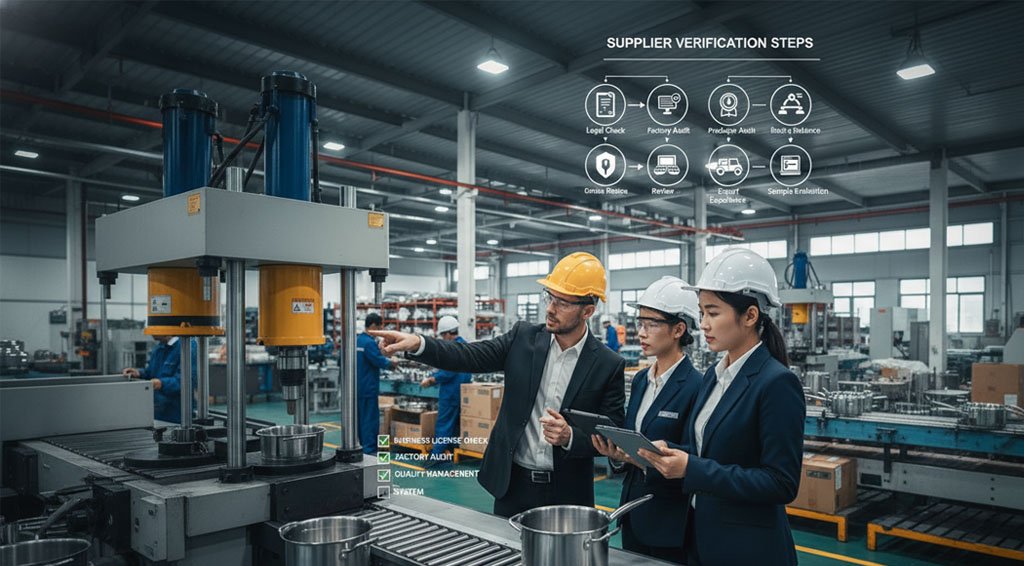
In our experience, the initial supplier selection phase is the most critical. A mistake here can cause problems all the way down the line. That's why we always recommend a multi-step verification process before placing any order. It's about moving from a long list of potential suppliers to a shortlist of qualified partners. This process requires a blend of online research and, most importantly, on-the-ground investigation. As a purchasing agency based in Yongkang, this is a core part of the value we provide.
Differentiating Factories from Trading Companies
A common challenge for overseas buyers is telling the difference between a true manufacturer and a trading company. Both have their place. A factory gives you direct communication, better pricing, and more control over production. A trading company might offer a wider product variety and lower Minimum Order Quantities (MOQs). The key is to know who you are working with. We check business licenses and perform on-site audits to confirm if they have actual production lines or just a showroom.
Key Verification Steps
A proper factory audit is non-negotiable. We don't just look at their samples; we assess their entire operation. Here are the steps we typically follow for our clients:
| Verification Step | Purpose |
|---|---|
| Business License Check | Confirms the company is legally registered and its official business scope. |
| On-Site Factory Audit | Assesses production capacity, quality management systems (like ISO 9001), and working conditions. |
| Production Line Review | Checks if their equipment is suitable for manufacturing your specific kitchenware product. |
| Past Performance Check | Reviews their experience exporting to your target market (e.g., North America, Europe). |
| Sample Evaluation | Tests a sample product to confirm their ability to meet your quality standards. |
This detailed approach ensures we partner with suppliers who are not only capable but also reliable for long-term business.
What Are the Key Quality Control Checks for Kitchenware?
Worried about receiving a shipment of defective kitchenware? A single quality failure, like a faulty non-stick coating or a weak handle, can lead to customer complaints, negative reviews, and significant financial loss.
Key QC checks for kitchenware include raw material inspection (e.g., stainless steel grade), in-process checks for defects, and pre-shipment inspections covering function, safety, and packaging. Food-grade material testing is absolutely non-negotiable for compliance and consumer safety.
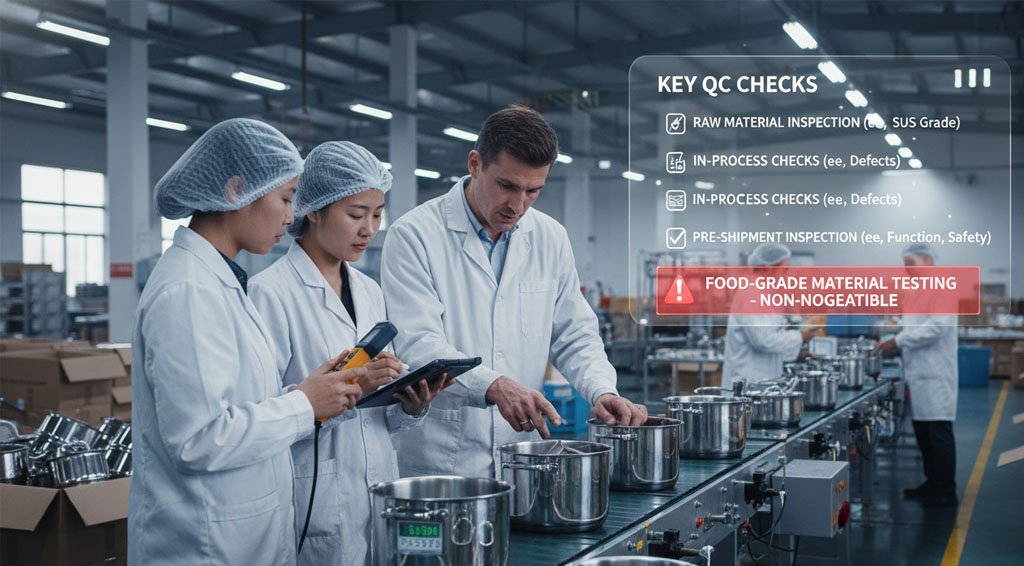
Quality isn't something you check for at the end; it's something you build into the entire production process. As a sourcing agency, we implement a multi-stage quality control plan for our clients. This prevents small issues from becoming big, expensive problems. A container of faulty goods arriving at your warehouse is a nightmare scenario that can be avoided with proactive inspections. It's about setting clear standards with the factory from day one and verifying them at critical milestones.
Pre-Production: Material Verification
The process starts before mass production even begins. For kitchenware, this is all about the raw materials. If a supplier uses a cheaper, non-food-grade stainless steel (like 201 instead of 304) to cut costs, your product could rust and fail safety tests. We always demand material certificates from the supplier and, for critical projects, will send material samples to an independent lab for verification. This ensures the foundation of your product is solid.
During Production: In-Process Inspections (DPI)
Once production starts, we arrange for in-process inspections. This means our team will go to the factory floor to check the products as they are being made. This is crucial for catching systematic issues early. For example, if we find scratches on the first batch of non-stick pans coming off the line, we can address the root cause immediately, rather than discovering that 10,000 pans are scratched during the final inspection.
Pre-Shipment Inspection (PSI)
The final step is the Pre-Shipment Inspection, based on AQL (Acceptable Quality Limit) standards. We randomly sample a statistically significant number of finished units and check them against a detailed list.
Here is a simplified example checklist for a stainless steel cooking pot:
| Check Category | Specific Points to Inspect |
|---|---|
| Visual Defects | Scratches, dents, polishing marks, incorrect logo placement. |
| Functional Tests | Lid fits securely, handle is firmly attached (pull test), pot sits flat on a surface. |
| Measurements & Specs | Dimensions match the approved design, material thickness is correct. |
| Packaging & Labeling | Correct barcode, proper inner and master carton packaging, drop test for durability. |
Only after a shipment passes this final inspection do we approve it for payment and shipping.
How Do You Manage Logistics and Compliance for Kitchenware Imports?
Ever had a shipment stuck at customs? Compliance issues can cause costly delays, fines, or even seizure of your goods, disrupting your entire supply chain and turning a profitable order into a loss.
Managing logistics involves choosing the right shipping method, coordinating with a reliable freight forwarder, and preparing all necessary customs documents. For compliance, you must ensure your products meet your target market's food-contact material regulations, like FDA or LFGB, before shipping.

Getting your product manufactured correctly is only half the battle. Getting it from the factory floor in China to your warehouse or distribution center is a complex process filled with potential pitfalls. As a one-stop sourcing agency, our job extends beyond the factory gate. We help our clients navigate the often-confusing world of international shipping, customs, and regulatory compliance. Proper planning here is just as important as it is in the production phase.
This is the single most important compliance area for kitchenware. Products that come into contact with food are heavily regulated. The specific regulations depend on your sales market. For example:
- USA: The Food and Drug Administration (FDA) sets the rules. Your products must be made from materials that are approved for food contact.
- European Union: The LFGB (Lebensmittel-, Bedarfsgegenstände- und Futtermittelgesetzbuch) standard is one of the most comprehensive. Products must pass stringent tests to get the "food safe" knife and fork symbol.
We work with clients to identify the required tests for their market and coordinate with certified third-party labs like SGS or TUV to get the products tested and certified. This must be done before shipping.
The Value of Consolidation
Many of our clients, especially e-commerce sellers, source from multiple suppliers. They might get stainless steel pots from one factory, silicone utensils from another, and bamboo cutting boards from a third. Shipping these orders separately would be incredibly expensive. This is where our 10,000㎡ warehouse in Yongkang becomes a huge asset. We can receive goods from all these different suppliers, consolidate them into a single shipment, and manage the export as one container. This dramatically reduces per-unit shipping costs and simplifies the import process for the client.
Why Is Yongkang a Key Hub for Sourcing Kitchenware?
Tired of generic advice about sourcing in China? Sourcing from the wrong region can mean higher prices, lower quality, and access to fewer specialized suppliers who truly understand your product category.
Yongkang, in Zhejiang province, is known as China's "Hardware Capital" and is a major manufacturing hub for stainless steel kitchenware like vacuum flasks, cookware, and utensils. Its concentrated supply chain means competitive pricing, skilled labor, and easy access to raw material suppliers.
While you can find kitchenware suppliers all over China, sourcing from a specialized industrial cluster offers significant advantages. These clusters are geographic areas where suppliers, raw material providers, and skilled labor for a specific industry are all concentrated. For metal and stainless steel kitchenware, Yongkang is one of the most important clusters in the world. Being a sourcing agency based right here gives us and our clients a powerful home-field advantage.
Yongkang's Specialization
Yongkang's expertise is in metal processing. This city is a global leader in producing:
- Stainless Steel Vacuum Flasks & Travel Mugs: The technology and machinery for creating vacuum insulation are highly concentrated here.
- Cookware: Factories specialize in producing stainless steel and aluminum pots, pans, and pressure cookers.
- Metal Utensils: Items like whisks, spatulas, and other stainless steel kitchen tools are mass-produced efficiently.
- Small Kitchen Appliances: Many factories also produce electric kettles, grinders, and blenders.
This specialization means the local factories have deep expertise, experienced engineers, and a workforce skilled in the specific techniques required for these products.
The Ecosystem Advantage
The true power of an industrial cluster like Yongkang is the complete supply chain ecosystem. A factory making a stainless steel pot doesn't have to import handles from another province. There is likely a specialized handle factory just a few kilometers away. The same goes for lid manufacturers, polishing workshops, and packaging suppliers. This proximity reduces transportation costs, shortens lead times, and allows for much faster problem-solving. If there is an issue with a component, we can often visit both the main factory and the component supplier on the same day to find a solution. This level of integration is a massive competitive advantage that benefits every client we work with. Our physical presence here in Yongkang allows us to leverage this ecosystem directly.
Conclusion
Sourcing kitchenware from China requires a focus on qualified suppliers, strict quality control, and careful management of compliance. A local China sourcing agent in a hub like Yongkang simplifies it all. Ready to build a reliable supply chain? Contact Auro Sourcing today.