

Your brand is built on adventure, but sourcing outdoor gear is risky. A leaking tent or a backpack with a broken zipper doesn't just ruin a trip; it ruins your reputation.
Material quality in outdoor gear is defined by verifiable technical specifications like fabric denier and waterproof ratings (HH). Durability is proven through rigorous functional testing of seams, zippers, and load-bearing components. A local China sourcing agent is essential to enforce these standards before shipment.
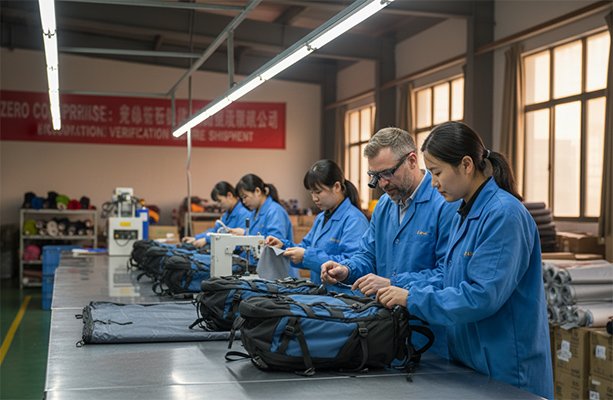
The difference between a top-rated product and a one-star failure often comes down to details that are invisible to the untrained eye. It’s the quality of the fabric's PU coating or the bar-tack stitching on a strap. As a sourcing agency, we've spent years on the factory floors here in China, learning to identify these critical details. A successful outdoor product isn't just designed well; it's manufactured and verified with zero compromise. Let's explore how to ensure your gear is built to last.
Why Is the Right Manufacturing Cluster Key for Durable Gear?
You've found a "tent factory" online, but what about the poles, zippers, and stakes? Sourcing from a generalist supplier means they are outsourcing these critical components, leaving you with little control over their quality and consistency.
The right manufacturing cluster provides an ecosystem of specialized suppliers. For outdoor gear with metal components—like tent poles, camping furniture, or stoves—a hardware hub like Yongkang offers direct access to expert factories, ensuring every part of your product is built to last.
While technical apparel is often centered in provinces like Fujian and Jiangsu, the structural backbone of much outdoor gear—the hardware—has its own centers of excellence. Yongkang, as China's "Hardware Capital," is a prime example. For any product that relies on the strength and precision of metal components, sourcing from this cluster provides a massive advantage. Our presence here allows us to manage not only the final assembly but also the quality of the critical hardware components at their source.
The Power of a Dual-Cluster Strategy
A great tent combines two things: high-performance technical fabric and a strong, reliable frame. A successful sourcing strategy often involves leveraging the strengths of different industrial clusters. We help clients manage this by:
- Sourcing Fabrics: Working with specialized textile mills in regions known for technical fabrics (e.g., Jiangsu) to get the right waterproof, breathable, and lightweight materials.
- Sourcing Hardware: Partnering with expert factories in Yongkang for the production of aluminum poles, steel stakes, metal buckles, and other structural parts.
Yongkang's Hardware Advantage
For the hardware that makes or breaks outdoor gear, Yongkang's expertise is unmatched. This is where we source:
- Tent Poles & Frames: Factories specializing in high-strength aluminum alloys (like 7001 series) with precision connectors.
- Camping Furniture: Robust steel or aluminum frames for camping chairs and tables, engineered for stability and load-bearing.
- Cookware & Stoves: Stainless steel and aluminum camp stoves, pots, and utensils designed for durability and performance.
- Carabiners & Connectors: Forged hardware where strength and reliability are non-negotiable.
By managing suppliers in the correct clusters, we ensure that every single component of our clients' products meets the required standard.
How Do You Verify the Technical Fabrics and Materials?
Your product spec sheet says "5000mm waterproof," but customers are complaining about leaks in a light rain. The factory cut costs on the PU coating, and now your entire inventory is compromised.
To verify technical fabrics, you must go beyond the supplier's claims. Demand fabric spec sheets and then send samples to a third-party lab to test key metrics like Denier (strength), Hydrostatic Head (waterproofing), and coating quality. This is the only way to guarantee performance.
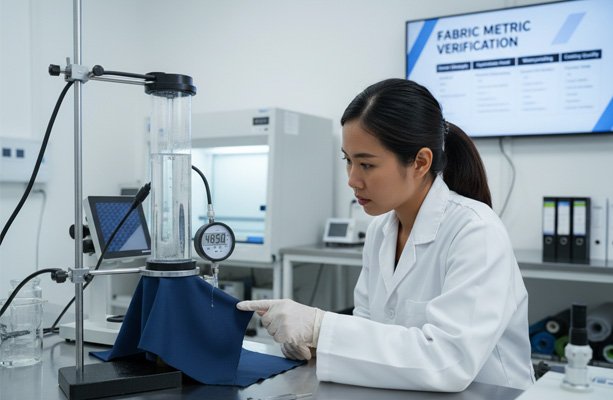
The fabric is the first line of defense against the elements, and its technical specifications are not just marketing terms—they are measurable performance indicators. We never take these specs for granted. A core part of our QC process for outdoor gear is to treat the fabric itself as a critical component that needs independent verification. A small investment in lab testing can save you from a catastrophic quality failure across thousands of units.
Fabric Strength: Denier and Weave
The "D" in "600D Polyester" stands for Denier, a measure of the fiber's thickness. A higher denier generally means a thicker, more abrasion-resistant fabric. However, the weave (e.g., ripstop, plain, oxford) also plays a huge role in tear strength. For a backpack, a 400D-600D is common for the main body, while the base might use a heavier 1000D fabric like Cordura for extra durability. We use digital microscopes and calipers to verify these specs against the approved sample.
Waterproofing: Hydrostatic Head (HH)
This is the most critical metric for tents, rain jackets, and pack covers. It measures how much water pressure a fabric can withstand before it leaks.
- 1,500mm HH: Considered waterproof for light rain.
- 3,000mm - 5,000mm HH: Suitable for moderate to heavy rain and typical for quality tents.
- 10,000mm HH+: Used for extreme conditions.
We facilitate lab tests where a column of water is placed on the fabric to determine the exact HH rating, ensuring the factory's production batch meets the standard you are paying for.
| Fabric Metric | What It Measures | Why It's Critical |
|---|---|---|
| Denier (D) | Thickness of the individual fibers. | Determines abrasion resistance and overall ruggedness. |
| Hydrostatic Head (HH) | Water pressure resistance before leaking. | The primary measure of how waterproof the fabric is. |
| Coating (PU/Silicone) | The waterproof layer applied to the fabric. | Coating quality and thickness directly impact the HH rating and longevity. |
| Stitch Count | Stitches per inch (SPI). | Higher SPI generally indicates stronger, more water-resistant seams. |
What About the Hardware? Aren't Zippers and Buckles the Weakest Links?
A customer buys your premium backpack, but the main zipper splits on their first hike. The product is now useless, the customer is furious, and a damaging one-star review is inevitable.
Hardware is a notorious failure point. The solution is to specify reliable, branded components (like YKK® zippers and Duraflex® buckles) in your tech pack and then conduct rigorous cycle and load tests during the pre-shipment inspection to verify both authenticity and function.
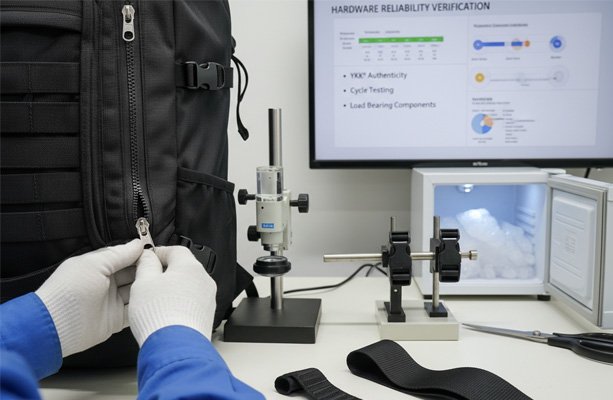
A $50 backpack can be ruined by a $0.10 zipper. This is a lesson many new brands learn the hard way. We stress to our clients that hardware is not the place to cut costs. The perceived quality and long-term durability of outdoor gear are disproportionately affected by the performance of its zippers, buckles, and straps. Our QC process includes dedicated checks for these small but mighty components.
Zippers: The #1 Failure Point
There is a vast difference in quality between generic zippers and those from a reputable brand like YKK. We check for:
- Authenticity: We inspect for genuine brand markings. Counterfeits are common.
- Type: Is it the correct type for the application (e.g., coil for flexibility, Vislon® for strength, AquaGuard® for water resistance)?
- Function: We cycle the zipper open and closed 50-100 times to check for snags, sticking, or separation.
Buckles and Straps
A buckle that shatters in the cold or a strap that slips under load is a critical failure.
- Buckle Material: We specify high-quality plastics like POM (Polyoxymethylene), which is strong and performs well in cold temperatures, over cheaper, brittle alternatives. We then test a sample by stressing it and even freezing it to check for brittleness.
- Webbing: We check that the supplier has used Nylon webbing (strong, durable) instead of Polypropylene (cheaper, degrades in sunlight, slips more easily).
- Stitching: We look for bar-tacking—a series of dense stitches—at all high-stress points where straps are attached to the bag. The absence of bar-tacking is a sign of a low-quality product.
How Do You Test for Real-World Durability Before Shipping?
The "Golden Sample" you approved was perfect, but how do you know if the 5,000 units from mass production have the same seam strength and load capacity? A product that fails under real-world stress is a liability.
Real-world durability is confirmed through a series of functional and destructive tests during the Pre-Shipment Inspection. This includes seam pull tests, load-bearing tests on frames and straps, and waterproof testing on fully assembled products to simulate actual use and abuse.
You can't know if a tent is waterproof until you spray it with water. You can't know if a backpack strap is strong until you pull on it with significant force. Our on-site inspectors perform these tests to simulate the lifetime of wear and tear a product will face. This is about moving beyond visual checks and gathering objective data on whether the product is truly fit for purpose.
Load-Bearing and Stress Tests
We push the product to its limits to find the weakest point.
- Backpack Load Test: We fill a sample backpack with a specified weight (e.g., 20kg for a hiking pack) and hang it by its straps for a set period. We also lift and drop it repeatedly to simulate being picked up and put down, then inspect all seams and attachment points for failure.
- Chair Stability & Load Test: We place a heavy, distributed weight on a camping chair to test its static load capacity. We also apply forces to the sides to ensure it doesn't tip over easily.
Seam and Water-Resistance Testing
These tests check the integrity of the assembly itself.
- Seam Pull Test: We use a force gauge to pull on seams to ensure the stitching doesn't unravel.
- Tent Waterproof Test: We set up a sample tent from the production line and spray it with water from all angles for a prolonged period, simulating heavy rain. We then inspect the interior for any leaks, especially around the seams and zippers.
These tests provide the final, crucial confirmation that the bulk production batch has been manufactured to the same standard as the approved sample.
Conclusion
Sourcing durable outdoor gear is about verifying technical materials and conducting relentless real-world testing. A China sourcing agent on the ground is your best defense against quality failure. Ready to build gear that lasts? Contact Aurosourcing today.