

A great smart home product idea can quickly become a liability. One missing certificate or privacy flaw can lead to customs seizures, bad reviews, and lost customer trust.
To safely source smart home devices from China, you must verify certifications, data privacy policies, software support, and ecosystem compatibility before placing bulk orders. A reliable partner isn't just a factory; it's a supplier who manages hardware, software, and long-term compliance as a complete system.
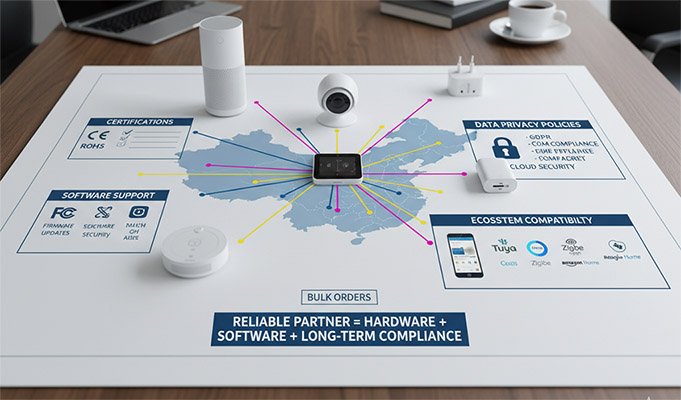
Smart home products are one of the most exciting categories to source right now. They hit a sweet spot of high consumer demand and great branding potential. But I've seen firsthand how their complexity can sink a project. Once a device connects to Wi-Fi, a mobile app, or a cloud server, the sourcing risks multiply. It's no longer just about the physical product's look and feel.
Many importers learn this lesson the hard way. They get a great price from a supplier, approve a polished sample, and wire the deposit. The problems—unstable apps, mismatched certifications, or privacy complaints—only surface after the products are in their customers' hands. That's why my team at Auro Sourcing and I insist on a more structured evaluation from day one. It's the only way to protect your investment and your brand.
Why is sourcing smart home devices different from sourcing ordinary electronics?
Many buyers treat smart home devices like regular electronics. This is a costly mistake that creates hidden compliance headaches and after-sales nightmares down the line.
Smart home sourcing is more complex because it involves a complete ecosystem of hardware, wireless tech, software, cloud services, and user data. You must evaluate this entire system, not just the physical product, to avoid critical risks that can damage your business.
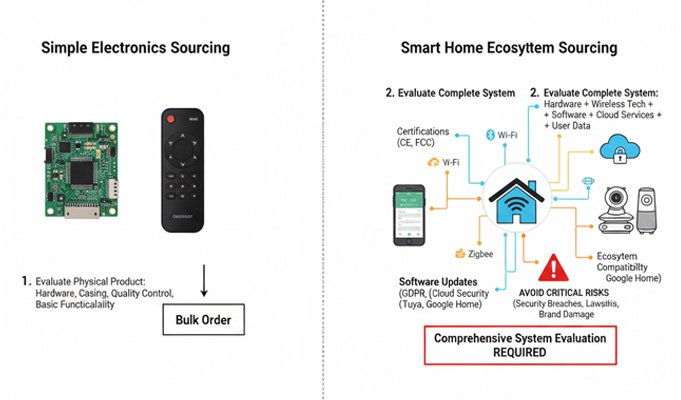
When we source a standard electronic item for a client, like a USB fan, our main focus is on safety, material quality, and function. A smart home device, however, is a different beast entirely. A smart plug, sensor, or camera depends on a connected ecosystem to function. I have to look at the wireless modules, the app pairing process, the firmware update mechanism, and the cloud servers that hold it all together. The sourcing risk expands far beyond the factory floor.
For an overseas buyer, the key question isn't just "Does the sample work?" It's "Will this product keep working reliably and compliantly in my target market a year from now?"
The Sourcing Risk Checklist
I often explain the difference to clients using a simple comparison. An ordinary product's risks are mostly physical and visible. A smart product's biggest risks are often invisible.
| Area | Ordinary Electronics | Smart Home Devices |
|---|---|---|
| Main Concern | Product quality and safety (e.g., Is it built well?) | Quality, connectivity, privacy, and software stability (e.g., Is it secure and supported?) |
| Compliance Scope | Simpler (e.g., basic safety, EMC) | Complex (e.g., radio frequency, data privacy laws, interoperability) |
| After-Sales Risk | Mostly hardware defects | Hardware + app bugs + firmware issues + cloud dependency |
| My Verification Focus | Factory audit and pre-shipment QC | Factory, certifications, firmware, app, and data handling protocols |
This is why, after 13+ years in this business, I've learned to screen smart home suppliers with a much finer-toothed comb than I use for general electronics. The potential for failure is simply higher.
Which certifications should you check before placing an order?
A product can look perfect and function flawlessly in a demo. But if the certification package is incomplete or mismatched, it's effectively unsellable in many markets.
Before ordering, you must verify that the product holds the correct wireless, safety, and material compliance certifications for your target market. Crucially, confirm the documents match the exact model, wireless module, and firmware version you are actually purchasing.
Certification isn't just a box to tick; it's your ticket for market access. If you're selling in the US, FCC compliance for wireless communication is non-negotiable. For Europe, you'll need a CE mark, which often involves the Radio Equipment Directive (RED). I always check for RoHS compliance too, as major platforms and distributors now expect it as standard.
Lately, interoperability standards like Matter are becoming just as important. While not always a legal requirement, a Matter logo is a powerful trust signal for consumers. I had a client recently who chose a slightly more expensive supplier specifically because their Matter integration was seamless, knowing it would reduce customer support tickets later.
How I Verify a Supplier's Claims
I never accept a single certificate PDF at face value. I ask for the full documentation package to cross-reference everything. This is a core part of the value we provide at Auro Sourcing.
| Document / Proof | Why I Insist on Seeing It |
|---|---|
| FCC / CE / RED Test Reports | To confirm it passed regulatory testing, not just that a certificate exists. |
| RoHS Documents | To prove restricted substance compliance for the specific materials used. |
| Declaration of Conformity (DoC) | To see the manufacturer's formal, legally-binding claim of compliance. |
| Product Spec Sheet | To confirm the model number and technical specs match the certified product. |
| Module Information | To prevent "silent swaps" where a cheaper, uncertified wireless module is used. |
| Firmware/Version Reference | To ensure the certified software is what's being loaded onto the final units. |
My job as your sourcing agent is to compare every one of these files against your quoted SKU and the physical sample. This detailed work upfront is what prevents disastrous surprises at customs.
Why should privacy and cybersecurity be part of supplier selection?
A factory can deliver your hardware on time, but if its software has weak privacy, it can destroy your brand's reputation with customer complaints and platform delistings.
Privacy is a critical sourcing checkpoint because smart devices handle user data. Before committing, you must understand the supplier's data collection policies, password security, update mechanisms, and cloud dependencies. A supplier who can't explain these things is a major red flag.
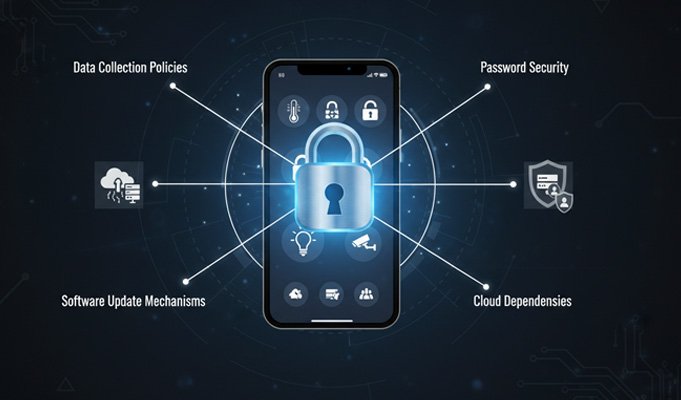
In traditional sourcing, we rarely talked about data privacy. With smart home products, it's one of the first things I bring up. When you ask a customer to put your device on their home network, you are no longer just selling them hardware; you are asking for their trust. This elevates the standard for supplier screening.
I ask suppliers direct questions: What data does the device collect? Is local control possible without a cloud connection? How are passwords and credentials protected? How are security patches delivered? A good supplier has clear, confident answers. A weak supplier will be vague or evasive.
Your Brand's Digital Reputation
Many sourcing projects fail when a product technically works but alienates users. This happens when the app demands too many permissions, the privacy policy is confusing, or the device relies on a third-party cloud service that the supplier doesn't even control. Your brand takes the blame for these issues, not the factory.
Here’s a practical privacy checklist I use during supplier evaluation:
| Checkpoint | What I Confirm for My Clients |
|---|---|
| Data Collection | What specific data is collected and is there a legitimate reason for it? |
| Storage Method | Where is the data stored (e.g., locally, specific country server)? |
| Account Model | Is a user account mandatory? Can the device function without one? |
| Password Security | Does it enforce strong passwords and block default credentials? |
| Update Path | Is there a reliable Over-The-Air (OTA) system for security patches? |
| Cloud Dependency | What happens if the cloud service goes down? Does the device become a brick? |
| App Ownership | Who truly owns and maintains the app? Can they lock you out? |
For importers and wholesalers, overlooking privacy isn't just a legal risk. It’s a direct threat to your product's longevity and your company's reputation.
How can you verify if a smart home supplier is truly reliable?
Polished samples and a stack of certificates look impressive. But they don't prove a supplier can support a complex smart home product for its entire lifecycle.
A truly reliable smart home supplier demonstrates control over certifications, engineering, app maintenance, firmware updates, and product changes. You must verify this entire support system, not just their sales pitch or the physical appearance of the factory.
The most common mistake I see is trusting a supplier too early. In practice, the real risks are hidden in the engineering and software supply chain. Some factories are just assemblers; they don't control the app, cloud, or firmware team. They might use a solution from an external design house or a white-label software partner.
This isn't necessarily a deal-breaker, but it means I need to dig deeper. I need to map out who controls what. If there's a critical bug after launch, who is responsible for fixing it? If the app needs an update to comply with new app store rules, who will do the work?
Auditing the Full Ecosystem, Not Just the Factory
Being based here in Yongkang, the heart of Zhejiang's hardware manufacturing hub, gives us at Auro Sourcing a huge advantage. I can visit a factory on short notice. But I don't just look at the assembly line. I ask to speak with the engineers. I want to understand their process for engineering change control and firmware versioning. This simple conversation often reveals more than a dozen emails.
| Verification Point | Why It's a Critical Part of My Audit |
|---|---|
| Factory Capability | Confirms they can produce consistently and have solid QC processes. |
| Module Consistency | Prevents unapproved component swaps that void certifications. |
| Firmware Responsibility | Clarifies who fixes bugs and security issues. Is it an in-house team? |
| App Ownership/Licensing | Avoids future disputes over access, branding, or maintenance fees. |
| Engineering Change Control | Reduces the risk of "silent updates" that break compatibility or compliance. |
| After-Sales Support | Ensures there's a capable technical team to help resolve post-shipment issues. |
Finally, I always tell clients to test the product like an end-user, not a buyer. Pair it, reset it, check app permissions, and try a firmware update. This hands-on testing reveals usability and stability issues that a spec sheet never will.
How can you build a safer sourcing process for smart home devices?
A safer sourcing outcome isn't about luck or finding a supplier who makes great promises. It comes from having a disciplined, multi-stage process that verifies everything.
Build a safer sourcing process by starting with market requirements, then systematically checking certifications, testing samples, reviewing privacy, assessing engineering control, and running a pilot order before committing to mass production. Don't skip steps.
A structured approach reduces both compliance and commercial risk. Instead of jumping straight to price negotiation, I guide my clients to begin by defining their target market, brand positioning, and ecosystem expectations (e.g., must work with Alexa). Only then do we begin screening suppliers based on their ability to meet those specific needs.
This is the exact structured process we use at Auro Sourcing. It may feel slower at the start, but it consistently saves our clients huge amounts of time and money by preventing problems before they happen.
The Aurosourcing Staged Verification Process
| Stage | Our Main Objective for You |
|---|---|
| 1. Market Definition | Clarify destination market regulations and commercial requirements. |
| 2. Supplier Pre-Screening | Filter suppliers by matching their product and support capability to your needs. |
| 3. Document Review | We chase down and cross-verify all certifications, test reports, and technical files. |
| 4. Hands-On Sample Testing | We validate function, pairing, stability, updates, and compatibility for you. |
| 5. Privacy & Security Review | We assess the data handling, permissions, and cloud structure for red flags. |
| 6. Engineering Assessment | We confirm accountability for firmware, hardware changes, and long-term support. |
| 7. Pilot Production Run | We test the supplier's consistency on a small batch before you scale. |
| 8. Pre-Shipment Inspection | We check final production for quality, version control, and packaging accuracy. |
For overseas buyers without a local team in China, managing this process is nearly impossible. This is where a partner like Auro Sourcing becomes essential. The most successful projects I've managed aren't the ones that moved fastest at the quotation stage. They are the ones that were the most disciplined in verifying details before mass production began.
Conclusion
Sourcing smart home devices is about more than buying hardware. It’s about securing a complete ecosystem of certifications, privacy, and long-term support to ensure your product can succeed and scale safely.
Ready to source your smart home device with confidence? Send us your RFQ or product specs. My team and I at Auro Sourcing are here to help you build a safer, more reliable sourcing plan from the ground up.