

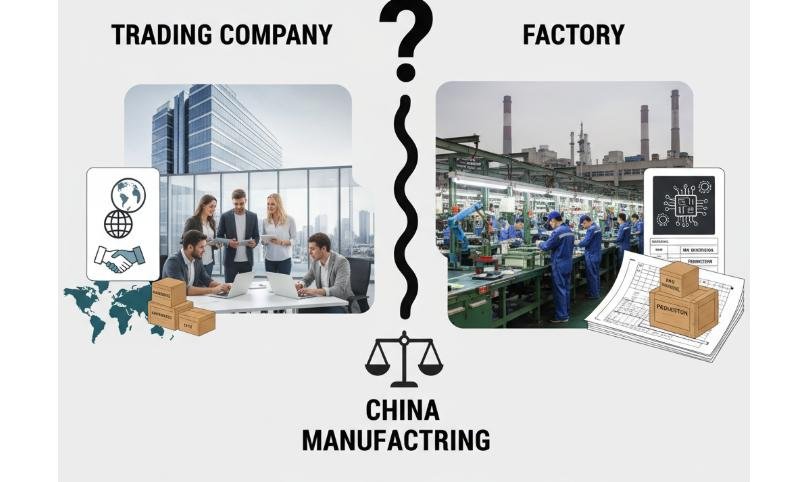
China is a massive source of international products.When sourcing products from China, all importers are puzzled with the question, “Am I dealing with a factory or a trading company?”The confusion occurs because both appear the same on the surface. They respond quickly, speak English, send their catalogs, offer competitive prices, and claim to provide easy exports. Most of them even identify themselves as manufacturers. This misunderstanding can cause real problems.
Buyers often believe they are negotiating directly with a factory. Later, they discover that a middleman controls the deal. This can affect pricing, quality control, production speed, and even the liability in the event of any wrongdoing.
To new importers, the risk and cost are raised due to the lack of clarity. Understanding the difference between trading companies and factories in China can help to avoid the issue. We have made this detailed guide, so you can easily identify which one you are dealing with: trading companies or factories.
What Are Trading Companies?
A trading company is a bridge between the buyers and the factories. It is not a producer of its own products. Rather, it orders products in one or more factories and sells them to foreign clients.
The majority of trading companies are stationed in urban centers, not in the industrial territory. Their departments are concerned with sales, suppliers, and customers. Their large number of factories allows them to provide a large range of products and be flexible with their order quantities. This renders them appealing to first-timers and importers who have a small business.
A trading company offers a user-friendly experience by handling the entire process door-to-door. It coordinates with multiple factories across different product categories. This allows buyers to work with a single point of contact. The company can consolidate all products into one shipment. This saves time, reduces complexity, and minimizes risk for buyers.
Example: Suppose a buyer wishes to obtain various products that are not related, like phone accessories, home decoration products, and promotional gifts. Then a trading company can handle all suppliers and ship all the products as one shipment. The buyer is able to have a single contact rather than a number of factories.
Trading companies make money by marking up factory prices. It is also an additional obstacle to transparency, as the buyer no longer holds direct control over the production process.
What Are Factories?
A factory directly produces goods using its own equipment, workers, and processes. It manages raw materials, production plans, quality levels, and production capacity. The factories tend to focus on a single type of product or a limited product range.
The majority of factories are located in industrial zones or manufacturing parks located outside of the major cities. They spend a lot of money on equipment, moulds, and a professional workforce. They are aimed at achieving high volumes of production efficiently and consistently.
Example: Let’s take an example of a stainless steel cookware-making factory. It understands metal grades, polishing methods, thickness control, and safety standards in detail. This level of specialization allows factories to offer better pricing and stronger quality control. You also have the option for customization.
The Differences Between Trading Companies and Factories
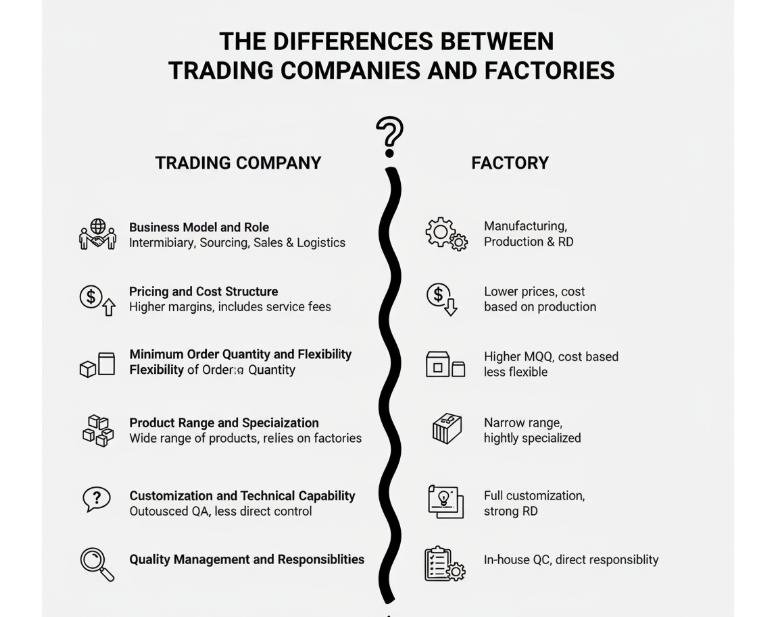
Business Model and Role
The most fundamental difference lies in what each one actually does. A factory manufactures products. A trading company manages transactions and relationships. When you purchase from a trading company, you indirectly purchase from the factory.
This disparity applies to all sourcing processes, including pricing problem resolution. Through a factory, you will be able not be able to negotiate with the individuals who dictate production. In the case of a trading company, you may take their help to do the trade more easily.
Pricing Structure
The unit prices provided by the factories are often lower, particularly when there are large orders, since they are sold directly.
Trading companies include a markup to cover their service, risk, and profit. The markup can be minimal; however, in some instances, it may be high in terms of price markup. In the case of small orders, the distinction can be insignificant.
That said, trading companies sometimes negotiate aggressive factory pricing and accept smaller margins to win business.
Minimum Order Quantity and Flexibility of Order Quantity
Factories design production lines for efficiency. Due to this reason, they tend to have a high minimum order quantity. Small orders hamper with workflow and make it less profitable.
The trading companies are more flexible. They believe that they can make combined orders with factories, since they receive orders from several buyers. This enables them to serve lower amounts of individual customers.
For startups or test orders, this flexibility can be valuable. In the case of well-known brands, factory MOQs can be easy to manage and profitable.
Product Specialization
Factories are depth-oriented and not breadth-oriented. They focus on a single or two products related to it and streamline their operations over time.
Trading companies are concerned with diversification. A trading company sells electronics, textiles, kitchenware, and promotional items at the same time. All this variety of products nearly always points to the fact that the company does not produce the products itself.
This distinction is important since specialization is associated with greater consistency, whilst variety brings about greater convenience.
Customization and Technical Capability
Factories can meet your expectations and handle customization. They design molds, manipulate materials, and change the production processes according to the buyer's demands.
Customization requests are communicated to factories through trading companies, which ensure that your requirements are clearly understood and properly executed. They act as a reliable bridge between you and the factory, accurately conveying specifications and expectations. When language barriers exist, a trading company becomes the ideal solution, helping to prevent misunderstandings and ensuring smooth, efficient communication.
Quality Management and Responsibilities
The quality in the factories is manipulated throughout the level of production process. Buyers may not be able to inspect the factory, track production, and introduce inspection criteria.
Trading companies can act as your trusted partner by inspecting everything on your behalf, especially when you are unable to be on-site yourself. They can check product quality, quantities, packaging, and compliance with your requirements before shipment. By working directly with factories, trading companies help identify and resolve issues early, reducing the risk of defects or delays.
How to Identify Whether You Are Dealing With a Factory or a Trading Company?
Licensing
The Chinese business license is one of the easiest ways to understand. Each of the legitimate suppliers has one. The key detail lies in the business scope.
In case the license includes terms of manufacturing, production, or industrial processing, then the company probably has a factory. If the scope focuses on trading, wholesale, sales, or import-export services, the company functions as a trading company.
This document reveals the legal nature of the business, not just its marketing claims.
Identify Location
Another good signal to identify a factory is its location. Factories usually sit in industrial zones, manufacturing parks, or rural areas where production costs stay low. These places are large buildings, heavy machinery, and logistics access.
Trading firms tend to operate out of office space in the downtowns or commercial areas of cities. These places are right where sales teams belong and not production lines.
A supplier who does not provide an in-depth address should be treated as a red flag.
Factory Audit
A genuine factory can show you its production floor. They will be able to show you machines, employees, raw materials, and working production lines.
The trading firms usually do not show live factory tours or provide fake photos. In case of necessity, a local inspection agency should be hired to help you.
Product Range Evaluation
A single factory is rarely capable of efficiently producing a wide variety of unrelated products. When a supplier offers a large number of items that are not closely related, this usually indicates that the business is a trading company rather than a single factory. Trading companies work with multiple specialized factories, allowing them to source different product categories under one supplier relationship.
Technical Question Testing
Technical intensity is the distinction between factories and traders. Factories are able to explain material, machinery, molds, tolerances, and steps in production.
The trading companies would normally give general answers or take a long time to respond since they need to verify with the factory. A series of responses, such as we will check are often indicators of a go-between.
Export License Ownership
Some factories do not hold export licenses and rely on trading companies for shipping and documentation. When your supplier tells you that he will start exporting to another company, then it is likely that you are dealing with a factory behind a trading partner.
It is a normal arrangement, and it need not be bad, but you would know who has control over the other part of the process.
When to Choose a Trading Company?
Trading companies are the best when buyers require flexibility, smaller volumes, or a variety of products. They simplify sourcing, reduce coordination effort, and help new importers avoid operational complexity. They suit test orders, short-term projects, and mixed-product sourcing.
When to Choose a Factory?
Factories are appropriate for buyers who prefer low prices, quality, stability, custom-made, and scalability. These apply to brands that have steady demand and have specifications.
Final Thoughts
Hope you understood the difference between trading companies and factories in China. Choosing one influence expense, management, interaction, and long-term achievement. The trading companies are convenient and flexible. The factories provide efficiency, uniformity, and scale. Smart customers make decisions that are based on strategy, and not assumptions.