

Quality control is one of the most significant aspects of modern production and international trade. When products are produced in large quantities, inspection of every unit is hardly feasible and economical. This is why businesses use a common sampling technique. AQL, or Acceptable Quality Level, is one of the most widely used systems that can be employed in this manner. It helps purchasers and manufacturers agree on the acceptable level of defects. So the parties can determine when a shipment can be accepted or rejected.
AQL standards are utilized in various industries. They offer a reasonable and uniform means of quality measurement that does not slow down production. Let’s try to understand more about AQL standards.
What Are AQL Standards?
AQL is an acronym that denotes Acceptable Quality Level. It refers to the maximum number of defective units that can be considered acceptable in a batch of products during a random sampling inspection. It’s not possible to inspect all the items; instead, inspectors examine a sample of the entire production lot. Furthermore, it helps to determine whether the overall shipment meets the agreed-upon quality standard.
AQL provides an answer to a rather practical question: how many defects are acceptable before a shipment is rejected?
AQL values are typically expressed as percentages, such as 1.0%, 2.5%, or 4.0%. These percentages do not mean that exactly that number of defects is allowed in the whole shipment. Instead, it determines the number of defects allowed in the inspected sample based on standardized sampling tables.
The AQL standards are basically based on internationally recognized standards, such as ISO 2859-1. These standards are widely accepted. AQL provides a common language for quality expectations between buyers and suppliers worldwide.
Why Are AQL Standards Important?
The primary reason AQL standards are essential is that they strike a balance between quality expectations and practical limitations. In massive production, it is not feasible to achieve zero defects. AQL allows for minor controlled defects while maintaining the overall product quality.
AQL standards also safeguard the buyers and suppliers.
It is beneficial to buyers because they have clear guidelines on the acceptance and rejection of goods. They do not need to use subjective judgments.
This is favorable to suppliers as well, as they become aware of the level of quality required. They can plan their production processes. This trust and relationship in the business is aided by this openness over time.
The entire inspection is significantly more time-consuming than a sampling inspection. The shipment is handled efficiently, avoiding redundant inspections and wasting time. This is especially applicable to the international supply chain, where factors such as lead times, shipping dates, and market deadlines are decisive.
How AQL Inspection Works?
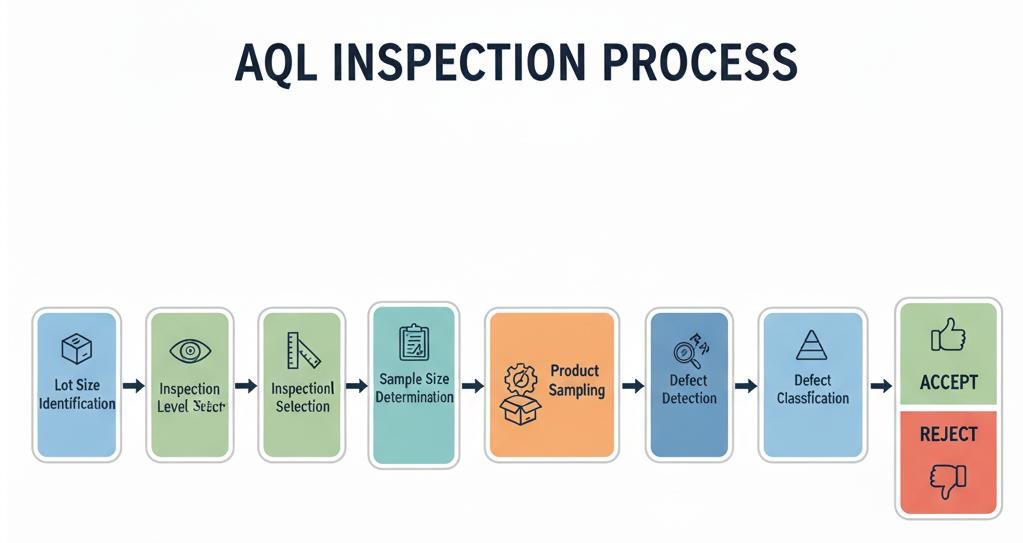
An AQL inspection follows a structured process. The details may vary slightly, but the core steps are the same for all industries.
Determine the Lot Size The lot size refers to the total number of units shipped. This may be 1,000 pieces to 100,000 pieces in number.
Choose the Inspection Level The majority use General Inspection Level II. This is an excellent compromise between accuracy and efficiency.
Select the Sample Size Using AQL tables, inspectors determine the number of units to be checked. It is basically based on the lot size and inspection level.
Inspect the Sample All the chosen units are checked for defects. Accidents are documented and categorized.
Step 5: Compare Results to AQL Limits If the number of defects stays within the allowed limits, the shipment passes. If not, it fails.
Industry Variations in AQL Standards
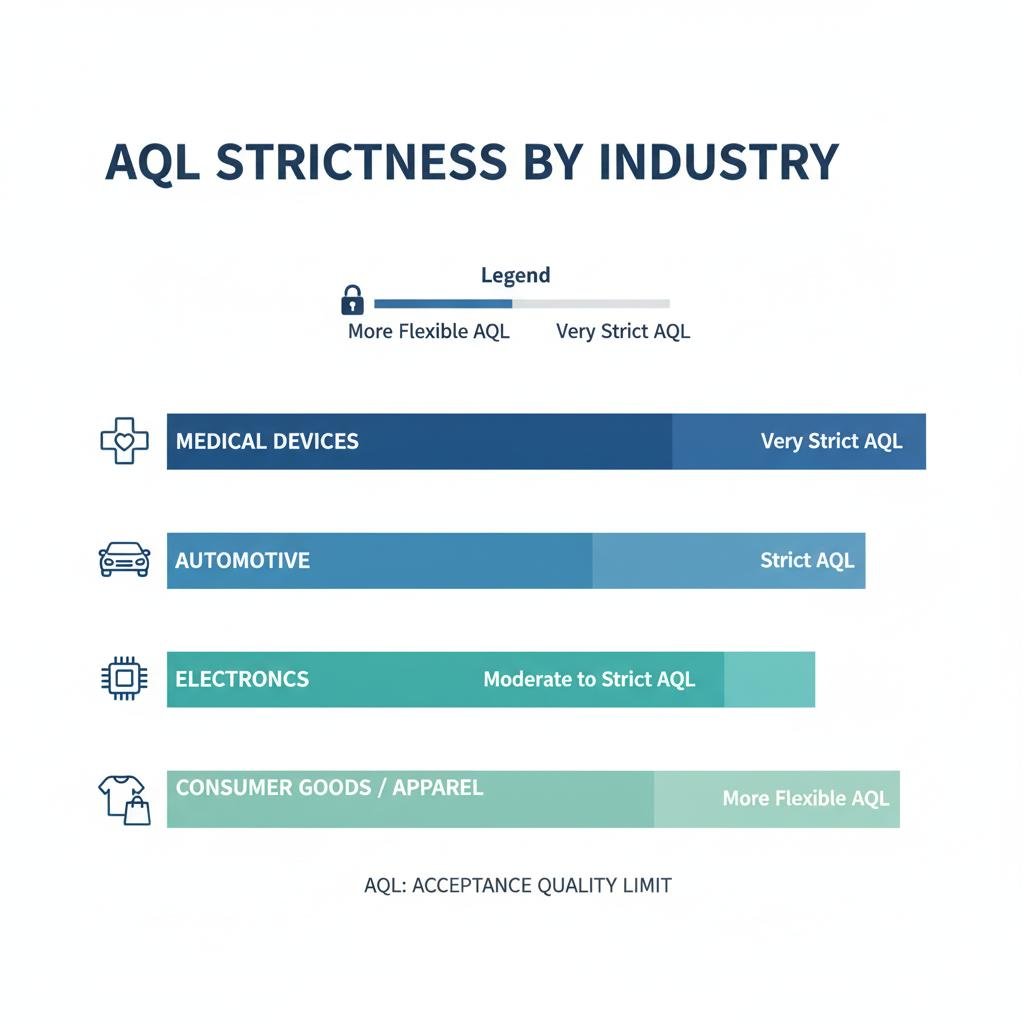
Standards of AQL differ in industries. Consumer goods, such as clothing or various household items, are expected to have higher AQL levels due to minor cosmetic defects, as they do not compromise the safety or functionality of the product. Of other industries:
Electronics Industry
The electronics industry uses higher AQL levels. Electronic products are sensitive, and any slight defect can lead to malfunctions, safety issues, and consumer dissatisfaction. For this reason, major defect AQL levels are often set lower for electronics, and critical defects are not tolerated at all.
Typical AQL levels:
- Critical defects: 0
- Major defects: 0.65 or lower
- Minor defects: 1.0
Medical Industry
Since these products are directly related to human health and safety, a single severe defect could lead to a severe outcome. Medical products tend to have very low AQL levels of major defects and zero tolerance against critical defects.
Typical AQL levels:
- Critical defects: 0
- Major defects: 0.65 or lower
- Minor defects: 1.0
Automotive
A malfunctioning component in a car may cause accidents, recalls, and lawsuits. That is why automotive companies attentively establish criteria for defects and rely on low AQL limits to provide high-quality standards.
Typical AQL levels:
- Critical defects: 0
- Major defects: 0.65–1.0
- Minor defects: 2.5
Categorizing Defects Using AQL Standards
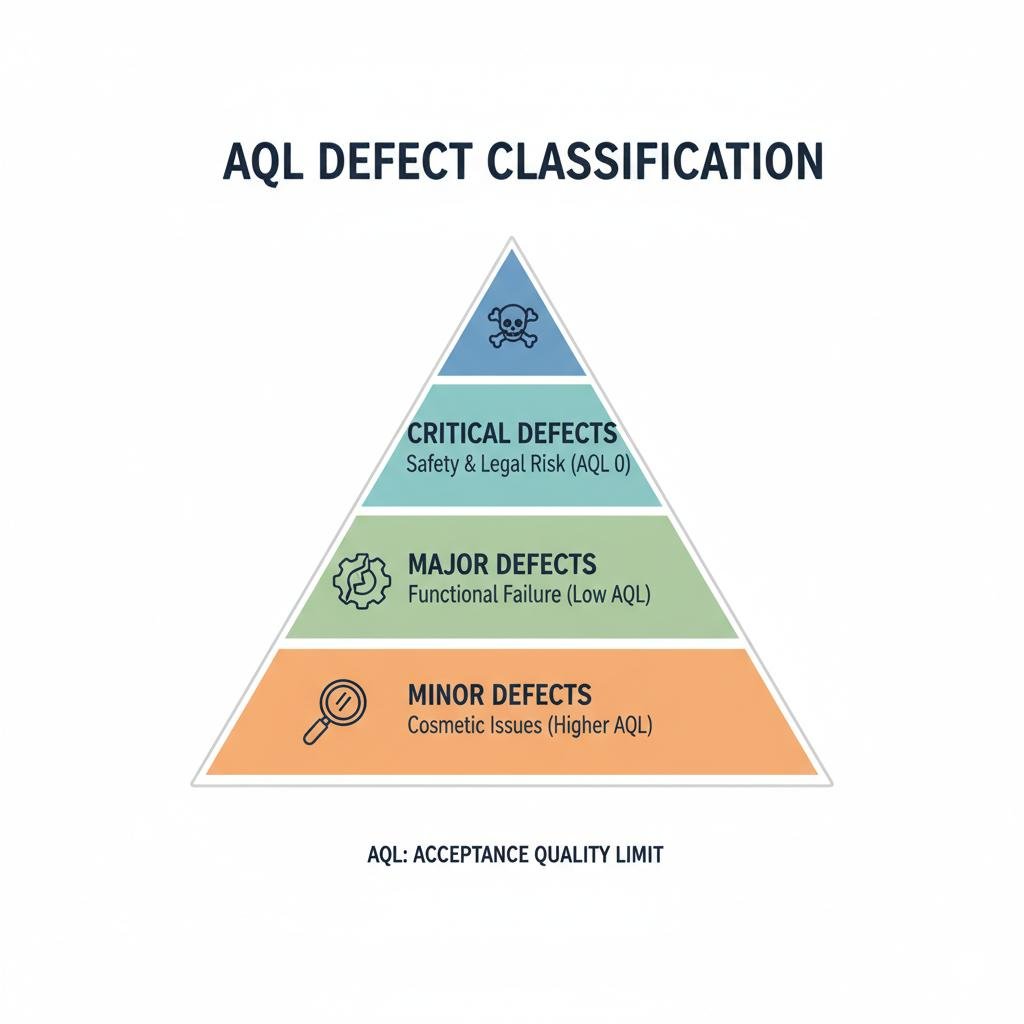
There are three typical types of defects. Each category indicates the severity of the defect and its potential impact. Have a look at the table for a better understanding:
| Defect Type | Risk Level | Examples | Typical AQL |
|---|---|---|---|
| Critical | Very High | Safety hazards, legal violations | 0 |
| Major | Medium | Functional failure, wrong specs | 1.0 – 2.5 |
| Minor | Low | Cosmetic flaws | 4.0 |
The most serious defects are those that are critical. These are flaws that may lead to injury, breach of safety regulations, or illegal sale of the product.
Major defects are not as severe as critical defects, yet they are still considerable. These flaws impact the functionality, usability, or performance of the product. The most minor defects are the least serious ones. These flaws have no impact on the product's functionality, but may decrease its outlook or quality.
Application of AQL in Real Life.
Garment Inspection
A factory produces 5,000 shirts. The major defects that are inspected by the inspectors are a sample of 200 units with an AQL of 2.5, and the minor defects are inspected with an AQL of 4.0. In case the number of defects detected remains within the acceptable limit, then the shipment is passed.
Electronics Inspection
Before shipping, an inspection of a shipment of power banks is conducted. Even just a few non-working units can reach the center of defect limit, and the shipment will be refused and will have to be reworked.
New Supplier Orders
In the case of a new supplier, the buyers tend to use a higher AQL level or perform more inspections to reduce the risk. With time, in case of quality enhancement, inspection requirements can be spared.
Choosing the Right AQL Level For Suppliers
The right AQL depends on several factors, including product type, market expectations, and legal requirements. Luxury or high-end brands may apply strict AQL criteria, as their customers demand nearly perfect quality. The higher AQL levels may be enabled through budget or promotional products to ensure competitive costs.
Legal and safety requirements are also significant. Goods and services that are highly regulated, such as those in the medical device or children's product industries, require a low AQL to comply with laws and standards. On the other hand, less risky products can be more flexible.
Finally, purchase agreements and quality specifications should be clearly spelled out in terms of AQL levels. To prevent misunderstandings, both the buyer and the supplier are required to agree on the definition of defects, inspection procedures, and acceptance criteria.
Limitations of AQL Standards
Although AQL is an effective quality control tool, it has its weaknesses. Because it is based on sampling, there is always a possibility that a flaw in the shipment will not be detected. AQL does not imply impeccable quality; it just gives a statistically reasonable risk level.
AQL does not serve well in minimal orders, where sampling can be irrelevant. A complete inspection or tailor-made quality control can be a better fit in such situations. Additionally, inspections, even with AQL levels, can lead to disputes in cases where there is a vague definition of defect criteria.
Conclusion
The AQL standards are crucial in contemporary quality management. It helps companies manage risks, costs, and quality throughout large-scale production. Being aware of the meaning of AQL standards and their differences across industries and companies will enable you to make informed quality decisions and establish more stable relationships with suppliers.
FAQs
What does 2.5% AQL mean? It means here 2.5% defective items are acceptable according to AQL tables. If the number of defects found in the sample exceeds the limit, the shipment fails inspection.
What are the four types of quality inspections? The four common types of quality inspections are Pre-production inspection, during production inspection, Pre-shipment inspection, and Container loading inspection.
What is the ISO standard for AQL? The ISO standard for AQL is ISO 2859-1. It defines sampling procedures and acceptance criteria for inspection by attributes.