

Food-grade silicone is not just a material choice. It is a market access decision.
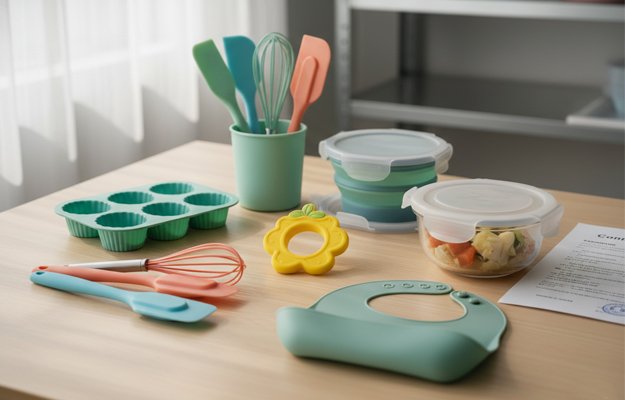
If you source silicone kitchenware, baby products, or food storage items from China, the biggest risk is not always price or lead time. It is buying a product that looks acceptable on paper but fails compliance when it enters your target market. In practice, a silicone spatula, baking mold, lunch box seal, or baby teether may all use “silicone,” but the grade, curing system, testing, and paperwork behind them can be very different.
For importers and brand owners, that difference matters. In the United States, food-contact rubber articles are commonly assessed against FDA 21 CFR 177.2600. In Europe, Regulation (EC) No 1935/2004 provides the general framework for food-contact materials. In Germany, buyers often ask for LFGB-related testing because it is widely treated as a stricter commercial benchmark for food-contact products, even though silicone itself does not have a single harmonized EU-wide material-specific measure in the same way some plastics do.
That is why sourcing silicone products needs more than a quotation comparison. You need to understand what grade of silicone is being used, whether it is platinum-cured or peroxide-cured, which tests have been completed, and whether the supplier can provide the right documents from credible laboratories.
Why food-grade standards matter in silicone sourcing
Silicone is widely used in food-contact applications because it is flexible, heat-resistant, and durable. But “silicone” is not a single universal quality level. A supplier may describe a product as safe, eco-friendly, or export quality, yet those terms mean very little without a specific compliance basis.
For buyers, food-grade standards affect three critical areas.
- First, they affect market entry. A product that cannot support FDA or EU/LFGB documentation may face problems with customs clearance, retailer approval, marketplace compliance, or customer claims. FDA rules for repeated-use rubber articles and the EU’s food-contact framework both exist to control migration and ensure that materials do not transfer harmful constituents to food in unacceptable amounts.
- Second, they affect product safety and brand reputation. Silicone used in direct food contact should not create unacceptable extractables, off-odors, off-tastes, or visible instability under normal use conditions. This becomes even more important in bakeware, baby feeding products, and high-temperature kitchen tools.
- Third, they affect sourcing efficiency. When compliance expectations are defined early, you can avoid wasting time on factories that only offer industrial-grade silicone or that cannot provide full test documentation. In other words, compliance screening should happen before sampling, not after mass production.
Key regulatory standards buyers should know
When sourcing food-contact silicone products, most overseas buyers focus on three regulatory references: FDA, LFGB, and the EU food-contact framework.
FDA (United States)
In the US market, FDA 21 CFR 177.2600 is the commonly referenced regulation for rubber articles intended for repeated use in contact with food. It sets conditions and extractive limitations for rubber articles used with food under defined conditions. For many silicone kitchenware and food-contact items sold into the US, this is the baseline reference buyers ask suppliers to meet.
A practical point for buyers: “FDA silicone” is often used casually in the market, but what matters is whether the finished material or article can demonstrate compliance with the relevant FDA food-contact requirement, not whether the sales team simply prints “FDA” on a spec sheet.
LFGB (Germany)
LFGB is frequently requested for products sold into Germany and is also widely used by European buyers as a stricter commercial benchmark for food-contact silicone. In sourcing conversations, an LFGB pass result often signals a higher testing threshold, especially regarding odor, taste, and migration-related concerns. While BfR recommendations are not themselves the same as a blanket certification law for all materials, they are an important reference point in Germany for food-contact assessments, including for materials such as silicone and rubber.
For this reason, many importers prefer suppliers that can show recent LFGB test reports from recognized third-party labs.
EU Regulation (EC) No 1935/2004
For the EU market, Regulation (EC) No 1935/2004 is the overarching framework for materials and articles intended to come into contact with food. Its core principle is that food-contact materials must not transfer constituents to food in quantities that could endanger human health, bring about unacceptable changes in food composition, or deteriorate organoleptic characteristics.
This regulation is essential, but buyers should understand its role correctly. It is a framework law, not a full silicone-specific technical standard by itself. That is why EU buyers often still ask for supporting migration tests, declarations of compliance where applicable, and additional country- or customer-specific evidence.
Understanding silicone grades before you place an order
Not every silicone product should be sourced to the same standard. The right grade depends on the application, the target market, and the risk level of the end use.
| Silicone Grade | Typical Applications | Common Compliance Reference |
|---|---|---|
| Food-grade | Kitchenware, bakeware, utensils, molds | FDA, LFGB |
| Medical-grade | Medical devices, implants, specialized healthcare use | USP Class VI or other medical standards |
| Industrial-grade | Gaskets, seals, technical components | Usually no food-contact certification |
| Platinum-cured premium silicone | Baby products, high-purity food-contact items | FDA, LFGB, often customer-specific extra requirements |
This is where many sourcing mistakes begin. A factory may already produce silicone gaskets or industrial molded parts and then offer to make kitchenware with the same production mindset. That does not automatically mean it has the right raw materials, curing system, contamination controls, or documentation discipline for food-contact products.
For everyday kitchenware, food-grade silicone is typically the minimum starting point. For baby products, many buyers move one step higher and specify premium platinum-cured silicone because purity expectations are higher and odor control is more important. For food storage products, especially those marketed in Europe, it is common to request both FDA-related compliance support and LFGB test evidence.
Platinum-cured vs peroxide-cured silicone
This is one of the most important sourcing decisions, because the curing method affects purity, performance perception, and compliance comfort.
Platinum-cured silicone
Platinum-cured silicone is generally seen as the premium option. It is favored for baby products, high-end kitchenware, and brands that want tighter control over purity and sensory performance. Buyers often prefer it because it is associated with cleaner curing chemistry, lower risk of residual by-products, and better suitability for products where odor and taste neutrality matter. It is also commonly used in food-contact substance notifications and applications involving platinum-catalyzed silicone elastomers under FDA-related compliance pathways.
Peroxide-cured silicone
Peroxide-cured silicone is usually more cost-effective. It can still be used in food-contact applications, but it typically requires proper post-curing and tighter process control to reduce volatile residues and odor issues. From a sourcing standpoint, peroxide-cured silicone is not automatically inferior, but it gives buyers less margin for error. If the factory’s post-cure process is inconsistent, the risk of smell, taste, or failed testing increases.
In simple terms, if your product is a baby spoon, teether, premium baking mold, or branded kitchenware sold into strict retail channels, platinum-cured silicone is usually the safer commercial choice. If your product is a more price-sensitive food-contact item and the factory has proven process control plus valid test reports, peroxide-cured material may still be workable.
Essential tests that should not be skipped
A compliant-looking specification sheet is not enough. Buyers should ask what testing has actually been completed on the finished material or product.
Extractables testing
Extractables testing helps assess which substances may be drawn out of the silicone under defined conditions. This matters because rubber and silicone food-contact regulations focus heavily on what can migrate or be extracted from the material during use. FDA 21 CFR 177.2600 itself is tied to extractive limitations for repeated-use rubber articles.
This evaluates whether constituents can transfer from the material into food or food simulants. For EU food-contact compliance, migration behavior is a central concept under the framework rules.
Physical properties testing
This includes tensile strength, elongation, tear resistance, compression set, heat resistance, and other stability indicators depending on the product. These are not only quality metrics. They also help confirm that the product can maintain performance during real use, especially in bakeware, freezer applications, or repeated dishwasher cycles.
Sensory testing
Taste and odor testing are especially important for silicone kitchenware and baby products. A product may technically pass a basic compliance screen yet still produce an unacceptable smell that triggers returns and complaints. This is one reason many buyers view LFGB-related testing favorably in commercial practice.
Documentation required from the supplier
When sourcing silicone products, documentation should be treated as part of the product, not as an afterthought.
At minimum, serious buyers should ask for:
- FDA compliance confirmation linked to the relevant material or finished article
- LFGB certificate or test report where required by the market or customer
- Material Safety Data Sheet or equivalent safety documentation
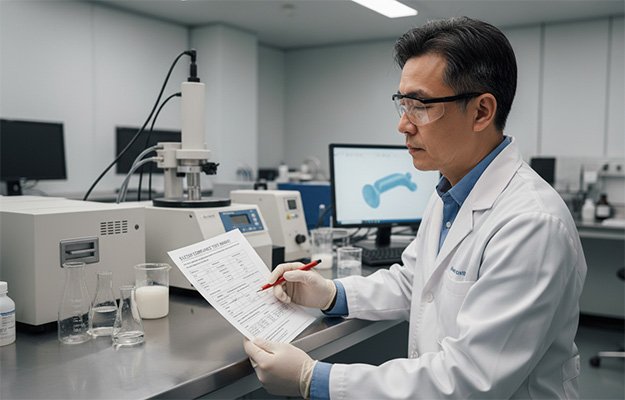
- Test reports from accredited third-party laboratories
- Clear raw material identification, including curing system when relevant
- Declaration of conformity or compliance statement where the market expects it
Be careful with one common issue: suppliers sometimes send old reports, unrelated reports, or reports issued for a different product made from a different formulation. Always check whether the report matches the exact item category, material grade, color, and manufacturing process you are buying.
It is also good practice to verify the laboratory name, report date, sample description, and test standard. A nice-looking PDF is not enough if the sample identity is unclear.
Application guide for common silicone product categories
Different applications need different sourcing standards. Using the same compliance target for all silicone items is inefficient.
Kitchenware
For spatulas, baking mats, molds, tongs, and utensils, food-grade silicone is the baseline. In most cases, buyers should strongly prefer platinum-cured silicone for products that contact hot food directly or are marketed as premium kitchen tools. FDA support is usually essential for the US, while LFGB testing adds stronger commercial credibility for Europe.
Baby products
This category needs the highest caution. Teethers, bibs, pacifiers, baby spoons, and feeding accessories should use premium high-purity silicone, usually platinum-cured. Odor neutrality, extractables control, and reliable third-party documentation are critical. Cost savings from lower-grade material are rarely worth the risk here.
Food storage products
Silicone lids, seals, collapsible containers, and related storage products should at minimum align with the target market’s food-contact requirements. For broad export use, buyers often request both FDA-related compliance confirmation and LFGB testing, especially when the item is promoted as reusable and long-term food-contact safe.
A practical sourcing checklist
Before approving a new silicone supplier, ask these questions:
- What exact silicone grade is being used?
- Is it food-grade, and is it platinum-cured or peroxide-cured?
- Which market is the product intended for: US, EU, Germany, or multiple regions?
- What test reports are available, and are they recent?
- Do the reports match the exact formulation and finished item?
- Which accredited lab issued them?
- Has the factory controlled for odor, post-curing, and contamination during production?
- Can the supplier provide batch consistency over repeated orders?
These questions will save far more money than pushing for the lowest unit price.
Final thoughts
Sourcing silicone products successfully is not about buying “silicone.” It is about buying the right grade, the right curing system, the right test evidence, and the right documentation for your target market. If you get those four parts right from the beginning, your product is much more likely to pass compliance checks, satisfy end users, and support long-term brand growth.