

Many kitchenware buyers start with confidence, then face delayed shipments, quality failures, or suppliers who go quiet when problems appear.
Alibaba works best for early research, supplier comparison, and small trial orders. Direct factory sourcing works better for experienced buyers with stable volume and clear specs. For serious wholesale kitchenware buyers, the most reliable strategy combines supplier research with local verification, inspection, and sourcing support.
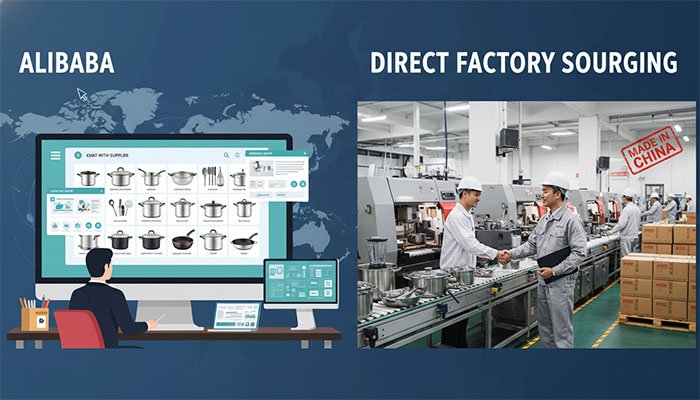
Sourcing wholesale kitchenware from China is not only about finding a supplier. It is about finding the right one, controlling production risk, confirming product quality, and protecting your business reputation.
Alibaba makes sourcing look easy. You can search thousands of stainless steel cookware sets, silicone utensils, baking tools, food containers, and kitchen gadgets within minutes. But a clean product photo does not always mean stable production ability.
Direct factory sourcing sounds more professional. You may expect better pricing, stronger customization, and fewer middlemen. But without local verification and production follow-up, factory direct can still carry hidden risks.
So the real question is not simply "Alibaba or direct factory?" The better question is: which sourcing method fits your current business stage, order volume, quality requirements, and risk tolerance?
What Is the Main Difference Between Alibaba and Direct Factory Sourcing?
Many buyers assume direct factory is always better, but the real difference is about how much supply chain responsibility you are ready to handle — not just where you find the supplier.
Alibaba is a B2B marketplace for fast supplier discovery and comparison. Direct factory sourcing means working with manufacturers through trade shows, referrals, or a local China sourcing agent. Alibaba offers speed and flexibility. Direct factories offer stronger customization and better long-term pricing for repeat buyers.
The key difference is not only where you find the supplier. It is how much responsibility you can manage after finding them.
| Factor | Alibaba | Direct Factory |
|---|---|---|
| Supplier access | Very easy | Harder without local network |
| Product comparison | Fast and convenient | Slower but more targeted |
| MOQ flexibility | Often more flexible | Usually higher |
| Price negotiation | Easy to compare, harder to verify | Better for long-term orders |
| Customization | Possible, depends on supplier | Usually stronger |
| Supplier verification | Buyer still needs to check | Buyer must check deeply |
| Best for | New buyers, trial orders, research | Repeat orders, private label, scaling |
For example, if you are testing a new silicone utensil line, Alibaba can help you collect price ranges quickly. But if you are developing a private label stainless steel cookware set with custom handles, specific thickness, branded packaging, and food-contact compliance requirements, direct factory sourcing is usually more suitable.
Both methods share one important limitation: you still need supplier verification and quality control regardless of which channel you use. The platform does not protect you. The factory does not inspect for you.
When Should You Source Kitchenware from Alibaba?
Alibaba is a useful starting point, but many buyers treat it as a finished solution rather than the beginning of a longer evaluation process — and that mistake creates real problems.
Alibaba works well when you are researching products, comparing prices, ordering samples, or placing a first small wholesale kitchenware order. It is especially useful for silicone utensils, kitchen gadgets, food containers, drinkware, bakeware, and low-complexity private label products.
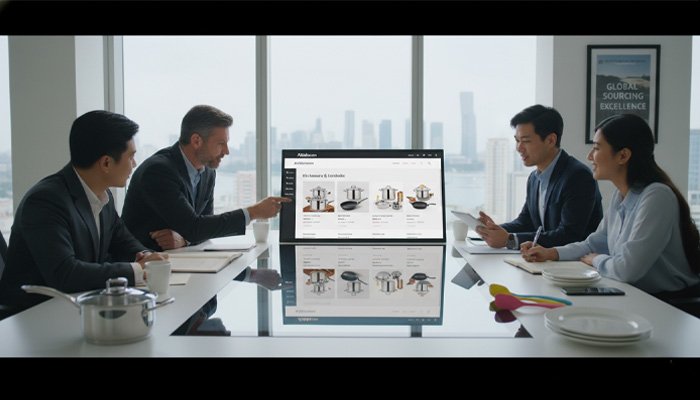
For first-time importers, Alibaba saves significant research time. You can filter by material, MOQ, certification, supplier location, and export market within minutes. This is genuinely useful before you commit to any sourcing relationship.
However, Alibaba has clear limitations that matter for kitchenware buyers specifically. Many listed suppliers are trading companies, not real factories. Some show wide product catalogues but have limited control over what they actually manufacture. Some quotations look attractive at first but exclude packaging costs, testing fees, mold charges, or logo setup costs.
What Should You Verify Before Trusting an Alibaba Supplier?
For kitchenware specifically, the technical details matter more than the headline price. Getting these wrong at the sourcing stage creates problems that are expensive to fix after production begins.
| Detail to Check | Why It Matters |
|---|---|
| Material grade | Affects safety, durability, and market compliance |
| Product thickness | Impacts strength and perceived quality |
| Coating quality | Critical for cookware and bakeware |
| Food-contact compliance | Required for most target markets |
| Packaging method | Prevents shipping damage |
| Export experience | Shows whether supplier understands your market |
| Sample consistency | Reduces mass production surprises |
| Production capacity | Prevents delays during peak season |
Alibaba opens the door. What you do with that access determines your outcome. If you only compare unit prices, you risk choosing the wrong supplier. If you compare material specs, production experience, communication speed, and export track record, Alibaba becomes a genuinely useful research tool rather than a sourcing gamble.
A low unit price can hide thinner material, cheaper coating, weaker cartons, or lower inspection standards. These hidden quality gaps do not appear in the quotation. They appear in customer returns, marketplace complaints, and damaged brand reputation.
When Is Direct Factory Sourcing Better for Wholesale Kitchenware?
Direct factory sourcing sounds simpler and more professional than it actually is, and the hidden challenges catch many buyers off guard before they build enough experience to navigate them.
Direct factory sourcing is better when you have stable order volume, clear product specifications, and repeat wholesale orders. It gives stronger control over pricing, customization, and production planning. It works especially well for private label cookware, technical products, custom packaging, and long-term supplier relationships.
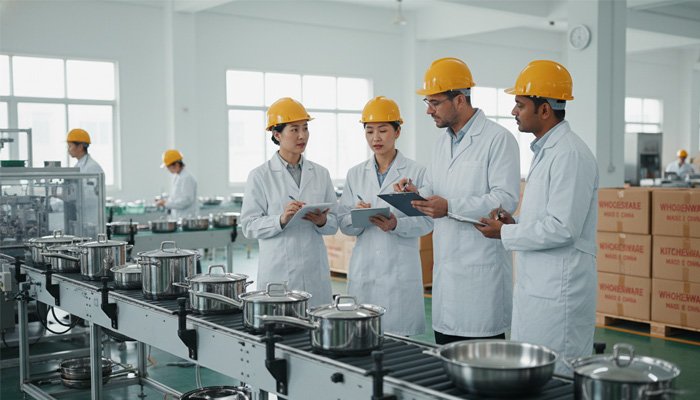
For example, if you are sourcing aluminum cookware, you need to confirm body thickness, coating type, handle riveting method, induction bottom structure, and carton protection. These details are much easier to control when you work directly with the actual manufacturer. When your business scales, small differences in material cost, defect rate, and production efficiency can have a large impact on margins and delivery reliability.
What Are the Hidden Challenges of Going Factory Direct?
Many factories focus on production, not international customer service. Some have limited English communication. Some do not understand Amazon packaging requirements, EU compliance frameworks, retail labeling standards, or North American market expectations. Some also prefer high-volume buyers and give limited attention to smaller or newer accounts.
| Hidden Challenge | Practical Impact |
|---|---|
| Higher MOQ requirements | Limits flexibility for testing new products |
| Slow communication | Delays decisions and problem resolution |
| Limited product range | May require managing multiple factory relationships |
| No export documentation support | Creates customs or compliance risk |
| No local team for problem-solving | Issues escalate before you hear about them |
| Difficulty verifying real production ability | No easy way to assess capability from overseas |
This is why direct factory sourcing works best when you either have an experienced internal sourcing team or a trusted local sourcing partner in China who can operate on your behalf.
At AuroSourcing, I regularly help overseas kitchenware buyers identify whether a supplier is a real factory, a trading company, or a mixed operation. We compare quotations, check production capability, follow up on order milestones, and resolve problems before shipment. For buyers without a China office, this local presence reduces risks that would otherwise be invisible until they become expensive.
Which Channel Gives Better Pricing and Quality Control?
The cheapest unit price is rarely the lowest total cost, and this misunderstanding causes more sourcing problems in kitchenware than almost any other single factor.
Direct factory sourcing can offer better unit pricing for stable, high-volume orders. But neither Alibaba nor direct factories guarantee quality. Real cost control requires checking material grade, coating quality, packaging structure, defect rate, and compliance standards — not just the FOB price on a quotation sheet.
Two suppliers may both quote a stainless steel mixing bowl at similar prices. One uses thinner steel with poor polishing. The other uses better material, smoother finishing, and stronger packaging. The first looks cheaper on paper. The second creates fewer complaints and stronger repeat sales. The actual cost difference, once you include returns and brand damage, is often significant.
What Does a Reliable Quality Control Process for Kitchenware Include?
For kitchenware products, inspection should not only check appearance. It should also verify function, structural integrity, material grade, labeling accuracy, packaging protection, and shipped quantity. A serious QC process includes multiple checkpoints across the production cycle, not just a final look before loading.
| QC Step | Purpose |
|---|---|
| Supplier background check | Confirm business legitimacy and registration |
| Factory audit | Check real production capacity and conditions |
| Sample approval | Confirm product standard before bulk order |
| Specification sheet | Eliminate unclear expectations in writing |
| During-production inspection | Find problems early when correction is still possible |
| Final random inspection | Check goods before releasing balance payment |
| Packaging inspection | Reduce transit damage and reduce return rate |
| Compliance document review | Support import clearance and market sales |
Common quality risks differ by product type. Stainless steel cookware may have wrong steel grade or poor polishing. Silicone utensils may carry bad odor or weak heat resistance. Plastic containers may have poor sealing or non-food-grade material. Bakeware may show coating peeling or sharp edges after shipping.
At AuroSourcing, our team handles these verification steps directly on the ground. We visit factories, check production samples against approved standards, monitor progress during manufacturing, arrange independent inspections, and communicate with suppliers in real time. For buyers who cannot travel to China or do not have a local team, this reduces the gap between what you ordered and what actually arrives.
Should You Use Alibaba, Direct Factory, or a China Sourcing Agent?
Most serious kitchenware importers end up using a combination of all three at different stages, and knowing when to use each one is what separates efficient buyers from frustrated ones.
Use Alibaba for market research and initial supplier discovery. Use direct factories for long-term production with stable volume. Use a China sourcing agent when you need local verification, negotiation, inspection, and order follow-up that you cannot manage effectively from overseas.
| Buyer Type | Recommended Approach |
|---|---|
| First-time importer | Alibaba + basic supplier verification |
| Small e-commerce seller | Alibaba + samples + pre-shipment inspection |
| Growing wholesale buyer | Alibaba research + sourcing agent verification |
| Private label brand | Direct factory + local production follow-up |
| Large importer | Factory network + audit + strict QC process |
| Buyer without China office | Sourcing agent + verified supplier network |
What Does a Practical Kitchenware Sourcing Process Look Like?
A structured sourcing process reduces risk at every stage and gives you better control over outcome. Here is how a reliable process typically works:
- Use Alibaba to research product categories and understand market price ranges.
- Shortlist suppliers based on product fit, communication quality, and export history.
- Verify whether each supplier is a real factory, trading company, or mixed operation.
- Request detailed quotations with clear specifications, not just price per unit.
- Order samples from two or three shortlisted suppliers.
- Compare sample quality, packaging, finishing, and supplier response time.
- Conduct a factory audit or third-party verification before committing to a large order.
- Confirm material standards, packaging details, labeling requirements, and inspection criteria in writing.
- Monitor production progress against agreed milestones.
- Inspect goods before releasing final payment and before shipment.
This process is not complicated, but it requires time, local contacts, and sourcing experience to execute properly. If you do not have these resources in-house, you do not need to manage everything alone.
AuroSourcing is a professional China sourcing agent based in Yongkang, Zhejiang, with 13+ years of sourcing experience and a supplier network covering cookware, kitchen tools, food containers, drinkware, bakeware, and related household categories. We act as your China office — covering supplier search, factory verification, quotation comparison, negotiation, sampling, production follow-up, quality inspection, packaging management, and logistics coordination.
If you are ready to source wholesale kitchenware from China, send us your product requirements and target quantity. We will come back with a practical sourcing plan based on your actual business stage.
Conclusion
Alibaba is good for starting. Direct factory sourcing is better for scaling. But for serious kitchenware buyers, local verification, quality control, and reliable production follow-up are what actually protect your margins and your brand.