

Apparel sourcing seems easy until your bulk order arrives with the wrong fit, fabric, or stitching. This can destroy your profit margins, brand reputation, and customer trust in an instant.
A complete tech pack and a disciplined sample process are your best defense. A tech pack provides a clear manufacturing blueprint, while samples verify execution. A professional China sourcing agent ensures these standards are met, preventing costly errors before they happen by managing the process on the ground.

For overseas wholesalers, importers, and brand owners, sourcing garments can look straightforward at first. You share an image, get a quote, approve a sample, and place the order. But in my 13+ years as a sourcing agent in Zhejiang, I’ve seen that apparel is one of the easiest categories to get wrong. I once had a client—a growing e-commerce brand—who sourced a batch of hoodies based on a beautiful sample. When the 2,000 units arrived, the drawcords were a different color, the fabric felt thinner, and the fit was a full size smaller than specified. The factory had cut corners to save costs, assuming the buyer wouldn't notice. These aren't minor issues; they are the details that dictate your success. That’s why experienced buyers treat tech packs and samples not as formalities, but as critical risk-control tools. When either is weak, you’re sourcing on guesswork, and guesswork is always expensive.
What Is a Tech Pack, and Why Does It Matter So Much?
You send a reference photo and expect a perfect garment. Instead, you get a sample based on the factory's assumptions about fit, fabric, and cost, wasting weeks of your time.
A tech pack is the essential blueprint for your garment. It details everything from measurements and fabric to stitching and trims. This document eliminates guesswork, ensures you get accurate quotes, and provides a concrete standard to hold your supplier accountable, preventing costly misunderstandings.
A tech pack is the single most important document in apparel manufacturing. It’s the contract between your vision and the factory's hands. Too many buyers, especially those new to sourcing, try to bypass this step. They send a picture and a few notes, assuming the supplier will "just know" what they want. In reality, this forces the factory to make dozens of decisions about construction, materials, tolerances, and finishing. They will almost always default to whatever is easiest or cheapest for them, not what is best for your brand. A clear tech pack also allows for apples-to-apples price comparisons. When different factories are quoting based on the exact same specifications, you can evaluate their offers on fairground. Without it, you're comparing one factory's cheap interpretation to another's high-quality one, making a true cost analysis impossible.
The Core Components of a Strong Tech Pack
A comprehensive tech pack removes ambiguity and serves as your primary tool for quality control. Here’s a breakdown of what it must include:
| Tech Pack Item | Why It Matters | Risk If Missing |
|---|---|---|
| Technical Sketch | Shows all seams, stitches, and design lines clearly | The factory may guess key construction details |
| Measurement Chart | Defines fit, sizing, and acceptable tolerances | High risk of inconsistent sizing and poor fit |
| Fabric & Trim Spec | Clarifies composition, GSM, hardware, and labels | The wrong, cheaper materials may be sourced |
| Construction Notes | Explains seam types, stitching (SPI), and reinforcements | Workmanship may be weak or not match expectations |
| Artwork & Labels | Details placement, colors, and sizing for branding | Logos and prints can look unprofessional or misplaced |
| Packaging Guide | Aligns folding, tagging, and carton requirements | Creates warehouse issues and poor presentation |
Going deeper, the Measurement Chart needs Points of Measure (POMs)—clear instructions on how to measure each part of the garment (e.g., "1/2 Chest, 1 inch below armhole"). It must also include grading rules that define how measurements change between sizes, and a tolerance (e.g., +/- 1 cm) for each measurement. The Fabric Spec should list composition (e.g., 95% Cotton / 5% Spandex), weight in GSM, and required finishes (e.g., "pre-shrunk, silicone wash for softness"). For Construction Notes, specifying the Stitches Per Inch (SPI) is crucial; a higher SPI generally means a stronger, more durable seam. This level of detail seems tedious, but it is precisely what prevents disputes and ensures consistency.
What Types of Samples Should You Ask For?
You approved "the sample," but the bulk order has inconsistent sizing and a different feel. Relying on just one sample stage is a common and costly mistake in apparel sourcing.
A professional apparel sourcing process uses multiple sample types: development, fit, size set, and pre-production (PPS). Each stage has a specific purpose, from confirming the design concept to locking in the final standard for bulk production. Understanding this process prevents surprises.
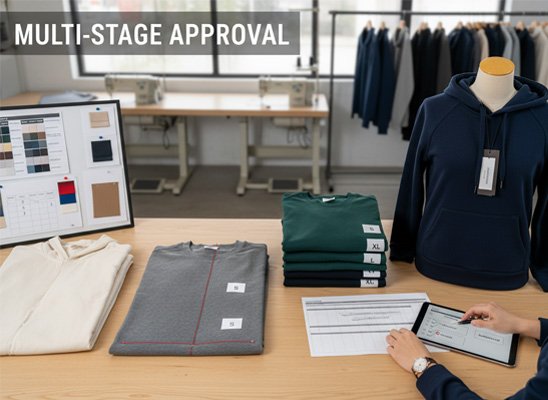
Many buyers talk about "the sample" as if it's a single item. In reality, a proper development cycle involves several distinct stages, each designed to answer a different question and mitigate a different risk. Approving the wrong sample for the wrong reason—or skipping a stage entirely—can create huge problems down the line. At AuroSourcing, we manage this multi-stage process closely for our clients to ensure every detail is locked in before bulk production begins. Rushing through the sample stages to save a week can end up costing you months in delays and rework. It's a structured conversation with the factory, where each sample is a new chapter that builds upon the last.
The Critical Sample Stages in Detail
Each sample moves you closer to a perfect final product. Skipping a step is like trying to build a house without checking the foundation.
- Development Sample: The first physical version of your idea. The goal is to see if the factory understands the basic design and can construct it. The fabric and trims might be substitutes. You're checking for overall feasibility and getting a feel for the supplier's capability.
- Fit Sample: Now, the focus shifts to how the garment wears. Using the correct base fabric, you must check the silhouette, proportions, and balance on a consistent fit model or mannequin. A garment can look great lying flat but fit terribly. This is where you catch issues like tight armholes, a twisted side seam, or an unbalanced drape.
- Size Set Sample: Once the base size (usually Medium) is approved, the factory produces samples in your other required sizes (e.g., Small, Large, XL) to check the grading. This is non-negotiable for anyone selling multiple sizes. Poor grading, where the proportions don't scale correctly, is a primary cause of customer returns.
- Pre-Production Sample (PPS): This is the "golden sample." It must be made with all final fabrics, trims, colors, labels, and packaging. It represents the exact standard that your entire bulk production run will be judged against. You must never approve a PPS if there are outstanding issues the factory promises to "fix in bulk."
- Top of Production (TOP) Sample: Some buyers also request this. It's a sample pulled from the very first units coming off the actual production line. It's your last chance to confirm that the approved PPS standard has been successfully transferred to mass production.
How Can Buyers Evaluate Samples More Effectively?
A sample arrives. It "looks okay," so you approve it. Two months later, your warehouse is full of products with issues that were present in that initial sample, but you missed them.
Approving a sample should be a structured, systematic review, not a casual glance. You must evaluate it against your tech pack, checking measurements, fabric, construction, and trims point by point. Clear, consolidated feedback is crucial for efficient revisions and holding the factory accountable.

A sample isn't just a preview; it's a test. Your job is to be the toughest critic. At AuroSourcing, we have a multi-point checklist we use for every sample review. This structured approach ensures nothing is overlooked. Start by laying the garment flat on a table. Don't just look at it—measure it. Compare every single Point of Measure (POM) against your tech pack's spec sheet. Is the chest width within tolerance? Is the sleeve length correct? Next, focus on the fabric. Does it match the specified GSM and composition? How does the hand-feel compare to your reference? Does it have the right amount of stretch and recovery? Then, turn the garment inside out. This is where you see the real workmanship. Are the seams clean and flat? Are there loose threads? Is the stitching consistent? Check all trims—do the zippers run smoothly? Are buttons attached securely? Finally, try the garment on if possible, or use a fit mannequin. This is the only way to truly assess fit, balance, and comfort.
Providing Feedback That Gets Results
How you communicate your feedback is as important as the feedback itself. Avoid scattered comments in multiple emails or chat messages. This creates confusion. The best method is to provide one consolidated document with clear, actionable points. Use your tech pack as the basis. Mark up photos with arrows and notes to show exactly where the problems are. For example, instead of saying "the logo is wrong," say "Logo is 3cm too low. Please move up to be 5cm from collar seam, as per tech pack." This leaves no room for interpretation.
What Problems Happen Between an Approved Sample and Bulk Production?
This is the ultimate frustration in apparel sourcing. The pre-production sample was perfect, but your bulk order is a mess. The fabric feels different, colors are off, and the quality is inconsistent.
This "sample vs. bulk" quality gap is common. It's often caused by unapproved material substitutions, poor production line discipline, or dye lot variations. The approved sample is a benchmark, not a guarantee. On-site inspections are essential to ensure the final product matches the standard.
An approved PPS is your benchmark, but it doesn't automatically guarantee a perfect bulk run. The pressures of mass production—speed, cost control, and material availability—can introduce new problems. A factory might use a different dye lot for the fabric, causing a slight color shift. They might switch to a cheaper zipper from a different supplier to save a few cents per unit. During bulk cutting, where dozens of layers of fabric are cut at once, the bottom layers can shift, causing measurement drift. Without someone on the ground monitoring the process, these small deviations can quickly multiply into major quality failures. This is where having a sourcing partner like AuroSourcing becomes critical. We act as your eyes and ears on the factory floor, ensuring the standard you approved is the standard you receive.
Common Issues and How to Prevent Them
Here are the most common problems we see and why on-the-ground follow-up is the best solution:
| Common Problem | Likely Cause | How a Sourcing Agent Helps |
|---|---|---|
| Bulk Fabric Feels Different | The factory substituted a cheaper material or used a different finish. | We verify incoming materials against the approved sample before cutting begins. |
| Fit is Inconsistent | Weak measurement control or pattern drift during cutting. | We conduct in-line inspections, pulling garments from the line to check measurements. |
| Trims are Mismatched | The original trim was unavailable, so the factory used a "similar" one. | We confirm all trims (zippers, buttons, labels) are correct before they are attached. |
| Color Varies | Inconsistent dye lots or poor color matching procedures. | We review lab dips early and check color consistency during final inspection. |
| Sewing Quality Drops | Workers are rushed to meet deadlines, leading to sloppy stitching. | Our AQL-based final inspections catch workmanship defects before the order ships. |
Conclusion
Strong tech packs and disciplined sample control are the foundation of successful apparel sourcing. Buyers who manage these stages carefully get better consistency, fewer production surprises, and a more reliable long-term supply chain.