

Many electronics sourcing projects look simple at the quotation stage, then turn expensive when hidden engineering problems, unstable firmware, or failed compliance tests appear too late.
When sourcing electronics from China, buyers must evaluate three connected areas: PCBA quality, firmware control, and EMC readiness. A weakness in any one of these can cause product defects, customer returns, shipment delays, or costly redesigns before the product even launches.
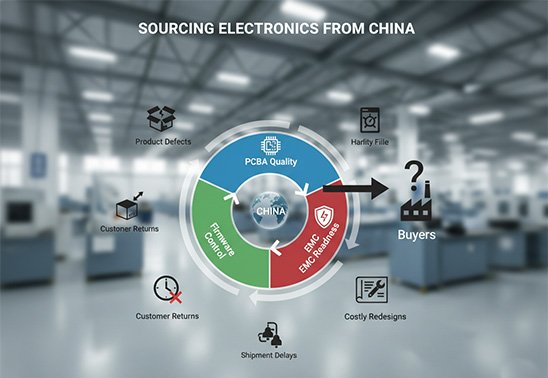
For importers and e-commerce brands, electronics are rewarding but full of hidden risks. In my 13+ years as a China sourcing agent, I’ve seen buyers focus on the visible price and casing, ignoring the crucial engineering for PCBA, firmware, and EMC. These are not separate issues; they are deeply interconnected. Understanding this connection is the key to making safer sourcing decisions and turning a risky project into a profitable one.
Why Does Electronics Sourcing Feel Riskier Than Other Categories?
A good-looking sample can hide serious sourcing risks when the real problems sit inside the board design, code logic, or compliance performance.
Electronics sourcing feels riskier because it involves multiple invisible technical layers: components, assembly, software, testing, and certification. You are not just buying a product; you are buying the reliability of the entire engineering system behind it.
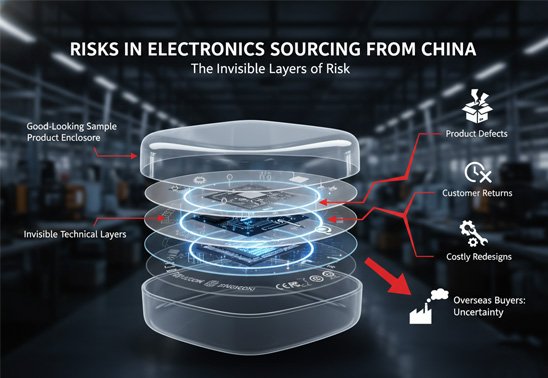
Unlike furniture, an electronic product's success depends on a long chain of technical steps, from PCB fabrication to firmware programming. A single weak link can make the entire product unstable. This is why a low price from a Chinese supplier means nothing without proof of their engineering discipline. The real risks often surface months after you've paid. For example, a supplier once secretly swapped a key Wi-Fi module for a cheaper one to save a dollar. The device passed basic tests but had poor real-world range, leading to a flood of negative reviews and costly returns that erased all initial savings. These hidden risks are why electronics must be managed as a technical project, not a simple purchase.
| Hidden Layer | Typical Risk in China Sourcing | Impact on Buyer |
|---|---|---|
| Components | Counterfeit parts, unannounced substitutions. | Delays, inconsistent quality, high failure rates. |
| PCBA Assembly | Poor process control, lack of testing. | High defect rates, intermittent faults, costly rework. |
| Firmware | No version control, source code ownership disputes. | Product bugs, security flaws, inability to update. |
| Compliance | Ignored design principles, failed lab reports. | Shipments blocked by customs, forced redesigns. |
What Should You Really Check in a PCBA Supplier?
Many suppliers can assemble a circuit board, but far fewer can manage it in a way that supports stable, long-term production.
A reliable PCBA supplier offers more than assembly capacity. Check their engineering review (DFM), Bill of Materials (BOM) control, testing procedures (AOI, FCT), and process traceability to ensure consistency from prototype to mass production.
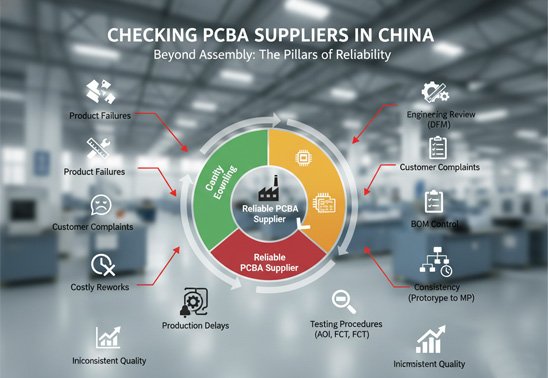
The PCBA is your product's heart. A weak board undermines everything. You need an engineering partner, not just an assembler. I focus on three areas:
- Design for Manufacturability (DFM) Feedback: A good factory reviews your files and flags potential production issues before starting. A simple DFM review for one client caught a design that was electronically perfect but impossible to assemble automatically, preventing slow, expensive manual soldering.
- Bill of Materials (BOM) Management: Unauthorized component substitutions are a massive risk. A trustworthy supplier has a strict process where any proposed substitution is flagged, documented, and requires your written approval.
- Testing Discipline: How do they verify their work? They must use Automated Optical Inspection (AOI) for soldering defects and, most importantly, Functional Circuit Testing (FCT) to ensure the board actually does what it's supposed to do.
A successful prototype only proves the concept can work once. You need a partner who can repeat that quality thousands of times.
Why Does Firmware Control Matter So Much?
Some buyers focus on hardware, but many product failures come from poorly managed firmware.
Firmware is the brain controlling your hardware. Before production, you must confirm source code ownership, implement strict version control, and define long-term maintenance responsibility. Otherwise, you're building your business on a "black box" you can't control.
Often overlooked, firmware controls how your product behaves. Inconsistent versions create support nightmares. The biggest risk is unclear source code ownership. Many Chinese factories treat firmware as their property, effectively holding your product hostage if you need to fix bugs or switch suppliers. A written ownership agreement is non-negotiable.
Equally important is version control. Without a documented log of changes, you have no way of knowing which firmware is on which batch when customers report a problem. Lastly, think about long-term maintenance. Is the code documented? Who is responsible for future bug fixes? Asking these questions separates professional suppliers from risky workshops.
What Is EMC Testing, and Why Does It Cause Delays?
A product that works perfectly on the factory bench can still fail compliance tests, often at the worst possible time.
EMC testing checks if a product creates or is vulnerable to electromagnetic interference. If ignored until the end, you risk costly redesigns, certification failures, and devastating shipment delays right before your launch.
EMC (Electromagnetic Compatibility) is a legal requirement for selling in markets like the US (FCC) and Europe (CE). The biggest mistake is treating it as a final paperwork step. EMC performance is determined by early design choices in the PCB layout, grounding, and shielding.
A client's "smart" water bottle failed EMC tests just before shipment due to an unshielded USB cable. They had to unbox thousands of units to add a tiny component—a fix that would have been free if planned from the start but ended up costing over $20,000 in rework and delays. Smart sourcing pushes EMC checks upstream with low-cost pre-compliance testing to find and fix issues early.
| EMC Stage | What Can Go Wrong | A Better Sourcing Practice |
|---|---|---|
| Design Stage | Noisy layout is "baked in" to the design. | Review basic EMC principles with the engineering team early. |
| Prototype Stage | Product fails informal pre-compliance tests. | Use a local lab for cheap pre-testing to find major flaws. |
| Pre-shipment | Final lab test fails, report is missing. | Verify exact target-market requirements in advance. |
How Can You Reduce Risk Before Placing a Full Order?
The safest electronics projects follow a structured verification process before committing significant capital.
Reduce your risk by vetting suppliers technically, not just on price. Mandate a pilot production run, and use a local China sourcing agent like Auro Sourcing as your eyes and ears on the ground.
Sourcing with confidence means building a robust process that catches errors early. Based on my experience helping over 3,000 clients, this simple framework works:
- Technical Vetting: We conduct on-site audits that evaluate a supplier's engineering capability and quality systems, not just their capacity.
- "Golden Sample" Lock-in: We formalize the perfect prototype—with its exact BOM and firmware—as the contractual standard. No changes are allowed without your approval.
- Mandatory Pilot Run: A small pre-production run tests the entire system, catching 90% of potential issues before they become expensive.
- Staged Inspections: We inspect at the beginning, middle, and end of production (IPC, DPI, FRI), not just when it's too late to fix problems.
As your Yongkang-based sourcing company, we execute this framework on the ground, acting as your local project management and technical team so you can focus on your business.
Conclusion
Successful electronics sourcing from China is about managing technical risk, not just hunting for a low price. By evaluating PCBA, firmware, and EMC together, you can reduce avoidable risks and build a more predictable supply chain.
Ready to Source Your Electronics Product with Confidence?
Managing the technical details of PCBA, firmware, and EMC from overseas is a huge challenge. Choose AUROSOURCING as your sourcing agent for electronics products. We become your strategic partner on the ground in China, helping you reduce the risk in your business.
Our experienced team dives deep into engineering audits, BOM verification, firmware control, and on-site production supervision. Choosing Auro Sourcing means launching your electronics product with predictable cost, quality, and lead time.
If you're ready to turn your product idea into delivered inventory with less risk, send us your project specifications for a free review. Let's build it right, together.