

Sourcing the wrong bakeware material leads to bad reviews, high return rates, and a damaged brand reputation. It’s a costly mistake that many importers make by focusing only on price.
For optimal baking performance and browning, choose carbon steel. For flexibility and easy release, especially in molds, silicone is best. For durability and a premium, corrosion-resistant finish, stainless steel is the strongest choice. Your decision should align with your product's application and market position.
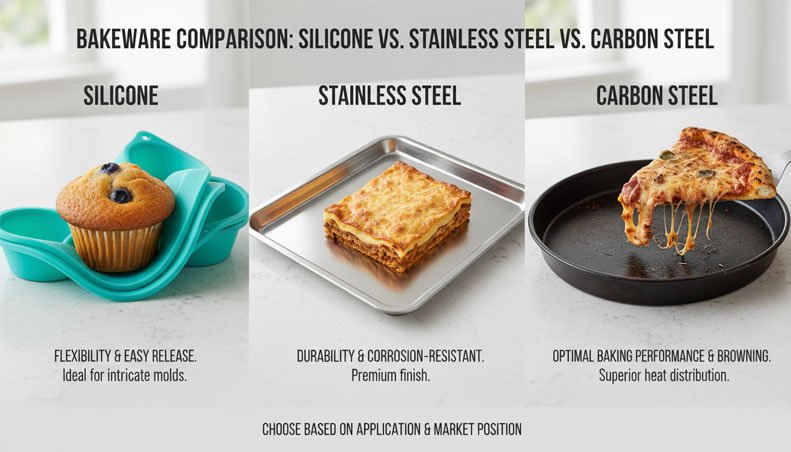
Many new importers ask me, "Which bakeware material is the best?" but that isn't the right question. As a sourcing agent based in Yongkang, the heart of China's metalware industry, I've learned that the real question is, "Which material is best for my specific product and target customer?" If you're developing a bakeware line, you must evaluate materials based on performance, durability, safety, and your brand's promise. Let’s break down how I guide my clients through this critical decision.
Why Does Bakeware Material Matter So Much for Your Business?
Two baking pans can look identical on a website, but one gets five-star reviews while the other gets returned. The difference is often the material and the manufacturing process behind it.
Bakeware material directly impacts heat transfer, browning, durability, food-contact safety, and ease of use. For your business, this translates into customer satisfaction, brand trust, and ultimately, your profit margin. Choosing correctly is a foundational sourcing decision.
From my experience managing production for over 3,000 clients, I can tell you that material choice is a commercial decision, not just a technical one. It defines how evenly your pan bakes, how beautifully a cake browns, and how easily it releases. It also determines if the product will warp after a few uses or last for years. This directly impacts your reviews and reorder rates. A flexible silicone mold solves a different problem than a heavy-duty carbon steel pan. One is about convenience; the other is about performance. This is why I always start a project by clarifying the end-user's expectations.
Here’s a simple breakdown I use with clients:
| Performance Factor | Why It Matters to Your Business |
|---|---|
| Heat Transfer | Affects baking speed and consistency, reducing complaints about uneven results. |
| Browning | Directly impacts the visual appeal and texture of baked goods, a key factor in reviews. |
| Release Performance | Good release reduces user frustration and prevents baked goods from being damaged. |
| Durability | Determines the product's lifespan and supports a higher price point and brand trust. |
| Compliance | Ensures market access and protects your company from legal and safety risks. |
A smart sourcing strategy doesn’t just chase the lowest price. It matches the right material to the right product to build a brand that customers trust.
Where Does Silicone Bakeware Perform Best?
Silicone looks modern and feels convenient, but I often see importers overestimate its capabilities and source it for the wrong applications.
Silicone excels in applications where flexibility and easy release are the top priorities. It's ideal for intricate molds, cupcake liners, and dessert forms where demolding without damage is critical, but it is not the top performer for browning or structural strength.
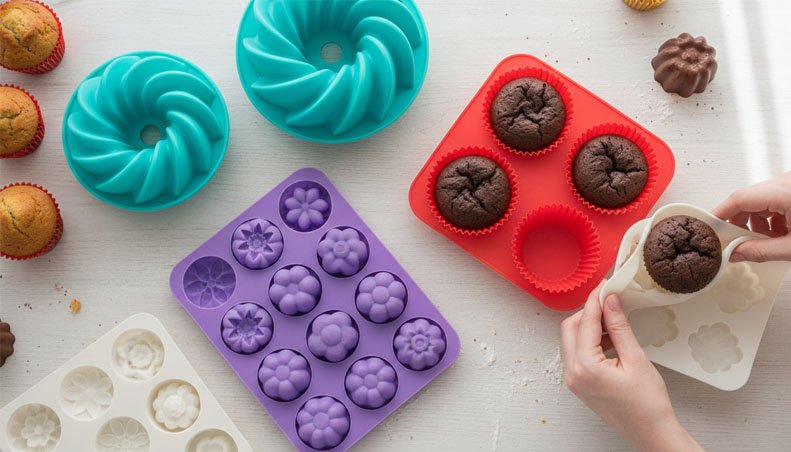
The main reason silicone bakeware is popular is that it solves the frustrating problem of sticking. For delicate cakes, muffins, and custom-shaped desserts, its flexibility is a huge advantage for the home baker. This makes it a great choice for e-commerce brands targeting convenience-focused consumers. However, I always caution my clients against marketing silicone as a universal high-performance material. It’s a poor conductor of heat compared to metal, which results in weaker browning. Its lack of rigidity means larger molds often need a metal baking sheet for support.
When I help a client source silicone products, we focus on verifying two things: 100% food-grade material (no cheap fillers) and consistent thickness. A poorly made silicone mold can feel flimsy or have thin spots that tear.
| Silicone Strengths | Sourcing Considerations |
|---|---|
| Excellent release | Verify 100% food-grade material through testing. |
| Flexible and lightweight | Check for consistent wall thickness during QC. |
| Great for complex shapes | Not suitable for products requiring crisp crusts. |
| Easy to clean and store | May require a metal tray for stability. |
If your brand is about fun shapes and convenience, silicone is a fantastic option. But if your customers are serious bakers who demand perfect browning, carbon steel is almost always a better choice.
What Are the Real Advantages of Stainless Steel Bakeware?
Stainless steel has a premium reputation in kitchens, but it's crucial to separate its image from its actual performance as a baking material.
Stainless steel's primary advantages are exceptional durability, corrosion resistance, and a clean, premium appearance. It is sourced for its longevity and food-safe reputation, not for superior heat conductivity or browning efficiency.
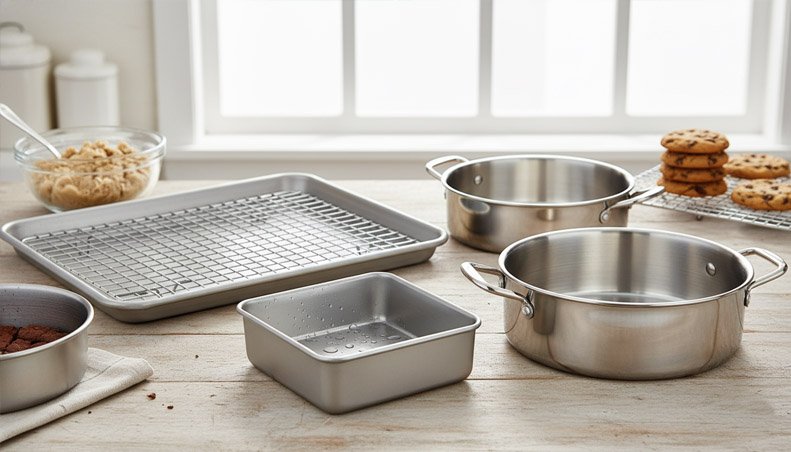
When clients want to build a "buy it for life" product line, I often point them toward stainless steel. It doesn’t rust, it's difficult to dent, and it maintains a polished look that justifies a higher price point. This makes it a strong choice for mixing bowls, measuring cups, and certain premium baking sheets or pans where durability is the main selling point. However, in terms of pure baking performance, it’s a slower, less even conductor of heat than carbon steel. This means it doesn't brown as effectively.
A key detail for any importer sourcing stainless steel is to verify the grade. Food-grade is typically 304 (18/8) or 316 stainless steel. Some factories might quote a lower price using a cheaper grade like 201, which is more prone to rust. A core part of our QC inspection service at Auro Sourcing is confirming the material grade, so you get exactly what you paid for.
| Stainless Steel Advantages | My Sourcing Advice |
|---|---|
| Excellent corrosion resistance | Always verify the steel grade (e.g., 304 vs. 201). |
| Premium, hygienic appearance | A great choice for building a high-end brand image. |
| High structural durability | The product will feel substantial and long-lasting. |
| Non-reactive with foods | Gives consumers high confidence in food safety. |
Choose stainless steel when your brand strategy is built on durability and a premium feel. But if your customers are chasing the perfect bake, there’s a better option.
Why Is Carbon Steel Often the Best Choice for Performance Baking?
When baking results are the top priority, I find that serious brands and experienced importers consistently choose carbon steel for their core product lines.
Carbon steel is preferred for performance bakeware because it offers excellent heat transfer for even baking and superior browning. Its structural strength makes it ideal for pans, trays, and molds where consistent results are paramount.
Here in Yongkang, we are surrounded by factories that specialize in carbon steel products. It's the go-to material for loaf pans, cake pans, pizza trays, and baking sheets for a reason: it works incredibly well. It heats up quickly and distributes that heat evenly, which is the key to a golden-brown crust and a perfectly cooked interior. From a sourcing perspective, carbon steel gives you a product that feels sturdy, performs reliably, and meets the expectations of most home bakers. This makes it a commercially safe bet for wholesalers, retailers, and e-commerce sellers alike.
However, sourcing carbon steel successfully requires attention to detail. The raw material itself is prone to rust, so the quality of the non-stick coating is everything. A poorly applied coating will peel or scratch easily, leading to customer complaints. Thickness is also critical; a pan that is too thin will warp in the oven. My team's on-site QC inspections focus heavily on coating adhesion tests, thickness measurements, and forming consistency to prevent these exact problems.
| Carbon Steel Strengths | How a Sourcing Agent Mitigates Risk |
|---|---|
| Excellent heat transfer | We verify material thickness to prevent warping. |
| Superior browning results | We conduct coating adhesion tests during QC inspections. |
| Strong, rigid structure | On-site inspections check for forming defects and sharp edges. |
| Cost-effective performance | Our local negotiations ensure fair pricing for the required quality. |
If your goal is to sell bakeware that delivers fantastic baking results, carbon steel is almost always the right answer. You just need a process to manage the manufacturing details.
How Do the Three Materials Compare Side-by-Side?
Seeing the options in a simple chart often clarifies the decision. I use this framework to help clients align their product goals with the right material.
Silicone wins on flexibility and release. Stainless steel wins on corrosion resistance and durability. Carbon steel wins on heat transfer and browning performance. Each material supports a different product strategy.
When I consult with a client building a full bakeware range, we don't pick one material for everything. That would be a mistake. Instead, we map their product ideas to the material that serves the user best. A brand can have a line of performance-focused carbon steel pans and a collection of convenient, fun-shaped silicone molds. The key is to be intentional. This comparison makes it clear where each material fits.
| Factor | Silicone | Stainless Steel | Carbon Steel |
|---|---|---|---|
| Heat Transfer | Low | Medium-low | Excellent |
| Browning | Weak | Moderate | Excellent |
| Easy Release | Excellent | Moderate | Depends on Coating |
| Rigidity | Low | Excellent | Excellent |
| Corrosion Resistance | Good | Excellent | Requires Coating |
| Best Use Case | Flexible Molds | Durable, Premium Lines | Performance Bakeware |
This table isn't about finding a single "winner." It's about helping you, the importer, build a smarter, more strategic product portfolio that meets diverse customer needs. That's how you build a resilient brand.
What Compliance and Safety Factors Must You Consider?
A product can bake perfectly, but if it fails to meet safety standards, your entire investment is at risk. This is a non-negotiable part of sourcing.
Before placing any order, you must verify that the material complies with food-contact regulations for your target market (e.g., FDA, LFGB). This involves reviewing supplier test reports, declarations, and ensuring all claims are accurate.
As a professional purchasing agent, managing compliance is a huge part of my job. For any food-contact product, whether it's silicone, stainless steel, or coated carbon steel, you need proof that it's safe. A factory's promise is not enough. You need to see the paperwork. I always press suppliers for up-to-date test reports from accredited labs that are relevant to my client's sales region. We review these documents for authenticity and ensure they match the exact materials being used in production. Temperature claims on packaging are another detail we scrutinize—an exaggerated claim can lead to product failure and liability issues.
Here are the checkpoints my team runs through for every project:
| Compliance Checkpoint | Why It's Critical for Your Business |
|---|---|
| Food-contact test reports (FDA/LFGB) | Guarantees your product can be legally sold. |
| Material composition declaration | Confirms you're getting what you paid for (e.g., no fillers). |
| Review of temperature/use claims | Prevents customer misuse and reduces return rates. |
| Labeling and packaging review | Avoids potential issues with customs or retailers. |
| Supplier documentation audit | Builds confidence that the factory is professional and reliable. |
Navigating compliance can be complex, but it's a standard part of our one-stop sourcing service. We handle these details so you can focus on growing your business.
Why Doesn't Material Alone Guarantee a Good Product?
This is the most important lesson I've learned in over a decade of sourcing: a great material in the hands of a bad factory still produces a bad product.
Material choice is only the starting point. The final product's quality is determined by manufacturing execution—factors like thickness, coating application, mold design, finishing, and overall production consistency.
I've seen premium carbon steel wasted by a non-stick coating that peels after one use. I've seen food-grade silicone molds with thin spots that tear. And I've seen "premium" stainless steel trays with sharp, unfinished edges. This is why having a team on the ground is so valuable. We are not just selecting a material from a list; we are managing a production system. Our AQL-based QC inspections check for the subtle defects that separate a winning product from a liability. We're on the factory floor in Yongkang and across Zhejiang, making sure the details are right.
A professional importer buys a manufacturing process, not just a material name.
| Product Variable | Potential Problem If Not Controlled by QC |
|---|---|
| Material Thickness | Warping in the oven; a cheap or flimsy feel. |
| Coating Quality | Peeling, scratching, poor release performance. |
| Edge Finishing | Sharp edges that are unsafe or unpleasant to handle. |
| Mold/Forming Quality | Inconsistent shapes, uneven baking. |
| Production Consistency | Quality that declines between your first and second order. |
Don't just source a material. Source a reliable production system.
So, Which Material Should Your Business Choose?
After reviewing all the factors, the decision becomes much clearer. There is no single best material, but there is always a best fit for your specific business goal.
Choose silicone for convenience-focused products like flexible molds. Choose stainless steel for premium, durability-focused lines. And choose carbon steel for core, performance-oriented bakeware where browning and even baking are critical selling points.
The smartest approach I've seen my most successful clients take is to build a balanced portfolio. They don't limit themselves to a single material. Instead, they use each material strategically to capture different segments of the market. This allows them to meet a wider range of customer needs and build a more robust brand. To help you decide, I always bring the conversation back to these three strategic pillars:
| Your Business Priority | My Recommended Material Choice |
|---|---|
| Convenience & Easy Release | Silicone |
| Premium Durability & Longevity | Stainless Steel |
| Superior Baking Performance | Carbon Steel |
Think about your brand promise. Are you selling performance, convenience, or lifetime durability? Once you answer that, your material choice becomes obvious. From there, the challenge shifts from selection to execution—finding the right factory and managing the production process effectively. That's where we come in.
Conclusion
The best bakeware material aligns with your product's purpose. Carbon steel is the top performer, silicone offers the most flexibility, and stainless steel delivers premium durability.
Making the right material choice is the first step. Let's work together to turn that choice into a high-quality, delivered product. Send me your product requirements today, and my team at Auro Sourcing will help you find the perfect factory partner here in Yongkang.